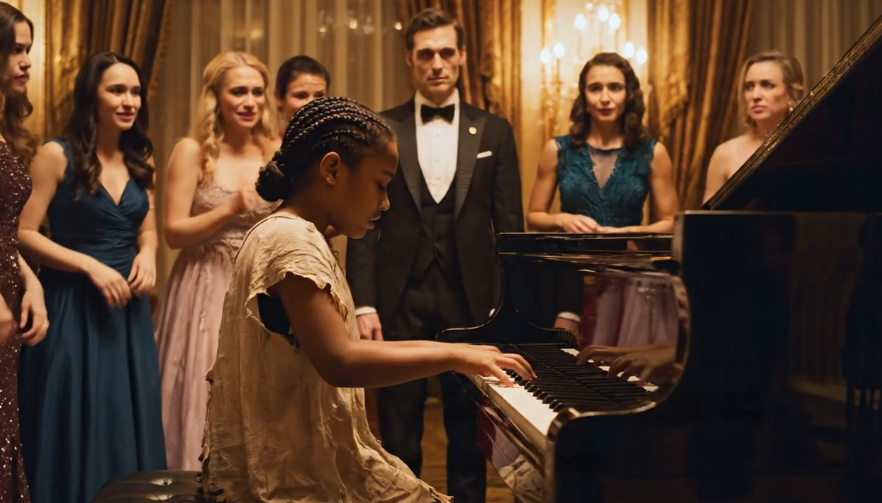
The ballroom of the Grand Astoria Hotel glowed with a soft amber light. Crystal chandeliers swayed gently above the polished marble floors, reflecting the shimmer of golden gowns and black tuxedos. It was the annual “Voices of Tomorrow” gala, a charity event meant to raise funds for underprivileged children. Ironically, no one present knew what it meant to be in need.
Except Lydia Hart.
At twelve years old, Lydia had spent nearly a year living on the streets of Boston. Her mother had died of pneumonia on a winter night, and her father had disappeared long before. With no one else, she survived by rummaging through leftovers behind restaurants and sleeping beneath the shelter of closed shop awnings.
That night, as snow fell onto the sidewalks, Lydia followed the scent of roasted meat and freshly baked bread to the glowing entrance of the Grand Astoria. She was barefoot, her jeans torn, her hair tangled by the wind. In her backpack she carried only a photograph of her mother and a broken piece of pencil.
The hotel guard noticed her slipping through the revolving door. “You can’t come in here, girl,” he said sharply.
But Lydia’s eyes had already fixed on something across the room. A grand piano gleamed beneath the lights, its lid open and its keys shining like ivory stars. Her heart began to race.
“Please,” she whispered. “I just want to play in exchange for something to eat.”
The guests turned their heads. Conversations stopped. Some laughed quietly. A woman wearing pearls murmured, “This isn’t a street corner.”
Lydia’s face flushed, but her feet refused to move. Hunger and hope held her in place.
Then a calm voice rose near the stage. “Let her play.”
The speaker was Mr. Oliver Marchand, a renowned pianist and founder of the charity. His silver hair glowed under the lights, and his expression carried quiet authority. He stepped forward and looked at the guard. “If she wants to play, let her.”
Lydia approached the piano hesitantly. Her hands trembled as she sat down. For a moment, she stared at the polished surface, seeing her reflection shake back at her. Then she pressed a single key. The note rang out clear and fragile. She pressed another, and another, until a melody began to take shape.
The murmuring ceased. All eyes were fixed on her.
Her playing was not refined. It wasn’t shaped by lessons or theory. It was raw and human, born of cold nights and hunger, of the pain of loss and the small spark of hope that refused to die. The music grew, flooding the ballroom until it wrapped around everyone present.
When the final note faded, Lydia kept her hands on the keys. She could hear her heartbeat louder than the silence that followed.
Then someone applauded.
An elderly woman in a velvet dress stood first. Her eyes shone as she began to clap. Others followed. Within moments, the entire ballroom was filled with applause so loud it echoed through the hall.
Lydia looked at them, unsure whether to smile or cry.
Mr. Marchand approached and knelt beside her. “What’s your name?” he asked gently.
“Lydia,” she whispered.
“Lydia,” he repeated softly, as if tasting the name. “Where did you learn to play like that?”
“I didn’t learn,” she replied. “I used to sit outside the downtown music academy. When the windows were open, I listened. That’s how I learned.”
A murmur of astonishment rippled through the crowd. Parents who had spent fortunes on lessons for their children lowered their eyes in shame.
Mr. Marchand stood and addressed the room. “We gathered here tonight to help children like her. And yet, when she walked in hungry and cold, we saw her as a nuisance.”
No one spoke.
He turned back to Lydia. “Did you say you wanted to play for food?”
She nodded weakly.
He smiled. “Then you will eat. But you will also have a warm bed, new clothes, and a scholarship to study music formally. If you’re willing, I will be your mentor.”
Tears filled Lydia’s eyes. “You mean… a home?”
“Yes,” he said quietly. “A home.”
That night, Lydia sat at the banquet table among the guests. The plate before her was full, but her heart felt even fuller. The same people who had rejected her only hours earlier now smiled at her with warmth and respect.
But it was only the beginning.
Three months later, spring light streamed through the tall windows of the Cambridge Conservatory of Music. Lydia walked its halls with a backpack that now held sheet music instead of scraps. Her hair was brushed, her hands clean, yet she still kept her mother’s photograph safely tucked inside.
Some students whispered about her. Some admired her talent. Others doubted she belonged there. Lydia paid them no attention. Every note she played was a promise to her mother that she would never stop climbing.
One afternoon, after practice, she passed a small bakery near the school. Outside stood a thin boy, hungrily staring at the pastries through the glass. Lydia stopped. She remembered herself, barefoot before the ballroom months earlier.
She reached into her bag, took out a sandwich wrapped in paper, and handed it to him.
The boy’s eyes widened. “Why are you giving this to me?”
Lydia smiled. “Because someone fed me when I was hungry.”
Years later, her name would appear on concert programs across Europe and America. Audiences would rise to their feet, moved by the emotion of her performances. Yet no matter how grand the stage, Lydia always ended each performance the same way. She let her hands rest lightly on the piano and closed her eyes.
Because once, the world had looked at her and seen nothing more than a poor girl who belonged nowhere.
And a single act of kindness proved them wrong.
If this story moved you, share it. Somewhere, another child is waiting to be heard.