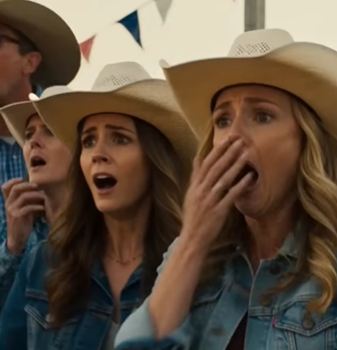
Nobody in the rodeo expected the scream to come from the crowd.
They expected it from the bull.
The arena had been loud only a second earlier—music blasting, the announcer hyping the next challenge, people laughing in the bleachers with drinks in their hands.
Then a little boy vaulted over the metal railing.
He hit the dirt hard.
Dust exploded around his small body.
For one stunned second, the whole arena forgot how to breathe.
“Hey! Kid— no!” the announcer shouted into the microphone, his voice cracking through the speaker.
The boy pushed himself up on shaking hands. He was small, too small to be in that ring, wearing a faded denim jacket over a gray hoodie, his face already wet with tears and dust.
Across the arena, the black bull turned.
Slowly.
Its massive body shifted, muscles rolling under dark skin, one hoof scraping the dirt like a warning from something ancient.
A woman in the crowd covered her mouth.
A man near the rail yelled, “What is he doing?!”
But the boy didn’t run.
That was the part no one understood.
He should have scrambled back to the fence. He should have cried for help. He should have frozen.
Instead, he reached inside his jacket with trembling fingers and pulled out a faded red bandana.
Old. Sun-worn. Frayed at the edges.
And in one corner, stitched by hand, were two initials.
He lifted it toward the bull with both hands like it was the only thing left in his life that mattered.
“My dad said you’d know this,” he said, voice shaking so badly it nearly disappeared in the wind.
The crowd went quiet.
Even the announcer stopped talking.
The bull lowered its head.
Not to charge.
To look.
Dust rolled beneath its hooves as it began moving toward the boy—slow, heavy, terrifying.
The boy’s lips trembled. His shoulders shook. But he held the bandana higher.
“He said you waited for him,” he whispered.
The bull kept coming.
Row by row, people in the bleachers rose to their feet.
The announcer had gone pale. He gripped the rail of the platform so hard his knuckles turned white.
The boy was crying now, not loudly, just enough to show how hard he was fighting not to break.
“Please…” he said, staring at the animal through tears. “Don’t leave me too.”
Then the bull lunged.
The entire arena screamed.
Dust burst upward in a golden wave as the animal thundered forward—straight at the child.
And then, impossibly, it stopped inches from his chest.
One horn nearly touched the boy’s jacket.
The bandana fluttered between them.
The boy’s breath caught.
The bull’s huge dark eye stared into his.
“Ranger…?” the boy whispered.
The bull began to lower its head toward the bandana.
And up on the announcer’s platform, the blue-suited announcer suddenly leaned forward, staring at the stitched initials like he had seen them before.
His face changed.
Not fear now.
Recognition.
“Oh my God…” he whispered.
Then he grabbed the microphone with a shaking hand and shouted:
“Wait… that name—”
The black bull was still standing in front of the little boy, its head lowered, nostrils flaring softly against the old red bandana.
The boy’s hands were shaking so badly he could barely keep holding it.
The announcer climbed down from the platform so fast he nearly fell. When he reached the dirt, he didn’t go to the boy first.
He went to the bull.
And he said one name.
“Cal.”
The crowd looked at him in confusion.
The announcer stopped a few feet away, tears already filling his eyes.
“Your father,” he said to the boy, voice breaking, “was Caleb Turner.”
The boy swallowed hard and nodded.
The arena exploded into whispers.
Every old rancher, every rodeo hand, every person who had been coming to that ring for years knew the name.
Caleb Turner had been the greatest bull rider in the county—fearless, reckless, beloved.
And ten years earlier, he had died after saving a child from a barn fire on the west side of town.
The boy held the bandana tighter.
“My mom said he talked about Ranger like he was family,” he whispered.
The announcer laughed once through tears, shattered by the memory.
“He did,” he said. “That bull was just a calf when your dad found him half-dead in a storm drain. Bottle-fed him. Slept in the barn with him. Said Ranger only listened to one voice in the whole world.”
The boy looked back at the bull.
Ranger nudged the bandana gently with his nose.
No aggression.
No violence.
Just recognition.
The crowd had gone so silent that every breath in the arena could be heard.
The boy’s lower lip trembled.
“He told me if I ever had nowhere to go,” he said, “I should find Ranger.”
The announcer’s face collapsed.
“Where’s your mom?” he asked softly.
The boy looked down.
“Gone,” he whispered. “Three weeks now.”
A woman in the front row started crying.
The announcer took one slow step closer.
“And you came here alone?”
The boy nodded again. “I didn’t know anybody else who might remember him.”
That broke the last of the room.
The same crowd that had come for noise and spectacle now stood frozen in a kind of grief.
The announcer wiped his eyes and turned toward the bleachers.
“You all hear that?” he shouted, his voice raw. “Caleb Turner’s boy came into this arena because he had nobody left.”
No one cheered.
They just listened.
Ranger lowered himself—slowly, heavily—onto his front knees in the dirt in front of the child.
A collective gasp moved through the stands.
The boy stared, stunned.
The announcer smiled through tears.
“He remembers,” he said.
The little boy stepped closer, one trembling hand reaching out.
When his fingers touched Ranger’s head, the bull stayed perfectly still.
And for the first time since jumping into the arena, the boy finally broke.
He dropped against the bull’s neck and sobbed into the coarse black hide.
The announcer turned away for one second just to gather himself.
Then he faced the crowd again.
“Caleb Turner gave this town everything,” he said. “Tonight, we’re not letting his son leave here alone.”
That was all it took.
A rancher in the front row raised his hand. Then another. Then another.
Money. Food. Offers of help. A place to stay. Work. School clothes. A room. A family friend who had known Caleb. A widow who said she still had his trophies packed away. A mechanic who swore Caleb once saved his life.
And in the middle of that dusty golden arena, with the bull resting calmly beside him, the little boy realized something his father had hoped he would someday learn:
He had not come to the only thing that remembered Caleb.
He had come to everyone who did.