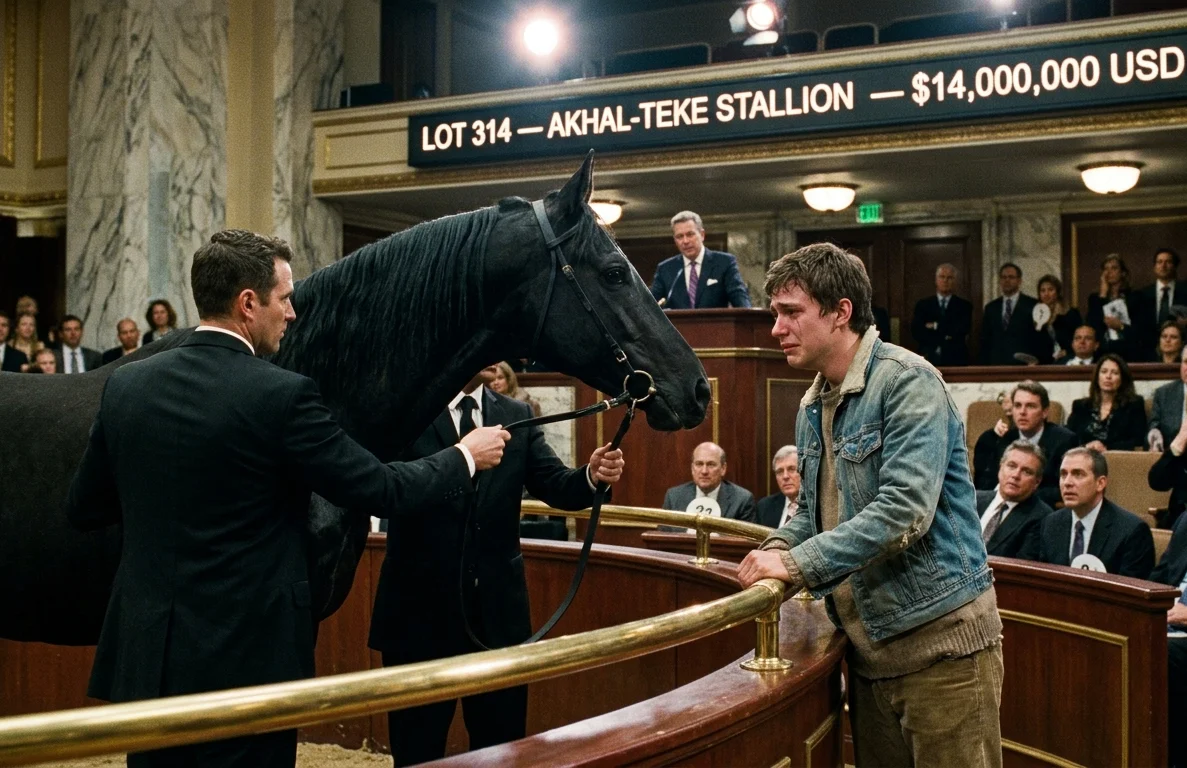
The marble floors stretched like frozen water beneath crystal chandeliers, wide and unforgiving. Above, tall arched windows poured in a pale, sterile morning light that turned everything too bright, too clean—like an operating room built to erase human emotion rather than hold it. Wealthy voices echoed softly through the grand space, detached and calculating, already measuring the worth of breath and heartbeat in numbers that didn’t belong to anything living.
At the center of this cold, opulent stage stood the horse.
A young black Akhal-Teke stallion, his coat shining like liquid obsidian under the harsh glare of the lights. They called it beauty, but it was a masterpiece trapped in a cage of eyes. He was restrained gently by silk-wrapped ropes, but his posture told a heartbreaking story—every muscle was wired with tension, alert, restless, suffocating under the weight of a hundred staring strangers. His dark, liquid eyes moved with a quiet, desperate intelligence, scanning the crowd, searching, pleading, but recognizing nothing familiar in this sea of expensive suits and blank faces. He was entirely, utterly alone.
Above him, the LED display burned like a neon brand of cold authority: “LOT 314 — AKHAL-TEKE STALLION — $14,000,000 USD”
The handlers stood close, professional, robotic, and completely detached from the living, breathing soul they guarded. The auctioneer’s voice rolled across the hall, a polished, confident drone describing pedigree, rarity, and genetic perfection—cruel, sterile words that reduced a majestic life into a mere investment, a trophy to be locked away.
No one noticed the sudden, heavy silence at the back door at first. Then, with a faint groan of iron, it opened.
A young man stepped inside. He didn’t belong here, and the room knew it instantly. His clothes were worn and simple, stained with the dust of the outside world, and his breathing was uneven, ragged, like he had run until his lungs burned, driven by a terror that couldn’t be stopped. He was trembling. But the exact moment his eyes locked onto the black stallion through the crowd, the frantic air left him. Everything in him froze.
Because the horse reacted first.
The stallion lifted his head sharply, a sudden, violent grace. His ears whipped forward.
And for a fraction of a second, the entire universe seemed to stop spinning. The crowd kept moving—paddles rising like cold hands, cameras flashing like artificial lightning—but between the boy and the beast, something invisible, ancient, and unbroken snapped into place.
The young man took one step forward. Then another, his boots leaving faint, dusty marks on the pristine marble. His throat tightened as a tidal wave of memories hit him all at once: the smell of dusty mornings, the vast calmness of quiet fields, the rhythmic, comforting sound of hooves before sunrise, and a bond built not in shackles or ownership, but in bleeding, unconditional trust. That horse wasn’t a “lot.” It wasn’t a status symbol.
It was his family.
He stopped right in the center of the aisle, a solitary figure drowned in luxury and noise. And then he said it—a sound low, broken, and barely holding together, torn straight from his chest: “Please… no.”
The hall didn’t understand the words at first. Some thought it was part of a protest. Some thought it was drama staged for attention. But the horse understood. It pulled against the restraint slightly, nostrils flaring, recognizing the voice before it even saw him clearly.
The auctioneer hesitated. For the first time, the rhythm broke. The young man’s voice cracked as he stepped closer, eyes never leaving the horse. “That’s mine,” he said, louder now. “That horse is mine.”
A ripple moved through the crowd—confusion, curiosity, irritation. Wealth didn’t like interruption. Ownership here was already decided in contracts and signatures. But emotion doesn’t follow paperwork.
The horse suddenly shifted again, a stronger movement this time. One handler tightened his grip, unsure now, sensing something unusual in the animal’s reaction. The young man reached the barrier, placing a trembling hand on it, as if distance alone was unbearable. “I raised him,” he whispered, almost to himself. “He knows me.”
And as if answering, the stallion stepped forward just enough that the chain pulled tight—and then it stopped, not from force, but from hesitation. The entire hall felt it. Even the cameras slowed.
The auctioneer looked uncertain now, glancing between the handlers and the crowd, trying to regain control of a room that was no longer listening. The young man didn’t shout anymore. His voice broke into something softer, more devastating. “Please don’t take him from me again.”
Silence followed—not complete, but heavy, suffocating. Because for the first time, the number on the screen didn’t feel like value. It felt like loss.
And the horse stood between two worlds—one built from money and marble, and one built from memory and loyalty—waiting for someone to decide what it truly was.
The auctioneer’s hammer hung suspended in the air. In the silence of the hall, only the horse’s heavy breathing could be heard.
In the first row, the elderly billionaire, who had just been about to raise his card to push the price to 15 million, slowly lowered his hand. He looked at the boy’s trembling fingers, then into the stallion’s eyes, which reflected only the image of that simple young man. In that gaze, there was no price at all.
The billionaire sighed, turned to the auctioneer, and said in a low but steady voice: “I withdraw my bid. There is not enough money in this hall to buy what belongs to the soul.”
Others followed his example. The buyers one after another lowered their cards. The enormous numbers on the LED screen seemed to fade and lose their shine.
The auctioneer, understanding the seriousness of the moment, slowly lowered the hammer without striking it. “Lot 314… is withdrawn from sale,” he announced, and there was no longer the previous coldness in his voice.
The guards loosened the chains. At that same moment, the black stallion surged forward, approached the barrier, and gently touched the boy’s face with its warm breath. The young man wrapped his arms around the horse’s neck, hiding his tears in its silky mane.
Together they walked toward the door, leaving behind the cold marble hall and millions. They were going home, where value is measured not in numbers, but only in loyalty.