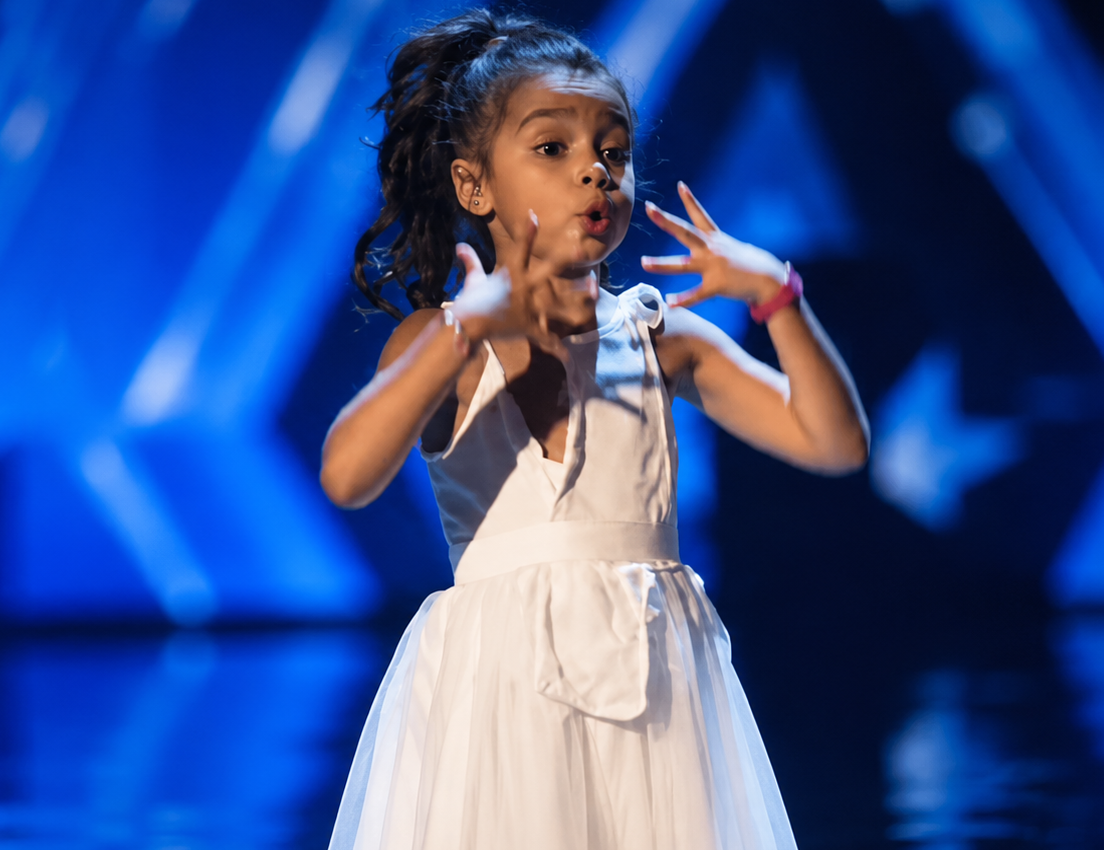
The audience wasn’t sure what to expect when the little girl stepped into the spotlight.
She looked no older than seven.
Her hair was pulled back, her feet were bare, and she wore a simple white dress.
But the dress wasn’t new.
There were stains near the bottom.
A small tear ran along one side.
And unlike most young contestants, she didn’t smile or wave when the audience applauded.
She simply stood in the center of the stage.
Alone.
Her hands trembled slightly.
The host walked toward her.
“Hello, sweetheart. What’s your name?”
“Amara.”
“And how old are you, Amara?”
“Seven.”
The audience applauded.
The host smiled.
“What are you going to do for us tonight?”
Amara looked toward the empty stage behind her.
“I’m going to dance.”
One judge noticed the condition of her dress.
“Is that your costume?”
Amara nodded.
“My mommy made it.”
The judge smiled.
“It’s beautiful.”
Amara looked down.
“She never got to see me wear it.”
The theater became completely silent.
The host crouched beside her.
“What happened?”
Amara took a long breath.
“My mommy was a dancer.”
Her mother, Naomi, had loved dancing since childhood.
She never became famous.
She never performed in enormous theaters.
Instead, she taught children at a tiny neighborhood dance studio.
Some families couldn’t afford lessons.
Naomi taught their children anyway.
“If a child wants to dance,” she always said, “money shouldn’t be the thing that stops their feet.”
Amara grew up inside that studio.
Before she could properly walk, she crawled across the wooden floor while her mother taught classes.
By four, she knew every song.
By five, she was copying the older students.
And by six, she had one dream.
She wanted to perform a duet with her mother.
Together they created a dance called “Always With You.”
Naomi even made Amara’s costume herself.
A simple white dress.
Every evening after class, mother and daughter practiced.
There was one particular movement Amara couldn’t master.
She had to turn, reach toward her mother, and then continue dancing without looking back.
Amara always stopped.
“I can’t do it.”
Naomi laughed.
“Why?”
“Because I need to see where you are.”
Her mother knelt beside her.
“You don’t always have to see me to know I’m there.”
Amara didn’t understand.
Not then.
Their performance was scheduled for a small community show.
But one week before it…
Naomi became seriously ill.
At first everyone thought she needed rest.
Then came the hospital.
Tests.
Doctors.
Whispered conversations Amara wasn’t supposed to hear.
The dance was postponed.
Every afternoon, Amara visited her mother.
She brought drawings.
Music.
And the white dress.
“Will you come home before our show?”
Naomi always smiled.
“We’ll dance when the time is right.”
But the time never came.
Several weeks later, Naomi passed away.
Amara stopped dancing.
The little studio became unbearably quiet.
Her grandmother packed away the music.
The white dress went into a box.
Months passed.
Then, one afternoon, Amara found her mother’s phone.
There were dozens of rehearsal videos.
She watched them for hours.
Then she discovered one she had never seen.
Naomi was alone in the studio.
She looked directly into the camera.
“If you’re watching this, little bird, maybe I’m not able to finish our dance with you.”
Amara froze.
Her mother’s voice continued.
“But I need you to finish it anyway.”
“Remember the part you always stop at?”
“Turn.”
“Reach for me.”
“And keep going.”
“Because even if you can’t see me…”
“You already know where I am.”
Amara watched the video every night for a month.
Then one morning, she opened the box containing the white dress.
She put it on.
It was slightly damaged from years of rehearsals and storage.
Her grandmother offered to buy her a new one.
Amara refused.
“Mommy touched this one.”
She returned to the studio.
The first day, she danced for twenty seconds.
Then cried.
The next day, thirty seconds.
Then a minute.
Eventually, she reached the movement she had always been afraid to perform.
Turn.
Reach.
Keep going.
This time…
She didn’t stop.
Her grandmother secretly recorded the rehearsal.
Months later, she submitted the video to a talent show.
And now Amara was standing on its enormous stage.
The host stepped away.
“Are you ready?”
Amara nodded.
The lights dimmed.
A soft melody began.
Amara closed her eyes.
Then she moved.
Her hands swept through the air.
Her bare feet traveled quietly across the stage.
At first, the judges watched with smiles.
Then they realized something unusual.
Amara kept leaving spaces in her choreography.
She would reach outward…
Pause…
Then move as though someone invisible had taken her hand.
She would turn toward an empty section of stage.
Smile.
Then continue.
The dance had clearly been created for two people.
But only one was there.
Halfway through the performance…
Amara reached the movement.
The movement she had once refused to complete.
She turned.
Stopped.
Extended one hand behind her.
For one long second, she stood perfectly still.
The entire theater held its breath.
Amara looked toward the empty space.
Then whispered:
“I know you’re there.”
And continued dancing.
One judge immediately covered her mouth.
Another lowered his head, wiping away tears.
Amara moved faster now.
Not perfectly.
Not like a professionally trained adult.
But with complete belief in every movement.
As the music approached its final note, she returned to the center of the stage.
She extended both arms toward the empty space beside her.
Then slowly brought them around herself…
As though receiving a hug.
The music stopped.
Silence.
Amara kept her eyes closed.
Nobody moved.
Then one person stood.
Another followed.
Within seconds, every judge was standing.
Then the entire audience rose.
The applause exploded through the theater.
Amara opened her eyes.
She looked surprised.
Then she looked upward.
And smiled.
The host returned.
“Amara, what were you thinking about during that final moment?”
She answered without hesitation.
“My mommy.”
“Did you feel like she was here?”
Amara nodded.
“She told me I didn’t have to see her.”
The host struggled to respond.
One judge finally spoke.
“I’ve watched thousands of performances.”
“But what you did tonight wasn’t just dancing.”
“You showed us what it means to continue loving someone after you can no longer hold their hand.”
Amara looked toward the judge.
Then quietly said:
“I can still hold her hand.”
The judge looked confused.
Amara touched her chest.
“Just differently.”
The audience broke into applause again.
After the performance aired, Amara’s story spread around the world.
Parents hugged their children tighter.
People who had lost loved ones shared videos of themselves returning to hobbies they had abandoned after grief.
Dance schools performed “Always With You” in memory of teachers and students they had lost.
But Amara never cared about becoming famous.
She returned to her mother’s small studio.
Years later, when she was old enough, she began helping teach younger children there.
On one wall hung the original white dress.
Beside it was a photograph of Naomi.
Underneath were the words:
“You don’t always have to see me to know I’m there.”
Whenever a frightened child said,
“I can’t do this…”
Amara smiled.
She would take their hand and repeat the lesson her mother had once given her:
“Turn.”
“Reach.”
“And keep going.”
Because that was what her mother had really taught her.
Not how to dance.
How to continue.
How to love someone through absence.
How to carry memories without allowing grief to stop every future step.
And years after that unforgettable night, people still remembered the seven-year-old girl in the worn white dress.
Not because she danced perfectly.
But because she stepped onto an enormous stage alone…
Reached for someone the audience couldn’t see…
And somehow made everyone in the theater feel that she wasn’t alone at all.
Sometimes the people we love can no longer stand beside us—but the love they leave behind can keep dancing with us for the rest of our lives.