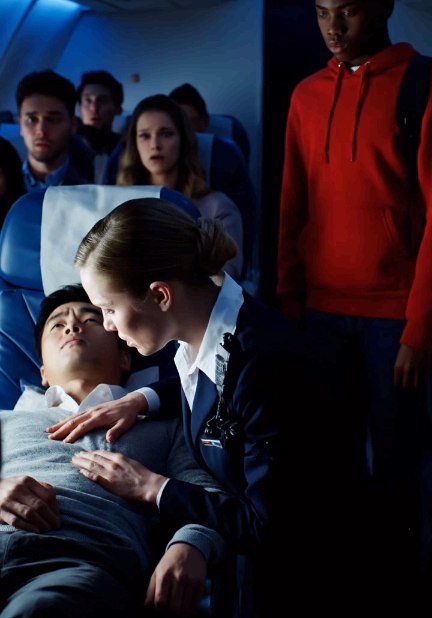
At 34,000 feet, panic doesn’t arrive with a scream.
It arrives as a whisper.
It begins with a strange pause between the engine hums, a silence that feels wrong. The seatbelt sign flicks on—not alarming, just enough to make people glance up from their screens.
Then someone gasps.
Row 18.
A middle-aged man in a gray business jacket slumps forward, his forehead resting on the tray table as his coffee spills across it, inching toward the edge.
“Sir?” the woman beside him says.
He doesn’t answer.
That’s when the whisper becomes fear.
Emily, a young flight attendant with a slightly crooked badge, rushes down the aisle. She checks his pulse—neck, wrist—one after another. Her training steadies her hands, but not her expression.
Weak.
Irregular.
Fading.
The cabin tightens around her.
She stands, gripping the armrest as the plane jolts lightly.
Her voice shakes under the weight of responsibility.
“Is there a doctor on board?”
Passengers look around, waiting for someone else to rise.
“This is a life-or-death situation!” she calls louder.
A baby cries.
A prayer is whispered.
A businessman tugs at his tie.
No one moves.
Emily presses her wrist communicator. The captain answers, voice calm but distant.
Nearest airport: forty minutes away.
Too long.
She tries again. “Please. Anyone with medical training—please stand up.”
Silence.
Then:
“I can help.”
A boy stands at the back of the plane.
Twelve years old. Hoodie too big. Sneakers worn. Hands shaking.
The cabin reacts instantly—confused, dismissive, annoyed.
Emily hurries to him. “This isn’t a game. Sit down.”
“I know,” he says.
“We need professionals,” she insists.
“My mom’s a cardiologist,” he replies. “He’s in ventricular tachycardia. Or almost.”
The words freeze the aisle.
Emily stares. “How do you know that?”
“The way he collapsed. His breathing. His skin color. My mom teaches me.”
Passengers murmur.
The boy pulls out a laminated card:
CPR & AED Certified — Pediatric Advanced Life Support Observer
Valid.
Emily hesitates. Time is running out.
“Fine,” she says. “You instruct. I act. You don’t touch him.”
He nods immediately.
“Lay him flat. Elevate his legs. Oxygen—full flow.”
Emily moves fast, following every word.
“Check pulse again,” he says. “If it drops, get the AED ready.”
The AED arrives.
The machine analyzes.
NO SHOCK ADVISED.
The boy exhales. “Okay. We still have time.”
Minutes drip by.
The man’s pulse steadies—barely.
Captain: “Descending. Ten minutes.”
Suddenly the monitor spikes.
The AED shrieks.
The boy’s voice sharpens: “Shock now!”
Emily hesitates—just a heartbeat.
The boy’s voice rises. “NOW!”
She presses the button.
A jolt.
A gasp.
A breath.
The man lives.
Passengers cry, clap, cover their mouths.
Emily collapses onto an armrest, shaking.
The boy slips back into his seat, hoodie sleeves covering trembling hands.
When they land, emergency crews take over. The man survives.
As people exit, whispers trail the boy.
“Hero.”
“He saved him.”
“He’s just a kid.”
Emily stops him.
“I’m sorry for yelling,” she says.
“It’s okay,” he replies.
“Why didn’t you speak up earlier?”
He shrugs. “People don’t listen to kids.”
That night, a headline spreads:
12-Year-Old Saves Passenger Mid-Air After Being Told to Sit Down.
By morning, it’s everywhere.
And somewhere in a hospital bed, a man opens his eyes—alive—because a child dared to speak when panic whispered.