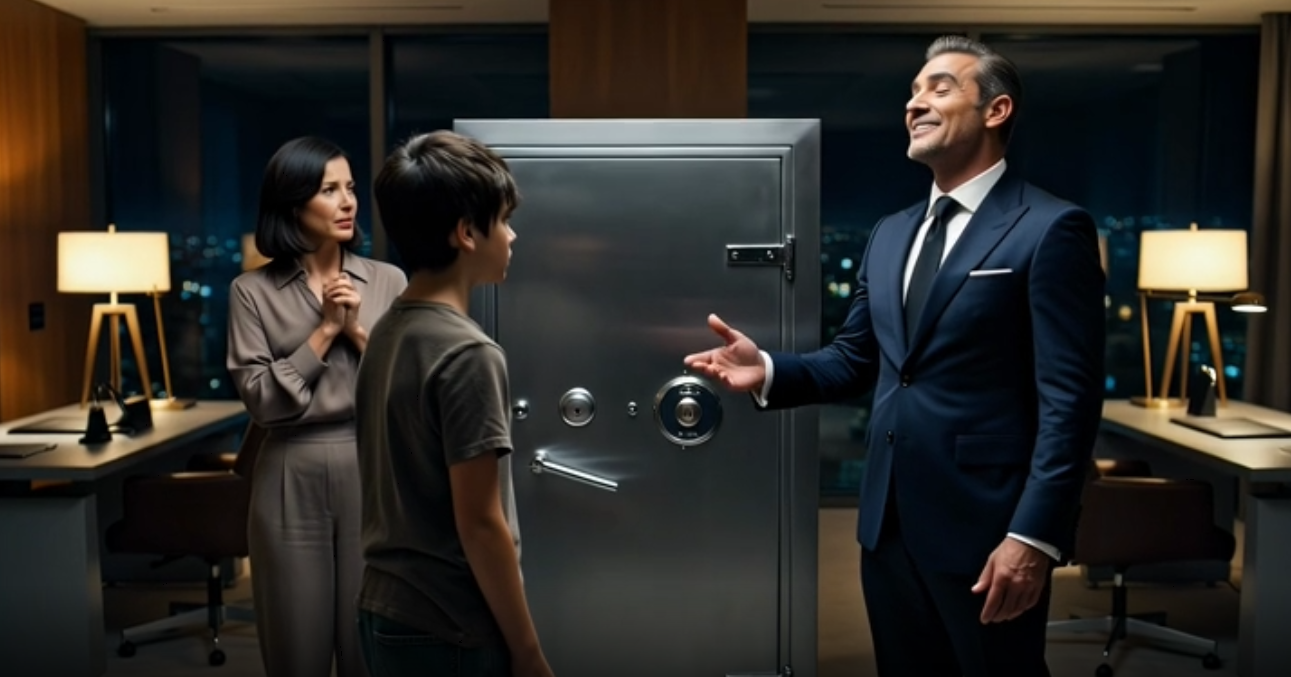
“I’ll give you 100 million if you open the safe,” the billionaire declared — and the room exploded with laughter.
Mateo Sandoval clapped his hands and pointed at the barefoot boy trembling next to the titanium safe.
“One hundred million dollars,” he shouted, smiling like a man who fed on cruelty. “All the money is yours if you crack this beauty. Well? What do you say, little street rat?”
The five businessmen around him laughed so hard they wiped tears from their eyes.
For them, it was the perfect spectacle:
An eleven-year-old child — in torn clothes, with a dirty face — staring at the most expensive safe in Latin America as if it had fallen from the sky.
“This is pure comedy,” howled Rodrigo Fuentes, a forty-nine-year-old real estate magnate. “Mateo, you’re a genius. Do you really think he understands what you’re offering him?”
“Please,” snorted Gabriel Ortiz, a fifty-one-year-old pharmaceutical heir. “He probably thinks a hundred million means a hundred pesos.”
“Or he thinks he can eat them,” added Leonardo Márquez, a fifty-four-year-old oil tycoon, triggering another wave of ugly laughter.
In a corner, Elena Vargas, thirty-eight years old, clutched the mop so tightly her hands were shaking.
The handle hit the floor with a dull thud — each strike like a heartbeat of humiliation.
She was the cleaning woman.
And she had committed the unforgivable crime of bringing her son to work because she couldn’t afford childcare.
“Mr. Sandoval…” she pleaded, her voice nearly swallowed by laughter. “Please, we’ll leave. My son won’t touch anything, I promise, he won’t—”
“Silence.”
Mateo’s voice sliced through the room like a whip.
Elena flinched as if she’d been struck.
“Did I tell you to speak?” he hissed. “For eight years you’ve scrubbed my toilets and I barely noticed you. And now you interrupt my meeting?”
The laughter faded.
In its place came a heavy, ugly silence.
Elena lowered her head, tears pooling, and backed away until she was nearly pressed against the wall.
Her son looked at her with an expression no child should ever wear — pain, helplessness… and something even deeper.
POWER AND HUMILIATION
At fifty-three, Mateo Sandoval had built a nine-hundred-million-dollar fortune by crushing rivals and stepping on anyone he considered “beneath him.”
His forty-second-floor office was a monument to ego:
floor-to-ceiling glass walls overlooking the city,
imported furniture worth more than a house,
and a Swiss safe that alone cost the equivalent of ten years of Elena’s salary.
But Mateo’s favorite luxury wasn’t the view or the furniture.
It was the power to stage scenes like this — scenes that reminded the poor exactly where he believed their place was.
“Come here, boy,” he ordered, beckoning lazily with his fingers.
The boy looked at his mother.
Through tears, Elena gave him the smallest nod she could.
He obeyed, taking small steps.
His bare feet left dirty marks on Italian marble that cost more per square meter than everything they had ever owned.
Mateo crouched down to be at eye level with him.
“Can you read?”
“Yes, sir,” the boy answered softly but firmly.
“And can you count to a hundred?”
“Yes, sir.”
“Good,” Mateo said, standing up, his smile returning.
The men behind him snickered, already waiting for the punchline.
“So you understand what a hundred million dollars means, right?”
The boy nodded.
“Tell me,” Mateo pressed, arms crossed. “In your own words. What does a hundred million dollars mean to you?”
The boy swallowed, glanced at his mother, and said:
“It’s… more money than we’ll ever see in our entire lives.”
“Exactly,” Mateo applauded, as if the child had just passed a test.
“More than you, your mother, your children — and their children — will ever touch.”
“It’s the kind of money that separates people like me from people like you.”
“Mateo, you’re ruthless. Even for you,” murmured Fernando Silva, a fifty-seven-year-old investor — though his smile betrayed how much he enjoyed it.
“This isn’t ruthless,” Mateo replied. “This is education. I’m teaching him how the world works. Some are born to serve. Others are born to be served. Some clean. Others make the mess and know someone else will clean it.”
He turned to Elena, who looked as though she wanted to disappear into the wall.
“Your mother, for example — do you know how much she earns scrubbing toilets?”
The boy shook his head.
“Tell him, Elena,” Mateo said coldly. “Tell your son what your dignity is worth on the labor market.”
Elena opened her mouth, but no sound came out.
Tears streamed down her face; her shoulders shook.
“You don’t want to?” Mateo pushed, savoring every second. “Fine. I’ll tell him. Your mother earns in a month what I spend on a single dinner with my partners. Incredible, isn’t it? That’s how this world is built.”
“This is better than Netflix,” Gabriel laughed, raising his phone. “We should film this.”
“Already am,” Leonardo said, waving his phone. “Straight to the private group. The guys at the club will choke laughing.”
The boy’s face, which until then had been filled with shame, began to change.
Beneath the humiliation, something else was awakening — a cold, controlled fury that burned in his eyes like embers.
THE GAME EXPOSED
“Alright, back to our little game,” Mateo said, turning to the safe and patting the metal like a prized animal.
“This masterpiece is a Swistech Titanium, shipped from Geneva. Want to know how much it cost?”
The boy shook his head.
“Three million dollars,” Mateo said, letting the number hang in the air.
“This safe alone costs more than your mother will earn in a hundred years of cleaning my bathrooms.”
“Military-grade technology. Biometrics. Codes that change every hour. Impossible without the correct combination.”
“Then why offer money for something impossible?” the boy asked quietly.
The question hit Mateo like a stone.
His smile twitched.
“What did you say?”
“If it’s impossible to open,” the boy repeated calmly, “then you’ll never have to pay the hundred million.”
“It’s just a trick — to laugh at us.”
This time, the silence was different.
The men shifted, exchanged uneasy glances.
With a single sentence, the child had exposed the very engine of Mateo’s cruelty.
“Look at that,” Rodrigo forced a laugh. “The kid actually has a brain.”
“A brain is worthless without education,” Mateo snapped, trying to recover. “And education costs money — money people like you don’t have.”
“My dad said the opposite,” the boy replied, still gentle, but now with steel in his voice.
“Your dad?” Gabriel sneered. “And where is he? Too busy taking care of his kid?”
“He’s dead,” the boy said simply.
Elena let out a sob that echoed against the glass walls.
The words fell like lightning.
Even the coldest among them felt something twist inside.
“I… I’m sorry,” Mateo muttered — and even he heard how hollow it sounded.
The boy held his gaze so steadily that Mateo, unwillingly, took a small step back.
“If you were sorry,” the boy said, “you wouldn’t do this.”
“Watch how you speak,” Mateo warned.
“Or—”
“Or what?” the boy asked, so calm it was unsettling.
“You fire my mother? Take the job that barely lets us eat? Make us even poorer than we already are?”
Each question landed like a slap.
Mateo realized — too late — that he had misjudged the child.
He had assumed poor meant stupid.
SANTIAGO’S SECRET
“My father was a security engineer,” the boy continued, walking toward the safe.
“He designed protection systems for banks and corporations.”
“He explained codes and algorithms to me for hours when he worked from home.”
“He said safes aren’t just metal and technology. They’re psychology. They’re about how people think.”
The five men watched in total silence.
“And what did he teach you about people?” Mateo asked without realizing it.
The boy placed a hand on the steel, his fingers gliding across the keypad with strange familiarity.
“He taught me that rich people buy the most expensive safes not because they need them,” he said, “but because they want to prove they can.”
“It’s ego, not security.”
“Nonsense,” Fernando muttered — but he didn’t sound convinced.
“Is it?” The boy looked straight at him. “Then tell me — what’s in your safe, Mr. Sandoval?”
“Something you truly couldn’t live without… or just expensive things you bought because you could?”
Mateo felt his chest tighten, because the boy was right.
Inside the safe were jewelry he never wore, documents that could be copied, cash insignificant compared to his fortune.
Nothing truly irreplaceable.
“My father always said people confuse price with value,” Santiago continued.
“You pay millions for things that don’t matter and despise people who do — just because they’re poor.”
“Enough,” Mateo tried to stop him, but his voice came out thinner than he wanted.
“I didn’t bring you here for philosophy.”
“You brought us here to humiliate us,” the boy said, unblinking.
“To remind us you’re rich and we’re not.”
“You wanted to feel superior. You just didn’t calculate that there’s something I know — and you don’t.”
“And what could you possibly know that I don’t?” Mateo spat, his confidence fading.
The boy smiled — not a child’s smile, but a sharp one born of pain.
“I know how to open your safe.”
The sentence fell into the room like a funeral bell.
The men froze, as if the air had turned to glass.
“You’re lying,” Mateo said, fear already creeping into his voice.
“Want proof?” the boy asked.
“Impossible!” Gabriel burst out. “It’s a three-million-dollar safe with military security. A street kid can’t open it.”
“A street kid,” the boy repeated, and for the first time emotion cracked his control.
“That’s what I am to you. Just a street kid.”
He turned to his mother, who looked at him with a mix of terror and wild pride.
“Mom,” he said softly.
“Can I tell them?”
Elena nodded — her eyes saying what her mouth couldn’t.
The boy took a deep breath, as if diving underwater.
“My name is Santiago Vargas Mendoza. My father was Diego Mendoza, chief security engineer at Continental Bank for fifteen years.”
“He designed protection systems in twelve countries, trained over a hundred technicians, and wrote three manuals that universities still teach today.”
The words hit like thunder.
Rodrigo frantically searched the name on his phone.
His face went white.
“My God… Diego Mendoza,” he whispered. “The article from two years ago. He died at the National Bank headquarters.”
“It wasn’t an accident,” Santiago said.
His voice trembled for a fraction of a second, but he held firm.
“It was negligence.”
“They hired the cheapest subcontractor for the electrical work.”
“A short circuit occurred while my father was testing the system.”
“He died instantly.”
Elena collapsed to the floor, sobbing.
“After he died, the company refused responsibility,” Santiago continued.
“They said he violated safety protocol.”
“They cut his pension.”
“They evicted us.”
“My mother — who was a teacher — had to quit to take care of me because I had nightmares every night.”
“And now she cleans toilets,” Leonardo said quietly, without mockery.
“And now she cleans toilets for men who pretend not to see her,” Santiago replied.
“For men who never asked her name, never cared that she’s raising me alone and working three jobs, never knew she taught literature and her students adored her.”
Slowly, the image in the room shifted: Elena was no longer just “the cleaning woman.”
She was an entire life, crushed by the same system that made them rich.
THE CODE THAT SHOULD NEVER HAVE EXISTED
“My father taught me everything about safes because he wanted me to understand his work,” Santiago said, turning back to the vault.
“We spent hours together, dismantling mechanisms, studying algorithms, learning how systems fail. That was our time together.”
He placed both hands on the panel.
His fingers moved with the ease of long practice.
“This model?” he said. “I know it. My father installed three before he died. He showed me exactly how it works.”
“Then open it,” Mateo challenged — but the arrogance was gone.
Santiago shook his head.
“I won’t open your safe, Mr. Sandoval.”
“Why not?” Gabriel demanded.
“Because if I open it, you’ll say it was luck, or cheating, or you’ll change the rules — the way rich people always do,” Santiago said.
“But I can do something better.”
He looked at Mateo.
“I can tell you the code.”
The air conditioner hummed.
Nothing else.
“Impossible,” Mateo whispered. “No one knows it but me. I never wrote it down.”
“Your code is 1-7-8-4-7,” Santiago said, as if stating the time.
Mateo staggered back as if struck.
The numbers were correct.
“H-how?”
“Because every Swistech safe comes with a factory master code that must be changed immediately,” Santiago explained.
“My father discovered that about seventy-three percent of clients never change it.”
“They add layers of security, but the initial weakness remains.”
He pointed to a small metal plate near the base.
“The master code is always the serial number reversed, and the last digit multiplied by three. The final code uses the last two digits of that result.”
He read the serial number, reversed it, did the calculation out loud — so precise, so clear, it couldn’t be a bluff.
Every man in the room understood: it was real.
Mateo sank into his chair as if the strength had drained from his bones.
For years he had bragged about his three-million-dollar safe and its “perfect security.”
And an eleven-year-old had just proven it was an expensive toy with a human flaw.
“Wait,” Santiago said, stepping closer. “There’s more.”
“More?” Mateo swallowed.
“Your security question is: ‘What was your first car?’” Santiago said.
“And the answer is ‘Corvette 987,’ right?”
Mateo could only nod.
“My father told me rich people always choose security questions about their favorite things,” Santiago said softly.
“Never about people — like their mother, their first love, the place they were born — because deep down, they value things more than the people in their lives.”
The five men stared at the floor, unable to meet the eyes of the child who had just exposed them.
A DIFFERENT KIND OF DEAL
“So, Mr. Sandoval,” Santiago said, his voice steady and final, “here’s my real offer.”
“I don’t want your hundred million. I want three things.”
Mateo swallowed hard.
The fight was gone.
“What things?”
“First,” Santiago said, “give my mother a real job in this company.”
“Not cleaning.”
“A position where she can use her real talent.”
“She can teach. She can train. She can do far more than hold a mop.”
Elena stared at him, shock and love colliding in her eyes.
“Second: the five of you create an education fund for employees’ children.”
“Not as charity — as recognition.”
“Talent exists everywhere, not just in rich families.”
The men looked at one another.
They all knew: if they refused now, in front of witnesses, they became monsters — at least in their own eyes.
“And third…” Santiago paused, a trace of cunning entering his voice.
“Change your code.”
“Because now I know it.”
“And if an eleven-year-old can figure it out, how safe do you really think your money is?”
The final sentence hit like a hammer.
Mateo understood that his symbol of power had been completely stripped away — by a child who refused to be trampled.
Santiago extended his hand.
Small.
Firm.
“Do we have a deal?”
Mateo stared at the hand for a long time.
To shake it meant admitting he had been defeated, humiliated, exposed.
But it also meant taking a step toward something he hadn’t considered in years:
Change.
He shook the boy’s hand.
“We have a deal,” he said quietly.
Santiago nodded once and turned to his mother, helping her to her feet.
Elena held him as if clinging to life itself — three lives of pain and love in a single embrace.
“Mr. Sandoval,” Santiago said, turning at the doorway, “my father used to say the best safes don’t protect money.”
“They protect the lessons we learn from our mistakes.”
“I hope you don’t waste this one.”
Mother and son left, leaving behind five wealthy men who suddenly felt like the poorest people in the building.
Mateo looked at his famous three-million-dollar safe and saw it differently for the first time.
He had spent a fortune protecting things that didn’t matter —
and had completely failed to protect the only thing that did:
his own humanity.
The “street kid” had just given him the most expensive lesson of his life.
And it hadn’t cost a single cent.