The mountain doesn’t care if you’re seven years old. The mountain doesn’t care if you’re wearing a thin jacket because you wanted to look “pretty” for a mother who isn’t coming home.
When the sun slipped behind the sharp peaks of Blackwood Falls, the temperature didn’t simply fall—it plunged like a stone dropped in a well.
My daughter was out there. Somewhere in the darkness, where the rain becomes needles of ice and the wind howls like a dying beast.
The police told me to stay back. The volunteers said it was too dangerous. They were preparing for a recovery, not a rescue.
But then, Elias Thorne arrived with a scarred Belgian Malinois named Boomer.
This is the story of the night the woods tried to take my soul, and the K9 who decided to give his life to keep a little girl warm.
It’s a story about why we never, ever give up on the ones we love—and why sometimes, the greatest humanity is found in a dog.
CHAPTER 1: THE SILENCE OF THE PINES
The rain in Washington state isn’t just weather; it’s a physical weight. It soaks through the layers of Gore-Tex and denim until it reaches your bones, turning your blood into slush.
I, Mark Miller, stood at the trailhead of the Iron Goat Trail, clutching a damp pink mitten like it was the only thing anchoring me to the earth.
“Lily!” I screamed again, but my voice was swallowed by the roar of the wind through the Douglas firs.
It had been four hours. Four hours since I’d turned my head to answer a work email—just one minute, I told myself—and looked back to find the trail empty.
Lily was gone. My sweet, imaginative, seven-year-old Lily, who still talked to her mother’s photograph every morning before school.
“Mr. Miller, you need to sit in the truck,” Sheriff Sarah Vance said, her voice firm but not unkind. Sarah was a woman built like the mountains she patrolled—tough, weathered, and used to dealing with tragedy. She’d seen too many kids wander off in these woods. Most of them didn’t come back the same. Some didn’t come back at all.
“I’m not leaving her,” I rasped. My throat felt like it was lined with sandpaper.
“The K9 unit just arrived,” Sarah said, pointing toward a mud-splattered Ford F-150 pulling into the gravel lot. “If anyone can find her in this mess, it’s Elias and Boomer.”
I watched as a man stepped out of the truck. He looked like he’d been carved out of the forest himself—tall, lean, with eyes that seemed to see through the darkness. But it was the dog that caught my attention.
Boomer wasn’t a polished show dog. He was a Belgian Malinois with a notched ear and a silver muzzle that spoke of years on the job. He moved with a stiff-legged grace, his nose already twitching, sampling the freezing air.
Elias Thorne didn’t offer a handshake. He didn’t offer platitudes. He just walked up to me and held out a hand. “Give me something of hers. Something she wore today.”
I handed him the other mitten.
Elias knelt down, pressing the fabric to Boomer’s nose. The dog went still. His entire body vibrated with a sudden, intense focus.
“Seek,” Elias whispered.
And then, they were gone, vanishing into the wall of green and grey.
The woods are a different world once you leave the trail. For Lily, it must have felt like a fairytale turned into a nightmare.
She had been following a blue butterfly. That’s what she’d told me earlier. “Daddy, look! It’s leading the way!”
I should have listened. I should have held her hand. But the grief of losing my wife, Claire, to cancer a year ago had left me in a fog. I was a father physically present but emotionally a thousand miles away.
As I sat in the cab of the Sheriff’s truck, listening to the rain lash against the roof, I realized that if Lily died tonight, I would have killed her twice. Once with my neglect, and once with the cold.
“Talk to me, Sarah,” I said, my voice trembling. “What are the odds?”
Sarah looked out the window. She was a mother of three; I could see the pain in her eyes. “The temperature is hitting thirty-two. With the rain, hypothermia sets in within an hour for a child her size. But Boomer… he’s special, Mark. That dog has a find-rate that defies logic. He doesn’t just track; he hunts for the heartbeat.”
Deep in the ravine, the world was a blur of mud and thorns.
Elias Thorne felt the familiar burn in his lungs. He was forty years old, and the shrapnel in his knee from his time in the Army still ached in the cold. But he didn’t slow down. He couldn’t.
He watched Boomer’s tail. It was the barometer of the search. When it was low and sweeping, they were on a cold scent. When it whipped back and forth like a frantic metronome, they were close.
Suddenly, Boomer stopped. He tilted his head, his ears forward.
“What is it, boy?” Elias whispered, clicking his flashlight off to let his eyes adjust to the gloom.
The dog didn’t bark. He gave a low, gutteral whine—a sound he only made when he found something “soft.” In K9 terms, “soft” meant a human who wasn’t moving.
Elias felt a cold dread settle in his stomach. He moved forward, sliding down a slick embankment of pine needles.
There, huddled under the roots of a fallen cedar, was a splash of pink.
“Lily?” Elias called out.
No response.
He scrambled toward her. She was curled in a tight ball, her face as white as the mountain mist. Her skin was blue around the lips. She wasn’t shivering anymore.
In the medical world, when a hypothermic person stops shivering, it means their body has given up. The internal furnace has gone out.
“God, no,” Elias breathed, reaching for his radio. “Dispatch, this is Thorne. I have the subject. Coordinates 47.34, -121.15. She’s non-responsive. We need an air-vac, but the weather is too thick. I need a ground team with a litter, now!”
He stripped off his heavy coat and wrapped it around her, but she was like a block of ice. He tried to rub her hands, but they were stiff.
“Boomer, back,” Elias said, trying to clear space to work.
But Boomer didn’t move back.
The dog, usually a model of disciplined distance, pushed past Elias. He sniffed Lily’s neck, then did something Elias had never seen in seven years of service.
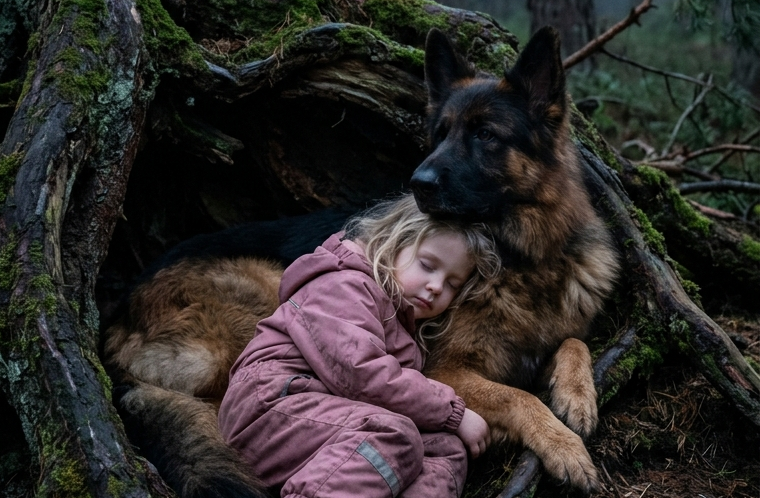
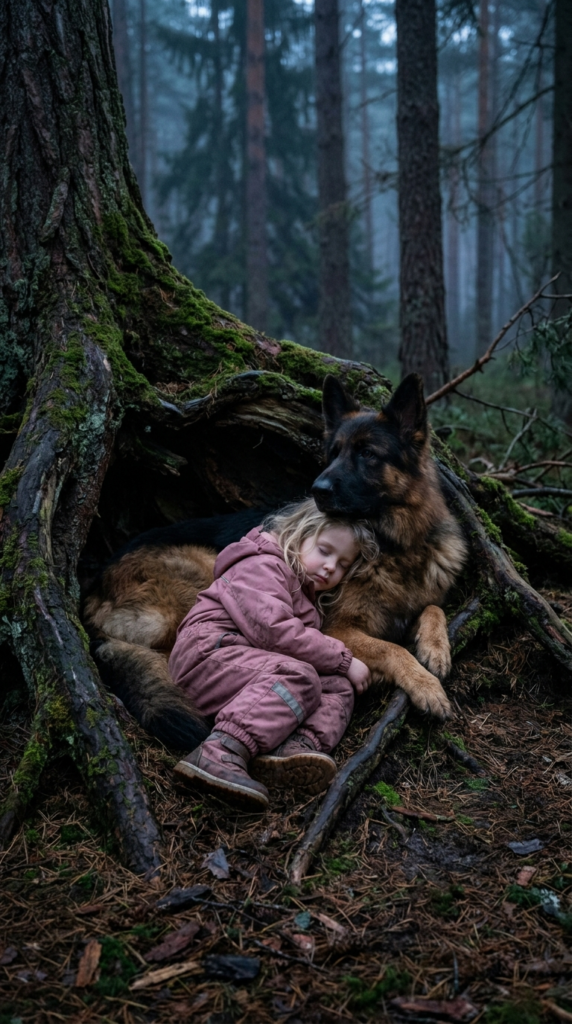
Boomer didn’t just lie down next to her. He crawled into the hollow of the tree, wedging his massive, warm body directly against the girl. He draped his heavy, fur-covered torso over her small frame, tucking his head under her chin.
“Boomer, what are you doing?” Elias started to pull him away, then stopped.
He saw the dog’s ribs heaving. Boomer was radiating heat—a steady, 102-degree furnace of canine life. He was intentionally pressing his chest against Lily’s heart.
The dog looked at Elias, his amber eyes steady and ancient. It was a look that said: I’ve got her. Don’t touch us.
Back at the command post, the radio crackled to life.
“Thorne to Base. The trail is washed out at the creek. The ground team is going to take at least two hours to reach us. I can’t move her—moving a Grade 3 hypothermic could trigger cardiac arrest.”
I grabbed the radio from Sarah’s hand. “Elias! Is she alive? Is my daughter alive?”
There was a long pause. The static hissed like a snake.
“She’s alive, Mark,” Elias’s voice came through, sounding strained. “But she’s fading. My dog… Boomer… he’s holding her. He’s keeping her warm. We’re going to hunker down. We’re not leaving her.”
I fell to my knees in the mud. I looked up at the black sky and prayed to a God I hadn’t spoken to since my wife’s funeral. Please. Take me. Take anything. Just let her heart keep beating.
The night became a blur of shadows and the rhythmic sound of Boomer’s breathing.
Elias sat at the mouth of the hollow, his own body shivering violently now that he’d given his jacket to the girl. He watched the way Boomer adjusted his weight every few minutes, careful not to crush her, but never leaving a gap for the cold air to seep in.
Every so often, Boomer would lick Lily’s cheek—a rough, warm tongue meant to stimulate blood flow.
“You’re a good man, Boomer,” Elias whispered, his teeth chattering.
He thought about his own life. About the wife who had left him because he “cared more about the dogs than the people.” About the silence of his empty house. He realized then that Boomer wasn’t just a tool. He wasn’t just a “service animal.”
Boomer was the only thing in this world that understood what it meant to carry the weight of someone else’s survival.
Around 3:00 AM, a miracle happened.
Lily’s hand, small and pale, twitched. Her fingers curled into Boomer’s thick fur.
A small, whimpering sound escaped her lips. “Mommy?”
Boomer let out a soft huff, a puff of steam rising from his nose. He didn’t move an inch. He stayed as still as a statue, a golden guardian in the heart of the storm.
“Not Mommy, kiddo,” Elias said softly, tears pricking his eyes. “But someone just as brave.”
The dawn didn’t bring sun; it brought a pale, grey light that revealed the devastation of the storm. Trees were down across the path, and the creek had turned into a raging river.
When the rescue team finally broke through the brush, they stopped dead in their tracks.
The scene looked like a painting. A massive dog, covered in mud and pine needles, wrapped around a small girl in a pink jacket. The girl’s eyes were half-open, her hand buried in the dog’s mane.
Elias was slumped against the tree, his face grey with exhaustion, but he was smiling.
“Careful,” Elias croaked as the medics rushed forward. “He’s protective.”
As the medics gently lifted Lily onto the stretcher, Boomer stood up. He was shivering now—the effort of maintaining that body heat for six hours had taken its toll on the old dog. He tried to follow the stretcher, his legs wobbling.
“Stay, Boomer,” Elias commanded softly.
The dog stopped. He watched as they carried the girl away. He let out one single, sharp bark—a salute.
I was waiting at the ambulance when they brought her out.
“Lily!” I cried, rushing to her side.
She was wrapped in a space blanket, oxygen mask over her face, but she was conscious. She looked at me, her eyes tired but clear.
“Daddy,” she whispered. “The big dog… he was warm. He smelled like vanilla and woods. He told me it was okay to sleep.”
I looked over at the trail. Elias was walking out, leaning heavily on a staff. Beside him, Boomer walked with his head held high, though his pace was slow.
I walked over to them. I didn’t know what to say. “Thank you” felt like an insult to the magnitude of what they’d done.
I knelt down in front of Boomer. The dog looked at me, and for a moment, I saw a wisdom in his eyes that no human could ever possess. I reached out and placed my hand on his head.
“You saved my world,” I whispered.
Boomer leaned his weight against my leg, just for a second. A silent acknowledgment.
Then, he turned and followed Elias to the truck.
That night, as I sat by Lily’s hospital bed, watching the steady rise and fall of her chest, I realized that we are never truly lost as long as there is someone—or something—willing to share their warmth when the world goes cold.
Lily recovered. She has a scar on her leg from a briar patch, but she doesn’t remember the pain. She only remembers the warmth.
And every year, on the anniversary of that night, we drive up to a small house on the edge of the mountains. We bring a massive steak and a new tennis ball.
And we sit on the porch with a man named Elias and a hero named Boomer, watching the sun set over the peaks that tried, and failed, to take our light away.
CHAPTER 2: THE FRAGILE THREAD
The descent from the ridge was a blur of mud, adrenaline, and the kind of fear that tastes like copper in the back of your throat. They wouldn’t let me carry her. They said I was too shaky, that my own mild hypothermia made me a liability on the slick, rain-lashed slopes. So I watched, my heart hammering against my ribs like a trapped bird, as the Search and Rescue team navigated the vertical terrain with Lily strapped into a specialized Sked litter.
Elias Thorne walked a few paces behind them, his hand never leaving Boomer’s harness. The dog was flagging; I could see it in the way his back hocks dipped slightly with every heavy step. He had given everything he had to my daughter—every calorie of warmth, every ounce of his seasoned strength.
“Easy, boy,” Elias muttered, his voice barely audible over the wind. “Almost home.”
We reached the staging area at the trailhead just as the first grey light of morning began to bleed through the canopy. The scene was a chaotic symphony of flashing strobes and idling engines.
That was when I met Jackson “Jax” Reed. He was a kid, maybe twenty-four, with a shock of blonde hair and a tech-vest loaded with drone batteries. He was the one who had been flying the thermal imaging scouts all night, frustrated by the thick canopy and the interference from the storm.
“She’s out?” Jax shouted, running toward us. He looked haggard, his eyes bloodshot from staring at a tablet screen for ten hours straight. His strength was his brilliance with tech, but his weakness was his ego; he looked like he was about to cry because his drones hadn’t been the ones to find her. “I had the grid mapped, Sheriff! The signal just wouldn’t penetrate the cedar grove!”
“It doesn’t matter now, Jax,” Sheriff Vance said, her voice like gravel. “Move the truck. We need the ambulance clear.”
Jax scrambled to comply, nearly tripping over his own feet. He was a local kid, brilliant but desperate to prove he wasn’t just a ‘computer geek’ in a town of lumberjacks and mountain men. He’d lived here his whole life, haunted by the fact that he’d been too small to help when the 2014 mudslides had taken out three houses on his street.
Then there was Clara Whitmore. She owned “The Rusty Anchor,” the only diner within thirty miles. She was sixty if she was a day, with hands calloused by forty years of frying eggs and a heart that had been broken so many times it was mostly scar tissue. She was standing by the command tent, handing out thermoses of black coffee to the shivering volunteers.
Clara saw me and didn’t say a word. She just stepped forward and wrapped a massive, wool blanket around my shoulders.
“Drink,” she commanded, pressing a Styrofoam cup into my numb hands. “Your girl is a fighter, Mark. She’s got Claire’s spirit. That woman never knew when to quit, and neither will Lily.”
Clara had been Claire’s best friend. She’d sat in the hospital with us during those final, agonizing weeks of the cancer. Her weakness was her grief; she’d lost her own son to a climbing accident in the Tetons twenty years ago, and she treated every lost hiker in these woods like they were her own flesh and blood.
“She’s so cold, Clara,” I sobbed, the coffee shaking in my hand. “She felt like a piece of ice.”
“But she’s breathing,” Clara said, her grip on my arm like iron. “Look at me. She is breathing.”
The ride to St. Jude’s Memorial in the ambulance was the longest thirty minutes of my life. Lily was hooked up to a cardiac monitor, the rhythmic beep… beep… beep… the only thing keeping me from a complete breakdown.
The paramedic, a quiet man named Officer Pete Russo, kept a steady hand on Lily’s IV line. Pete was Vance’s deputy, a man of few words who knew these roads better than his own backyard. His strength was his calm; his weakness was a secret battle with PTSD from his time as a first responder in the city, which was why he’d moved to this quiet mountain town.
“Her core temp is rising,” Pete said, glancing at the monitor. “Slowly. That’s what we want. If we heat her up too fast, her heart could go into an arrhythmia. It’s called after-drop.”
“After-drop?” I asked, the word sounding like a death sentence.
“The cold blood from her limbs starts moving back to her core as she warms up,” Pete explained, his eyes fixed on the screen. “It can cause the heart temperature to actually fall even after she’s rescued. But that dog… Boomer… he did something incredible. By focusing the heat on her chest, he kept her heart just warm enough to avoid the worst of it. He’s a smart animal.”
I looked out the back window of the ambulance. Following us in the mud-caked Ford was Elias and Boomer. I could see the dog’s silhouette in the passenger seat, his head resting on the dashboard.
I leaned back against the padded wall of the ambulance and closed my eyes. Suddenly, I wasn’t in the ambulance anymore. I was back in our living room, fourteen months ago.
Flashback: October 12th, 2024
“Mark, put the phone down,” Claire had said, her voice thin but playful. She was sitting on the sofa, a colorful turban covering her bald head. The chemo had stolen her hair, but it hadn’t touched the spark in her hazel eyes.
“Just one second, honey,” I’d replied, my thumbs flying over the screen. “The regional manager is breathing down my neck about the Q4 projections. If I don’t finish this proposal tonight, I’m toast.”
“We’re all toast, eventually,” she whispered, so softly I almost didn’t hear her.
Lily, only six then, was on the floor building a castle out of Legos. “Daddy, look! I built a tower for the Queen!”
“That’s great, Lil,” I said, not looking up.
Three hours later, I was still in the home office. I heard a thud from the living room. Then a silence so profound it felt like the air had been sucked out of the house.
By the time I reached her, Claire was on the floor. Lily was standing over her, clutching a Lego brick, her eyes wide with a terror no child should ever know.
“Mommy’s sleeping funny,” Lily had said.
Claire had suffered a massive stroke, a complication from the treatment. She never woke up. My last memory of my wife was her asking me to put my phone down, and me choosing a spreadsheet over her voice.
The ambulance lurched, pulling me back to the present. We were turning into the hospital bay.
“We’re here,” Pete Russo said, snapping his kit shut.
The doors swung open, and a swarm of white coats descended. Lily was whisked away through double doors that I wasn’t allowed to pass through.
I stood in the hallway, the hospital lights blindingly bright, feeling the sudden, crushing weight of the silence. Then, the automatic doors at the entrance slid open.
Elias Thorne walked in. He looked exhausted. His clothes were stained with mud and Lily’s blood from where she’d scraped her leg. He didn’t have Boomer with him.
“Where is he?” I asked.
“In the truck,” Elias said. “He’s resting. The vet is coming to check him there. He’s too tired to move, and he doesn’t like the smell of hospitals. Reminds him of the kennel where he was raised.”
We sat down in the plastic chairs of the waiting room. A clock on the wall ticked with agonizing slowness.
“You saved her,” I said, looking at my hands. “How do I ever pay that back?”
Elias leaned back, his eyes fixed on the ceiling. “You don’t pay it back. You just pay it forward. Boomer… he wasn’t always a hero. He was a ‘washout’ from the police academy in Portland. Too aggressive, they said. Too unpredictable. They were going to put him down.”
I looked at him, surprised. “Why didn’t they?”
“Because I saw something in him,” Elias said, a ghost of a smile appearing on his face. “He wasn’t aggressive; he was frustrated. He had all this drive, all this loyalty, and nowhere to put it. I took him in, spent two years rebuilding his confidence. He’s not a tool, Mark. He’s a partner. Tonight, he didn’t find Lily because I told him to. He found her because he knew a pack member was missing.”
“A pack member?”
“In his mind, once he caught her scent from that mitten, she became his,” Elias explained. “That’s why he stayed with her. He wasn’t just keeping her warm. He was guarding what belonged to him.”
An hour later, a doctor emerged. It was a woman in her fifties with grey hair pulled back in a tight bun. Dr. Aris Thorne—no relation to Elias, just a coincidence of the small-town registry. She was the head of the ER, a woman known for her clinical precision and her hidden soft spot for the local kids.
“Mr. Miller?” she asked.
I stood up so fast I nearly fell. “Is she…?”
“She’s stable,” Dr. Thorne said, and the world seemed to click back into focus. “Her core temperature is up to ninety-six degrees. We’ve started a warm IV saline drip and she’s in a Bair Hugger warming blanket. She’s sleeping now. The labs look good, but we’re going to keep her in the ICU for forty-eight hours to monitor her heart.”
I let out a breath I felt like I’d been holding since I saw that empty trail.
“Can I see her?”
“Briefly,” she said. “She’s been asking for ‘the big dog.’ She’s a bit delirious, but that’s a good sign. It means her brain is firing again.”
I followed the doctor into the ICU. The room was dimmed, the only light coming from the glowing monitors. Lily looked so small in the middle of that big hospital bed. Her hair was matted with leaves, and her face was scratched, but her color was coming back.
I sat down in the chair beside her and took her hand. It was warm. Truly warm.
“Hey, bug,” I whispered.
Her eyelashes fluttered. “Daddy?”
“I’m here, baby. I’m right here.”
“Is the doggy okay?” she mumbled, her voice thick with sleep. “He was… he was real soft. He told me the rain couldn’t hurt me.”
“The doggy is fine, Lil. He’s a hero. He’s getting a big steak tonight.”
She closed her eyes again, a small, peaceful smile on her face.
I stayed there for hours, watching her sleep. Around 6:00 AM, there was a soft knock on the door. It was Jax, the drone kid. He looked sheepish, holding a small, stuffed Belgian Malinois he’d clearly bought at the hospital gift shop.
“I… I know it’s not the real thing,” Jax said, stepping into the room. “But I wanted her to have something. I feel bad, Mr. Miller. If my tech had been better, maybe we would have found her sooner.”
“Jax,” I said, looking at the young man. I realized then that everyone in this town was carrying a burden. Jax’s burden was the need to be perfect to make up for the past. “You stayed out there all night. You didn’t stop looking. That’s what matters. Thank you.”
Jax nodded, his eyes shining, and placed the toy on the foot of Lily’s bed.
As the sun finally broke through the clouds outside, casting long, golden fingers across the hospital floor, I realized that the forest hadn’t just tried to take Lily. It had forced me to see the world again. It had forced me to see the people—the broken, brave, beautiful people like Elias, Clara, Jax, and Pete—who make up the safety net we all take for granted until we fall.
But most of all, it had shown me the soul of a dog who didn’t need words to explain what it meant to love.

CHAPTER 3: THE WEIGHT OF A HERO
The hospital was a vacuum of fluorescent light and the antiseptic smell of bleached floors, a sharp contrast to the raw, earthy scent of the Cascades that still clung to my skin. I hadn’t showered. I hadn’t eaten. I just sat in the vinyl chair by Lily’s bed, listening to the rhythmic sigh of the ventilator assist and the soft hum of the warming blanket.
By the second day, the world outside Blackwood Falls had found out about what happened in the hollow of that cedar tree.
It started with Jax Reed. Driven by a mix of guilt and a desperate need for the town to see the value of the Search and Rescue team, he had posted a single, grainy photo he’d snapped with his phone just as the medics reached the ravine. It showed Boomer—muddy, exhausted, his eyes half-closed—curled like a crescent moon around my daughter’s shivering form.
The caption Jax wrote was simple: “They say he’s just a dog. They say he’s too old for the job. Last night, he stayed in the freezing rain for six hours to keep a seven-year-old girl’s heart beating. This is Boomer. This is what a hero looks like.”
By noon, the post had half a million shares. By evening, it was on the national news.
I watched the “Likes” and “Comments” tick upward on my phone, a digital tide of sympathy and awe from people thousands of miles away. But inside the room, the reality was much quieter. And much more fragile.
Lily woke up fully around 10:00 AM on Tuesday. She didn’t cry. She didn’t scream. She just looked at me with eyes that seemed decades older than they had forty-eight hours ago.
“Daddy,” she whispered, her voice a dry rasp.
“I’m here, baby. I’m right here.” I leaned over, kissing her forehead. Her skin was warm—a miracle I would never take for granted again.
“Where’s the puppy?” she asked. She didn’t call him a dog. To her, he was the giant, furry guardian from her dreams.
“He’s at the vet clinic, Lil. He’s resting just like you. He worked really hard.”
She nodded slowly, her fingers picking at the edge of the blue hospital blanket. “He didn’t let me go, Daddy. When the wind made that scary noise… the one like the giants in my books… he just pushed closer. He was like a big, warm heater.”
She looked toward the window, where the rain was still drizzling against the glass. “I’m sorry I followed the butterfly. I thought it was Mommy. I thought she was calling me to show me where the flowers grow in winter.”
The words hit me like a physical blow. I had to turn away to hide the tears. I had been so wrapped up in my own grief, so buried in my work and my phone, that I hadn’t realized my daughter was searching for her mother in the middle of a mountain storm.
“Mommy is always with us, Lil,” I managed to say, though the lie felt heavy in my mouth. “But she wouldn’t want you to follow her into the dark. She wants you to stay here. With me.”
She reached out her small, IV-bruised hand and touched my cheek. “You’re crying, Daddy. Don’t be sad. The big dog said it’s okay now.”
While Lily was recovering, a different kind of storm was brewing at the Blackwood Falls Town Hall.
I left the hospital for an hour to get some real food at The Rusty Anchor, mostly because Clara Whitmore had threatened to come to the ICU and drag me out by my ears if I didn’t eat a vegetable.
The diner was packed. The air was thick with the smell of bacon grease and woodsmoke. But the usual cheerful banter was missing. People were huddled over copies of the Mountain Gazette or staring at the television mounted above the counter.
“He’s doing it again, Mark,” Clara said, slamming a plate of eggs and hash browns in front of me. She looked like she wanted to punch something.
“Who’s doing what?” I asked, my mind still half-buried in Lily’s medical charts.
“Councilman Arthur Sterling,” she spat.
I knew the name. Sterling was a man who viewed the town’s budget as his personal game of Tetris. He was a retired actuary from Seattle who had moved here for the “quiet life” and immediately started trying to trim the “fat” from public services. To him, the Search and Rescue K9 unit was an expensive hobby.
“He’s using Boomer’s age as leverage,” Clara explained, leaning over the counter. “He’s claiming that the fact Boomer nearly died from exposure proves the dog is a liability. He wants to pull the funding for Elias’s contract and replace the K9 unit with a ‘contracted drone service’ out of Tacoma.”
I looked at the television. There was a local news segment. Sterling was standing in front of the Town Hall, looking polished in a wool overcoat.
“While we are all grateful for the outcome of the Miller search,” Sterling was saying to a reporter, “we have to look at the data. An aging animal in the field is a risk to himself and his handler. We cannot have our primary rescue assets collapsing on the job. It’s time for modern solutions.”
“Collapsing?” I whispered. “He saved her.”
“He’s a snake, Mark,” Clara said. “He doesn’t care about the save. He cares about the insurance premiums and the bottom line. And Elias… you know Elias. He won’t fight back. He’ll just pack up his truck and disappear into the trees before he begs for a paycheck.”
I felt a slow, hot anger beginning to simmer in my chest. It was the first time I’d felt anything other than fear in days.
I found Elias at the Blackwood Veterinary Clinic later that afternoon. The waiting room was empty, save for a tired-looking receptionist.
“He’s in the back,” she said, recognizing me. “Dr. Halloway is running some fluids.”
I walked through the swinging doors and found Elias sitting on a metal stool in a small exam room. Boomer was lying on a padded lift table. He had a catheter in his front leg, and a thick, wool blanket draped over him. He looked smaller than I remembered. The majesty of the mountain hero was gone, replaced by the reality of an eleven-year-old dog whose body had been pushed past its limit.
Elias was stroking the dog’s ears, his face a mask of exhaustion.
“How is he?” I asked quietly.
Elias didn’t look up. “His kidneys are struggling. The cold… it does a number on the organs at his age. He’s dehydrated and his heart rate is irregular. Halloway says it’s ‘exhaustion-induced myocarditis.’ Basically, he gave so much of his own energy to Lily that he didn’t have enough left to keep his own systems regulated.”
I stood there, looking at the dog who had literally traded his health for my daughter’s life. Boomer’s tail gave a weak, pathetic little thump against the table when he saw me. He remembered me.
“I heard about Sterling,” I said.
Elias stiffened. “Sterling is a man who knows the price of everything and the value of nothing. It doesn’t matter. I was going to retire Boomer after this winter anyway. I just… I didn’t want it to be like this. I didn’t want him to be ‘decommissioned’ like a broken truck.”
“He can’t do that, Elias. The whole world knows what he did.”
“The world has a short memory, Mark,” Elias said, finally looking at me. His eyes were bloodshot. “In a week, they’ll be clicking on a video of a cat playing a piano. Sterling will still be here, holding the checkbook. He’s already sent me a formal notice. My contract is ‘under review’ pending a safety audit of the K9s.”
I looked at Boomer. The dog’s eyes were cloudy, but they still held that strange, deep intelligence.
“What can I do?” I asked.
“Nothing,” Elias said. “Just take care of your girl. That’s why we do this. For the kids. The rest of it… it’s just noise.”
I didn’t listen to him. I couldn’t.
I went back to the hospital, but I didn’t go into Lily’s room. I sat in the cafeteria with my laptop. I wasn’t working on Q4 projections. I wasn’t answering emails from my manager.
I was writing.
I wrote about the silence of the woods. I wrote about the weight of a pink mitten. I wrote about the man who didn’t ask for a reward and the dog who didn’t know he was supposed to be a ‘liability.’
I wrote about the way Lily had smelled like the forest when she came back to me, and how that smell was now a symbol of a second chance I didn’t deserve, but was given anyway.
And then, I called Jax Reed.
“Jax,” I said when he picked up. “You’re good with those drones of yours, right? You know how to live-stream?”
“Yeah, why?”
“Meet me at the Town Hall tonight. We’re going to give Sterling his ‘modern solution.’”
The town council meeting was held at 7:00 PM. It was usually a dull affair attended by three old men and a woman who complained about the height of her neighbor’s hedges.
But tonight, the room was packed.
Clara was there, her arms crossed over her “Rusty Anchor” apron. Pete Russo stood at the back in his uniform, looking stoic. Even some of the hikers who had been at the trailhead that night had shown up.
Sterling sat at the center of the raised dais, shuffling papers. He looked annoyed by the crowd.
“This meeting will come to order,” Sterling said, rapping his gavel. “We have a long agenda, mostly concerning the winter road maintenance budget—”
“I want to talk about the K9 unit,” I stood up, my voice echoing in the small chamber.
Sterling looked at me, his eyes narrowing behind his spectacles. “Mr. Miller, I understand you’ve had a traumatic experience. But this is a budget hearing. There is a time for public comment at the end.”
“No,” I said, walking toward the front. “We’re going to talk about it now.”
I looked back at Jax. He nodded and hit a button on his tablet. On the large projector screen behind the council—usually used for showing zoning maps—a video began to play.
It wasn’t a professional video. It was a montage of clips Jax had pulled from his drone footage and the body-cam footage from Pete’s vest.
It showed the darkness. The rain. The sound of the wind.
And then, it showed the thermal feed from the drone. A tiny, faint blue dot in a sea of black. That was Lily. She was fading. The blue was turning to the same color as the ground around her. She was dying.
Then, a brighter, hotter dot appeared. A vibrant, pulsing red. That was Boomer.
We watched the red dot move toward the blue dot. We watched as the red dot merged with the blue, the heat from the dog bleeding into the cold of the child until the two dots became one purple mass, flickering with life in the center of the storm.
The room was deathly silent.
“That ‘liability’ you’re talking about, Councilman,” I said, pointing at the screen, “is the only reason that blue dot didn’t vanish. Your drones couldn’t see her through the trees. Your ground teams couldn’t find her in the dark. But the dog did. And when he found her, he didn’t just bark. He gave her his life.”
“Mr. Miller, this is highly irregular,” Sterling stammered. “We have to consider the long-term fiscal—”
“Fiscal responsibility?” Clara shouted from the back. “How much is a child’s life worth on your spreadsheet, Arthur? Because I’ll tell you right now, if you cut that unit, there isn’t a person in this town who will vote for you to manage a lemonade stand, let alone our budget.”
The room erupted. Pete Russo didn’t say a word, but he slowly took off his hat and placed it over his heart. One by one, the other officers in the room did the same.
Sterling looked around, his face turning a mottled shade of purple. He realized then that he wasn’t fighting a budget line. He was fighting a legend.
I walked out of the meeting before it was over. I didn’t need to hear the vote. The atmosphere in that room told me everything I needed to know.
I went back to the vet clinic.
Elias was still there, but he was asleep in the chair, his head resting against the wall. Boomer was awake. His breathing was steadier. He watched me as I walked in, his tail giving a single, strong thwack against the table.
I sat on the floor next to the exam table. “They’re staying, Boomer. You and Elias. You’re staying.”
The dog leaned his head over the edge of the table, resting his chin on my shoulder. I could feel the heat of him—the same heat that had saved Lily.
I stayed there for a long time, in the quiet of the clinic, thinking about Claire. I thought about how I’d spent so much time looking at screens and chasing goals that didn’t matter, while the things that did—the warmth of a hand, the loyalty of a dog, the breath of a child—were right in front of me.
Lily was going to be okay. Boomer was going to be okay.
But I realized that I was the one who had truly been rescued. I had been lost in a forest of my own making for over a year, and it took a Belgian Malinois with a notched ear to lead me back to the light.
The next morning, the sun finally came out. It hit the snow on the peaks, turning the mountains into a wall of diamonds.
I was at the hospital, helping Lily into a wheelchair so we could take her home. She was clutching the stuffed dog Jax had given her.
“Daddy?” she asked as we reached the car.
“Yeah, bug?”
“Do you think the big dog knows he’s my best friend?”
I looked at the mountain road, thinking of Elias and Boomer. “I think he knew that the moment he found you, Lil. Some friends don’t need to be told.”
As I pulled out of the parking lot, I saw a familiar Ford F-150 driving toward the vet clinic. In the passenger seat, a silver-muzzled head was silhouetted against the morning sun.
I honked the horn—two short bursts.
Boomer didn’t bark. He just watched us go, his steady gaze reflected in the rearview mirror until we turned the corner and headed for home.

CHAPTER 4: THE ECHO OF A HEARTBEAT
The return to our house in the foothills was not the triumphant homecoming I had imagined. It was quiet. A heavy, contemplative silence settled over the rooms that had once felt so hollow. For the first few days, Lily didn’t want to go outside. She stayed in her room, curled under three layers of blankets even though I had turned the thermostat up to seventy-four.
The trauma of the cold doesn’t just leave the body; it lingers in the mind, a ghost of a shiver that returns whenever the wind rattles the windowpanes.
I sat on the edge of her bed on Friday evening. The sun was dipping low, casting long, bruised shadows of the Douglas firs across her carpet. I had my laptop in my hand, but for the first time in years, it was closed. I had deleted my work email from my phone. My manager had called three times; I’d sent him a text saying I was taking an indefinite leave of absence. If they fired me, they fired me. I realized that a career is just a way to pay for a life, and I had almost let the life part slip through my fingers.
“Daddy?” Lily asked, her voice small. She was clutching the stuffed dog Jax had given her. The plush fur was already matted from her holding it so tight.
“Yeah, bug?”
“Do you think Boomer is dreaming about me?”
I looked out at the darkening woods. “I think dogs dream about the things they love, Lil. So, yeah. I bet he is.”
“I dream about the blue butterfly,” she whispered. “But it’s not Mommy anymore. It’s just a butterfly. And it’s lost, too. I try to tell it to come inside where it’s warm, but it won’t listen.”
I pulled her into my arms, feeling the fragile strength of her heart beating against mine. “The butterfly found its way home, Lil. Just like you did.”
A week later, a heavy envelope arrived in the mail. It was from the Town Council.
I opened it at the kitchen table while Clara Whitmore sat across from me, sipping tea. She had become a fixture in our house, bringing over casseroles and making sure Lily was eating her greens.
“What’s the verdict?” Clara asked, her eyes sharp.
I read the letter aloud. “By a unanimous vote, the Blackwood Falls Town Council has moved to solidify the K9 Search and Rescue contract for the next five years. Additionally, a new ordinance has been passed—The Boomer Act—which guarantees lifetime veterinary care and a pension for all retired service animals in the county.”
Clara let out a sharp, barking laugh and slapped the table. “About damn time those suits did something right. Sterling looked like he’d swallowed a lemon when he had to sign that.”
“It’s more than that,” I said, reading the fine print. “They’re naming the new trailhead after him. ‘Boomer’s Watch.’”
But the victory felt bittersweet. I knew, from my daily texts with Elias, that Boomer wasn’t back to his old self. He was walking again, yes, but the fire in his gait had dimmed. He was an old warrior who had spent his final reserve of magic on a rainy night in a cedar grove.
The official retirement ceremony was held on a crisp Saturday in November. The air was sharp and smelled of woodsmoke and damp earth. Half the town had gathered at the trailhead—the very place where I had stood in despair just weeks before.
Jax Reed was there, his drones grounded for once, standing tall and proud. Pete Russo stood by the ambulance, a small smile on his face.
Elias Thorne pulled up in his Ford F-150. When he opened the door, Boomer didn’t leap out with the explosive energy of a Malinois in his prime. He stepped down slowly, his movements deliberate and stiff. But when he saw the crowd, his ears pricked up. He held his head high, the silver on his muzzle catching the light like a badge of honor.
Sheriff Vance stepped forward, her voice uncharacteristically thick with emotion. She didn’t give a long speech. She didn’t need to.
“Some heroes wear badges,” she said, looking at Boomer. “Some wear uniforms. And some just wear a coat of fur and a heart that doesn’t know the meaning of the word ‘quit.’ Boomer, for your years of service, for the lives you’ve found, and for the one you refused to let go… we thank you.”
She reached down and unclipped the heavy, official “K9 SEARCH & RESCUE” harness from his back. It was the symbolic end of his watch.
In its place, she slid on a simple leather collar with a gold tag that read: BOOMER – GUARDIAN OF THE FALLS.
The crowd erupted. It wasn’t the polite applause of a town meeting; it was a roar of genuine, tear-streaked gratitude.
But the most important moment happened away from the cameras and the cheering.
Lily walked up to Boomer. She wasn’t afraid of him anymore. She knelt in the dirt, oblivious to her clean jeans, and wrapped her arms around the dog’s neck. She buried her face in his fur, and for a long minute, neither of them moved.
Boomer closed his eyes, leaning his weight into her. He let out a long, contented sigh—the sound of a job finally, truly finished.
Elias looked at me, his own eyes misty. “He’s been waiting for this,” Elias whispered. “He wouldn’t settle down until he saw her standing on her own two feet.”
That evening, after the crowds had dispersed and the mountains had turned a deep, royal purple, Elias and I sat on the tailgate of his truck. Boomer was sprawled at our feet, his head resting on Lily’s lap as she read him a book by the light of a lantern.
“What’s next for you, Elias?” I asked.
He looked out at the horizon. “The council wants me to head up the training for the new pups. They’re bringing in two young Malinois next month. I’ll teach the handlers, but Boomer… Boomer is going to spend the rest of his days on my porch, chasing the sun across the boards.”
He turned to me. “And you, Mark? You going back to that office in the city?”
I looked at Lily. She was pointing at a picture in the book, and Boomer was watching her finger as if it were the most important thing in the universe.
“No,” I said. “I sold the condo in the city. We’re staying here. I’m going to help Jax with the community tech center. And I’m going to be a father. A real one. The kind that hears the butterflies when they call.”
Elias nodded, a slow, knowing smile spreading across his face. “The woods have a way of stripping away the things that don’t matter, don’t they?”
“They do,” I agreed. “It’s just a shame it takes a storm to see the stars.”
EPILOGUE: THE WARMTH THAT REMAINS
It has been three years since that night in the Cascades.
Lily is ten now. She’s tall, with a laugh that sounds like wind chimes and a fierce love for the mountains. She wants to be a vet, or maybe a park ranger. Whatever she chooses, I know she’ll do it with the heart of a lion.
Boomer passed away peacefully last spring, on the porch of Elias’s cabin, with the sun on his coat and Lily’s hand on his head. He didn’t suffer. He just went to sleep and decided it was time to track different scents in a place where the rain never turns to ice.
The town built a statue of him at the trailhead. It’s bronze, and if you touch it on a cold day, the locals swear it feels warmer than it should.
I still have that pink mitten. It sits on my mantle, a reminder of the night I almost lost everything.
People often ask me what I learned from that experience. They expect me to talk about mountain safety or the importance of K9 units. And I do talk about those things. But the real lesson is much simpler.
We live in a world that is increasingly cold, increasingly digital, and increasingly distant. We hide behind screens and spreadsheets, forgetting that the only thing that truly matters is the warmth we can give to one another.
Sometimes that warmth comes from a father’s hug. Sometimes it comes from a stranger’s kindness. And sometimes, if you’re very lucky, it comes from an old dog who refuses to let a little girl go cold in the dark.
Love isn’t a feeling. It’s an action. It’s the choice to stay when the wind howls. It’s the choice to give your heat to someone who has none left.
And if we can live our lives with even half the loyalty and heart of a scarred Belgian Malinois named Boomer, then the world will never truly be cold again.
ADVICE & PHILOSOPHY
Be Present: The world will always ask for more of your time, your labor, and your attention. But your children only have one childhood. Don’t let a “notification” be the reason you miss a miracle.
The Silent Heroes: There is a profound depth of soul in the animals we share our lives with. They don’t need words to speak the truth. Treat them with the respect their loyalty deserves.
Grief is a Compass: If you are lost in loss, look for the “light” in the service of others. We heal our own wounds by helping to heal the world around us.
Never Underestimate a “Washout”: Just because someone—or something—doesn’t fit into a rigid system (like an academy or a corporate structure) doesn’t mean they lack value. Often, the ones who “fail” the standard tests are the ones who excel in the extraordinary moments.
THE END.
If this story touched your heart, please share it. Let’s remind the world that heroes come in all shapes, sizes, and species.