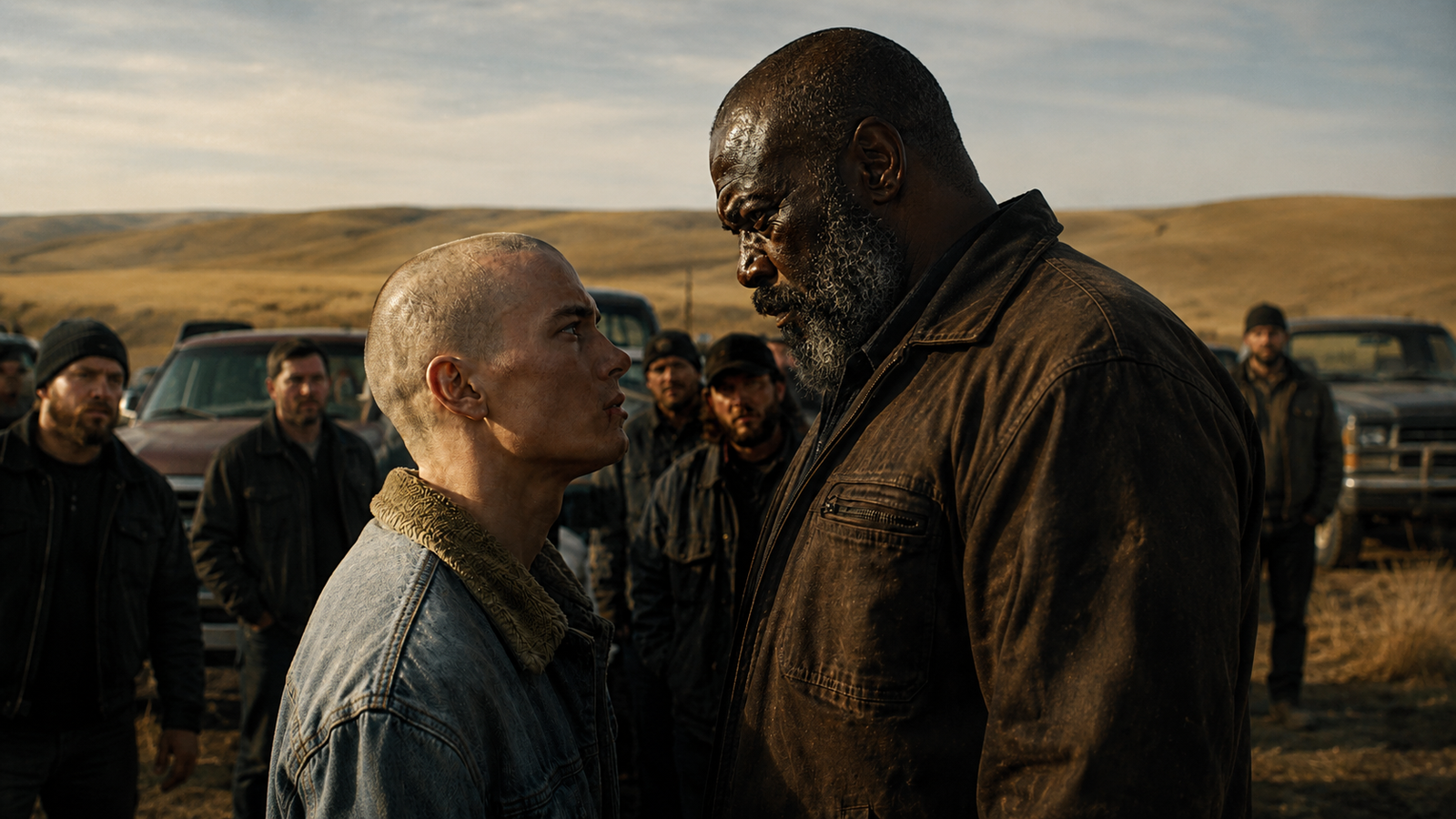
The first mistake they made was laughing at how slowly Otis Freeman walked.
Three men stood beside a black pickup at the edge of his fence, boots planted in the red dirt, arms crossed, faces smug under the hard morning sun.
Otis saw them before they called out.
He always saw things before people thought he did.
The broken fence wire.
The fresh tire marks near the south gate.
The way the tallest one kept his right hand close to his jacket.
The way the youngest one looked nervous, like he had come to scare an old man and was beginning to wonder why the old man wasn’t scared.
Otis kept walking.
One feed bucket in each hand.
Chickens scattered around his boots. His overalls strained across his broad stomach. Sweat darkened the collar of his faded work shirt.
To them, he looked like easy prey.
An old, heavyset Black farmer with bad knees and a tired face.
The tall man grinned.
“Morning, Otis. Still pretending this place belongs to you?”
Otis stopped beside the fence.
He did not raise his voice.
He did not tighten his hands.
He only looked at the three men and said, “It does belong to me.”
The man laughed.
“Not for long.”
Behind Otis, the old red barn stood quiet in the sunlight.
Inside that barn, hidden behind sacks of feed and rusted tools, was a locked wooden trunk he had not opened in sixteen years.
Inside the trunk was a folded Navy uniform.
A Silver Star.
A photograph of six men in desert camouflage.
And the name of the man Otis Freeman had been before this town decided he was just old, slow, and alone.
The Farm They Wanted
Otis Freeman woke every morning at 4:45.
Not 4:44.
Not 4:46.
4:45.
Old habits did not retire just because a man did.
He would sit on the edge of his bed for ten seconds before standing. Ten seconds to listen. Wind against the shutters. Pipes settling. The distant sound of cattle shifting in the pasture. His granddaughter Maya breathing softly in the room down the hall when she stayed over.
Then he would rise.
Slowly, yes.
But not weakly.
There was a difference.
At sixty-eight, Otis carried two hundred and eighty pounds on knees that had survived parachute jumps, desert marches, and one explosion outside Kandahar that left three inches of metal in his left thigh. People saw the weight first. Then the limp. Then the gray in his beard.
They never looked long enough to see the balance.
The stillness.
The way his eyes moved once and missed nothing.
Freeman Farm sat outside the small town of Bell Creek, Georgia, where the road narrowed between soybean fields and pine woods before ending at a hill crowned by the old family house. The land had belonged to the Freemans since 1926, when Otis’s grandfather bought the first twenty acres with money saved from years of sharecropping and night labor at a sawmill.
Every generation added something.
A barn.
A well.
A peach grove.
A strip of pasture.
A family cemetery beneath two oak trees.
Otis’s wife, Delia, was buried there.
So were his parents.
So was his son Aaron, who came home from Afghanistan with a folded flag and a silence that never fully left the house.
That land was not property to Otis.
It was memory with fence lines.
Which was why Clayton Rusk wanted it.
Clayton owned Rusk Development, though people in town still called it what it had always been: a family of bullies with money. His father had bought up half the failing farms along County Road 18 and turned them into warehouse lots, storage units, and cheap subdivisions with patriotic names like Liberty Grove and Heritage Pines.
Now Clayton wanted Freeman Farm.
Not because he loved the land.
Because the new highway expansion would run less than a mile from Otis’s east pasture. A distribution company had already made quiet inquiries. If Clayton could assemble enough acreage before the route was finalized, he would become very rich.
Otis had received three offers.
Then five.
Then a lawyer’s letter questioning an old boundary line.
Then a visit from a county inspector claiming the barn violated safety codes.
Then someone poisoned two of his dogs.
That was when Otis stopped pretending this was business.
The morning the men came to the fence, Maya was in the kitchen making biscuits from Delia’s recipe. She was seventeen, sharp-eyed, and angry in the way young people become when they realize adults can be cruel and still own suits.
She saw the truck through the window.
“Granddad.”
“I see them.”
“You want me to call Sheriff Boone?”
Otis picked up the feed buckets.
“Not yet.”
Maya frowned.
“They cut the south fence last week.”
“I know.”
“They left that note on the porch.”
“I know.”
“You can’t keep acting like this is nothing.”
Otis looked at her then.
Maya had her father’s eyes.
That still hurt sometimes.
“This is not nothing,” he said. “That’s why we don’t move foolish.”
She crossed her arms.
“They think you’re scared.”
Otis almost smiled.
“No. They think I should be.”
He went outside before she could argue.
The three men by the fence were Clayton’s kind of people. Not employees officially. Men like that were never official. They hung around gas stations, worked seasonal construction, drank too much, and liked being useful to powerful men who could make charges disappear.
The tall one was Wade Harlow.
Otis knew him.
Everyone did.
Wade had been trouble since high school and had mistaken not being stopped for being strong.
Beside him stood his cousin Brett and a younger man Otis did not recognize.
Wade leaned on the fence post.
“Fine morning.”
Otis poured feed in a clean arc.
“For some.”
Wade laughed.
“You always this rude to neighbors?”
“You’re not my neighbor.”
“Clayton says he made you a generous offer.”
“Clayton talks too much.”
Brett spat into the dirt.
“Old man, you got no idea what you’re sitting on.”
Otis looked at him.
“I know exactly what I’m standing on.”
Wade’s smile thinned.
“That sentimental stuff is cute. But sentiment doesn’t pay property tax. Doesn’t fix barns. Doesn’t stop accidents.”
Otis set the empty buckets down.
There it was.
Not hidden now.
Accidents.
He looked at Wade’s right hand again.
Still close to the jacket.
“You boys came all the way out here to threaten me before breakfast?”
Wade stepped closer to the fence.
“No threat. Friendly warning. Sell before something happens you can’t fix.”
Behind Otis, the porch door creaked.
Maya stood there with her phone in her hand.
Wade saw her and smiled.
“That your granddaughter? Pretty girl. Would be a shame for her to grow up watching this place fall apart.”
Otis did not move.
But something changed in the air.
The chickens stopped clucking.
Even Wade seemed to feel it, though he did not understand it.
Otis picked up the buckets.
“You ever mention my granddaughter again,” he said quietly, “you and I will have a different conversation.”
Wade laughed too loudly.
But his cousin did not.
The young man took half a step back.
Otis noticed.
Wade slapped the fence post.
“Think about the offer, old man. Next time we come, we might not be so polite.”
They climbed back into the truck.
As they drove away, dust rolled across the fence line.
Maya came down the porch steps, furious.
“You should’ve let me call.”
Otis watched the truck disappear around the bend.
“I need to know who all is with him first.”
“With Clayton?”
“With whoever is standing behind Clayton.”
Maya stared at him.
“What does that mean?”
Otis looked toward the road.
“It means men like Wade don’t wake up early unless someone pays them.”
That evening, Otis walked to the barn and opened the locked wooden trunk.
The hinges complained.
Dust rose.
For a long moment, he looked at the folded uniform inside.
Then he reached beneath it and took out an old field notebook wrapped in oilcloth.
On the first page was a lesson written in his own hand from another life.
Never react to the first threat.
Map the network.
Find the pressure point.
Then move.
The Men At The South Gate
Two days later, the south gate was open.
Otis found it at dawn.
The chain had not been cut this time.
It had been unlocked.
That bothered him more.
He checked the mud near the gate and crouched slowly, ignoring the complaint in his knee. Boot prints. Two men. One with a worn heel. One lighter, maybe the younger man from the truck.
Tire tracks stopped thirty feet inside the property.
No livestock missing.
No tools gone.
No broken windows.
That meant they had not come to steal.
They had come to look.
Otis followed the tracks to the old equipment shed. The padlock hung untouched, but the dirt beneath the window was disturbed.
He stood there for a long moment.
Then he looked toward the tree line.
A glint.
Small.
Too clean for morning dew.
Otis walked over and pushed aside the weeds.
A trail camera.
Not his.
Cheap model. Fresh batteries. Angled toward the house and the barn.
He removed it without breaking it.
Back inside, Maya was pouring coffee when he placed the camera on the kitchen table.
Her face went pale.
“They’re watching us?”
“They were.”
“We need police.”
Otis sat down.
“We need evidence.”
“That is evidence.”
“It proves trespassing. Maybe harassment. Not who paid for it.”
Maya slammed the mug down.
“You keep talking like this is a mission.”
Otis looked at the camera.
“Because it is.”
She stared at him.
Maya knew her grandfather had been in the Navy. She knew he kept old medals in the barn. She knew he did not talk about war, and the family had learned not to push.
But she did not know everything.
Delia had known.
Aaron had known pieces.
The rest of town knew almost nothing, which suited Otis just fine.
A man who has done violent work for his country does not always want that work turned into personality. Otis had spent decades becoming a farmer again. He liked seeds, rain, fence repair, church fish fries, and the sound of Maya laughing on the porch.
He did not miss being Commander Freeman.
But men like Wade Harlow had a way of waking old ghosts.
That afternoon, Otis drove into town.
Bell Creek looked peaceful if you didn’t know how to read it. White courthouse. Brick shops. Flags along Main Street. A diner with peach pie cooling in the window. Men sitting outside the hardware store pretending not to discuss everybody’s business.
Otis parked near the county records office.
Inside, a young clerk with pink nails looked surprised when he requested property filings for parcels surrounding Freeman Farm.
“That may take a while, Mr. Freeman.”
“I brought lunch.”
He sat at a public computer for four hours.
Slow.
Patient.
Careful.
By the time he left, he had printed twenty-three pages.
Clayton Rusk had formed three shell companies over the past year. Each had purchased small parcels around Otis’s land. One had filed a petition challenging the old creek boundary. Another had applied for zoning consideration near the proposed highway route.
The third company interested Otis most.
Hollow Ridge Agricultural Partners.
Listed address: a law office in Atlanta.
Registered agent: Thomas Vale.
Otis knew that name.
Not personally.
But from his son’s old paperwork.
Aaron had worked after deployment as a county surveyor before his death. He had been investigating irregular land transfers near Bell Creek. Otis remembered late nights. Phone calls. Aaron saying, “Something’s wrong with these easements, Pop.”
Then Aaron died in a single-car crash on a wet road.
Everyone called it tragic.
Otis had called it unfinished.
He drove home with the documents in a folder on the passenger seat.
When he reached the farm, Maya was on the porch.
Not standing.
Frozen.
The front door was open behind her.
“What happened?” Otis asked.
She pointed inside.
The kitchen had been torn apart.
Cabinets open.
Drawers dumped.
Papers scattered.
Delia’s old recipe box smashed on the floor.
But nothing valuable was gone.
Otis moved room to room.
No forced entry at the front.
Back window unlatched.
Muddy boot print beneath it.
They had searched the house.
For what?
Then Maya cried out from the hallway.
Otis turned.
She was holding a framed photograph.
Aaron’s old survey crew picture.
The glass had been broken. The photo removed, then shoved back crookedly.
Otis took it gently.
Behind the photo, where the cardboard backing had been loosened, was a folded map.
Aaron’s handwriting covered the margin.
Dad — if something happens, look at the creek line. Rusk is not the top.
Otis stood very still.
Maya read the note over his shoulder.
Her voice came out small.
“Granddad… Dad knew?”
Otis closed his eyes.
Aaron had not been paranoid.
Aaron had been close.
And now, years later, the same men had come back for the land, the map, and whatever truth his son had died trying to reach.
Outside, near the south pasture, a crow lifted from the fence and disappeared into the trees.
Otis opened his eyes.
The mission had changed.
This was no longer just about saving the farm.
This was about finding out who had already killed for it.
The Farmer They Misread
Sheriff Boone arrived an hour later.
He was not a bad man.
That was the problem.
Bad men are easier. You know where they stand.
Boone was decent in the way small-town officials often are when decency costs nothing. He went to church. Helped at fundraisers. Called Otis “sir.” Sent flowers when Delia died.
But he also played golf with Clayton Rusk.
He also owed campaign money to half the men buying up land along the highway route.
And when he walked through Otis’s ransacked kitchen, his mouth tightened not with outrage, but discomfort.
“Could be kids,” Boone said.
Maya nearly exploded.
“Kids looking for property maps behind family photographs?”
Boone glanced at her.
“Miss Maya, I understand you’re upset.”
Otis put a hand on her shoulder.
“Let him work.”
The sheriff looked relieved.
Otis saw that too.
Boone took notes. Photographed the muddy print. Bagged nothing. Promised patrols would “keep an eye out.”
When Otis showed him the trail camera, Boone frowned.
“You touch it?”
“I removed it from my land.”
“Might be harder to process now.”
Otis stared at him.
Boone looked away first.
“What about Wade Harlow?” Otis asked.
Boone sighed.
“Otis…”
“He threatened my family.”
“You got proof?”
“Maya heard him.”
“Family witness.”
The silence that followed was not empty.
It was full of things Boone did not want to say.
Otis nodded slowly.
“I see.”
Boone shifted his weight.
“Look, between us, Clayton can be aggressive. But he’s business-minded. If you sit down with him—”
“You telling me to sell?”
“I’m telling you to think about your granddaughter.”
Maya stepped forward.
“My grandfather is thinking about me. That’s why he won’t sell.”
Boone’s face flushed.
Otis almost smiled.
Delia would have liked that.
After the sheriff left, Maya turned on Otis.
“He’s not going to help.”
“No.”
“You knew that before he came.”
“Yes.”
“Then why call?”
Otis picked up the broken recipe box and began gathering Delia’s cards.
“Because now we know.”
“What?”
“Who won’t help.”
That night, Otis did something he had not done in years.
He made calls.
The first was to a man named Luis Ortega, who owned a private security firm in Savannah and still answered the phone with, “Freeman, if this is about poker money, I deny everything.”
The second was to Danielle Mercer, a retired intelligence analyst who now taught cybersecurity workshops to bored executives and occasionally helped old friends who asked politely.
The third was to Reggie Cole, who had served with Otis in places none of them discussed and now ran a trucking company with better surveillance equipment than most police departments.
By midnight, Otis had three favors in motion.
By morning, he had cameras hidden along the property line, a background search running on Hollow Ridge Agricultural Partners, and Reggie’s nephew parked two miles down the road in a utility van with a long lens and a thermos of coffee.
Maya watched all of this with growing disbelief.
“You just have people?”
Otis was cleaning an old shotgun at the kitchen table.
“I know people.”
“What kind of people?”
“Useful people.”
She sat across from him.
“You were more than Navy, weren’t you?”
Otis did not answer right away.
Rain tapped against the window.
He could hear Delia’s voice in his head.
Tell her enough. Not all. Enough.
“I was a SEAL,” he said.
Maya stared.
“A Navy SEAL?”
“Yes.”
“For real?”
“No, baby. I’ve been lying for dramatic effect.”
Despite everything, she laughed once.
Then her face changed.
“Did Dad know?”
“Yes.”
“Why didn’t anyone tell me?”
“Because I wanted you to know me as your granddad. Not as what I used to be.”
She looked at the shotgun.
“And what are you now?”
Otis met her eyes.
“The same thing I’ve always been when somebody comes for my family.”
The next threat came Friday.
Not at dawn.
Not quietly.
At noon.
A convoy of three trucks rolled up the main drive while Otis was repairing the barn door. Clayton Rusk stepped out of the lead truck wearing pressed jeans, polished boots, and a smile that belonged in a courtroom.
Wade and four others climbed out behind him.
Clayton removed his sunglasses.
“Otis. We need to talk.”
Otis kept working the hinge.
“You know where the mailbox is.”
Clayton laughed softly.
“Still stubborn.”
“Still trespassing.”
Clayton’s smile faded.
“I tried being respectful.”
Otis looked at the men behind him.
“This what respect looks like now?”
Clayton stepped closer.
“This farm is going under one way or another. You can get paid, or you can get buried in legal fees until the county takes it for taxes. I’m offering you dignity.”
Otis set down the wrench.
“Dignity doesn’t come from men who send dogs to my fence.”
Wade’s eyes flickered.
Clayton did not react.
“You’re making accusations now.”
“I’m making notes.”
Clayton tilted his head.
“You think that military stare scares me? I know all about you, Commander Freeman.”
Otis went still.
Clayton smiled again.
“There it is. You thought nobody knew. Retired hero hiding out with chickens. Cute story.”
Maya appeared on the porch.
Otis saw Clayton notice her.
Saw the calculation.
Saw Wade shift.
Clayton said, “Last chance. Sign the sale agreement by Monday. After that, things get complicated.”
Otis walked toward him.
Slowly.
Every man in Clayton’s group tensed.
Otis stopped three feet away.
“You tell whoever is behind you,” he said, “that I found Aaron’s map.”
Clayton’s face changed.
Not much.
Enough.
Then Otis said, “And tell Thomas Vale I remember names.”
Clayton’s smile vanished completely.
For the first time since the fight began, he looked afraid.
Not of Otis’s size.
Not of his past.
Of what Otis knew.
The convoy left five minutes later.
Maya ran down from the porch.
“What did you just do?”
Otis watched the trucks disappear.
“I told the snake we found the hole.”
“And now?”
Otis picked up the wrench again.
“Now we wait for it to come out.”
The Night They Came For The Barn
They came during a storm.
Otis expected that.
Thunder covers engines. Rain softens footprints. Lightning makes cameras unreliable if men don’t know where the backup sensors are.
But Otis knew where the sensors were.
He had placed them himself.
At 1:17 a.m., the small monitor beside his bed flashed.
South gate.
Three heat signatures.
Then two more.
Then headlights killed before the bend.
Otis sat up.
For ten seconds, he listened.
Rain on roof.
Wind through trees.
Maya breathing down the hall.
A truck door closing too gently.
He stood and dressed without turning on a light.
In the hallway, Maya opened her door before he knocked.
“I heard the alert.”
Her voice was steady.
Too steady.
Otis handed her a phone.
“Go to the safe room.”
“I’m not leaving you.”
“This is not a debate.”
“Granddad—”
He put both hands on her shoulders.
“The brave thing is not always staying. Sometimes it’s doing exactly what keeps you alive.”
Her eyes filled with angry tears.
“I hate this.”
“I know.”
She took the phone.
“What are you going to do?”
Otis looked toward the window.
A flash of lightning revealed shapes moving near the barn.
“I’m going to have a conversation.”
The safe room was Delia’s old pantry, reinforced after Aaron died because Otis had never liked how many windows the house had. Maya locked herself inside with a shotgun she knew how to use, a radio, and direct lines to Reggie’s van, Luis Ortega’s team, and Danielle’s cloud backup.
Otis stepped onto the porch carrying no visible weapon.
That was important.
Men like Wade wanted a story.
Old farmer attacks local men.
Dispute turns violent.
Tragic shooting.
Otis had no intention of giving them an easy headline.
He crossed the yard in the rain.
The barn doors stood open.
A lantern glowed inside.
Five men moved between feed sacks and tools, searching. Wade was there. Brett too. The young nervous one from the first day. Two others Otis recognized from Clayton’s construction sites.
One held a gas can.
That disappointed Otis.
Not surprised him.
Disappointed him.
Wade turned when Otis stepped into the barn.
“Well, look who woke up.”
Otis glanced at the gas can.
“You boys planning to burn wet wood?”
Brett lifted a crowbar.
“We’re planning to end this.”
The young man whispered, “Wade, he’s not supposed to be here.”
Otis looked at him.
“What’s your name?”
The young man swallowed.
“Shut up, Tyler,” Wade snapped.
Tyler.
Otis stored it.
Names matter.
Wade stepped forward.
“You should’ve taken the money.”
“You should’ve finished school.”
Brett lunged first.
That was predictable.
Men with crowbars often believe the crowbar is the plan.
Otis moved half a step left.
Not fast like a young man.
Efficient like an old one who knew exactly how much movement was necessary.
Brett’s swing missed. Otis caught his wrist, turned it, and used the man’s own momentum to drive him face-first into a stack of feed sacks. The crowbar dropped.
Wade froze.
The others did too.
Otis picked up the crowbar and tossed it aside.
“You can still leave.”
Wade pulled a pistol.
There it was.
The line.
Otis raised his hands slowly.
“Bad choice.”
Wade’s mouth twitched.
“Not from where I’m standing.”
“You sure?”
A red dot appeared on Wade’s chest.
Then another.
Then one on the man with the gas can.
Reggie’s nephew had a rifle from the tree line. Luis’s team had arrived along the creek road. Small drones hummed above the barn roof, invisible in the rain until lightning caught them.
Wade looked down at the red dot.
His confidence drained.
“What the hell?”
Otis’s voice stayed calm.
“You boys are being recorded from six angles. Audio too. The gas can. The gun. The forced entry. Everything.”
Brett groaned from the floor.
Tyler dropped to his knees.
“I didn’t know they were going to burn it,” he said quickly. “I swear. Clayton said just scare him.”
Wade swung the pistol toward Tyler.
Otis moved.
Three steps.
A grip.
A twist.
The gun hit the dirt.
Wade hit the wall.
By the time thunder rolled again, Otis had him pinned with one forearm across his chest and the pistol kicked behind a water trough.
He leaned close.
“You mentioned my granddaughter.”
Wade’s eyes widened.
“I didn’t—”
“You did.”
Otis pressed just enough for Wade to feel how easily more could come.
Then he let go.
Because rage is not discipline.
And discipline was the only reason Wade was still conscious.
Sirens sounded faintly beyond the storm.
Not Sheriff Boone’s.
State police.
Danielle had made sure the call bypassed Bell Creek dispatch after Reggie’s cameras captured the gas can.
Otis stepped back.
The men were on the ground now, hands visible, rain blowing through the open barn doors.
Tyler was crying.
Wade was cursing.
Brett was bleeding from his nose.
The gas can lay on its side, unopened.
Otis looked at them and felt no triumph.
Only exhaustion.
He had spent years trying to become a man who mended fences instead of breaking bodies.
Then Clayton Rusk and whoever stood behind him had brought war to his barn.
State troopers arrived in four vehicles.
Behind them came an unmarked SUV.
A woman stepped out in a dark raincoat, badge clipped to her belt.
“Commander Freeman?”
Otis turned.
“Retired.”
“Special Agent Harris, state bureau.”
“You’re early.”
She looked at the men on the ground.
“Looks like we’re right on time.”
Wade lifted his head.
“Clayton sent us! It was Clayton!”
Otis looked at Agent Harris.
She smiled slightly.
“We were hoping he’d say that.”
From the porch, Maya emerged with the shotgun lowered at her side.
Otis saw her face.
Fear.
Relief.
Pride.
And something else.
Understanding.
He was not just her old grandfather anymore.
He was still that.
But now she had seen the shadow behind him.
The man he had been.
The man he had kept buried so she could grow up in peace.
Agent Harris approached Otis and held out a sealed evidence bag.
Inside was a copy of Aaron’s old map.
“We need to talk about your son.”
Otis’s chest tightened.
Because the barn was safe.
The farm was standing.
But the night had not ended.
It had only opened the case Aaron Freeman died trying to prove.
The Map Aaron Left Behind
Clayton Rusk was arrested at 6:40 the next morning.
Not at his office.
Not at home.
At a private airstrip twenty miles outside Bell Creek with a duffel bag, two phones, and fifty thousand dollars in cash.
Men like Clayton always planned exits.
They rarely planned them well enough.
Wade talked before breakfast. Brett talked before lunch. Tyler talked the moment someone offered him coffee and told him arson carried real prison time.
By evening, the story Clayton had built began collapsing.
He had hired Wade’s group to intimidate Otis. He had authorized the break-in to search for “documents.” He had ordered the barn burned if they found nothing useful.
But Clayton was not the top.
Aaron’s map had been right.
Thomas Vale was.
Vale was a lawyer, lobbyist, and silent investor with ties to the highway expansion committee. He had used shell companies to buy land around Bell Creek before the route was public. Clayton was his local hammer. Sheriff Boone was his insurance. County inspectors were pressure tools.
Aaron had discovered the pattern years earlier while working as a surveyor.
He found altered easements.
Backdated filings.
Boundary shifts that would make Freeman Farm appear partially encroached on county development land.
Then he died on a wet road after his brake line failed.
At the time, it was ruled an accident.
Agent Harris did not say murder at first.
Investigators rarely give grief the word it wants before evidence can carry it.
But she said enough.
“Your son’s case is being reopened.”
Otis sat at his kitchen table.
Maya sat beside him, holding his hand.
For years, Otis had carried suspicion like a stone in his chest. Too heavy to forget. Too unproven to share.
Now someone had finally placed that stone on the table and called it evidence.
“What do you need from me?” he asked.
Agent Harris slid Aaron’s map forward.
“Everything you remember.”
So Otis told her.
About Aaron’s late-night calls.
The files hidden behind the photograph.
The name Thomas Vale.
The county clerk who retired suddenly after Aaron died.
The mechanic who said the brake line looked “funny” but changed his statement after a visit from men he would not name.
He told her about Clayton’s threat.
Wade’s mention of Maya.
The trail camera.
The break-in.
The barn.
He did not dramatize.
He did not rage.
He gave facts.
Clean.
Ordered.
Precise.
Like a mission report.
Maya cried silently through parts of it.
Otis did not.
Not until Agent Harris asked about Aaron’s last words to him.
Then the old soldier disappeared.
The father remained.
Otis looked at the table.
“He said, ‘Pop, if I’m wrong, laugh at me later.’”
His voice broke.
“I never got to laugh.”
Maya leaned into him.
Agent Harris looked down at her notes.
The investigation took seven months.
Vale fought hard.
Men like him do not threaten directly. They bury intent under contracts, calls through intermediaries, plausible deniability, and charitable donations to the right campaigns.
But Wade had recordings.
Clayton had emails.
Sheriff Boone had bank deposits he could not explain.
And Danielle Mercer found deleted files in a cloud server tied to Hollow Ridge Agricultural Partners that included scans of Aaron’s survey notes, internal messages about “neutralizing Freeman resistance,” and one line that made Otis leave the room when he read it.
The son was handled. The father may be more difficult.
Handled.
That was the word they used for Aaron.
Not killed.
Not murdered.
Handled.
As if he were a permit problem.
A zoning objection.
A loose fence board.
Sheriff Boone resigned before indictment.
Clayton pleaded guilty and testified.
Thomas Vale went to trial.
For weeks, Bell Creek watched men in suits explain how corruption works when it wears respectable shoes. Land fraud. Bribery. Conspiracy. Arson solicitation. Obstruction. And finally, after new forensic analysis and testimony from the mechanic, charges connected to Aaron’s death.
The verdict came on a gray Thursday.
Guilty on most counts.
Not all.
The law rarely gives the dead a perfect answer.
But it gave Aaron enough.
After court, reporters crowded the steps.
They wanted Otis to speak.
Heavyset Black farmer targeted by gang.
Former Navy SEAL defends family land.
Hero grandfather exposes corruption.
They had their headlines ready.
Otis hated every one.
Maya squeezed his hand.
“You don’t have to.”
“I know.”
But he stepped to the microphones anyway.
Not for the reporters.
For Aaron.
For Delia.
For his grandfather, who bought land nobody thought a Black man would keep.
For every farmer pressured by men who called theft development.
Otis looked into the cameras.
“My son Aaron Freeman died trying to protect this land and this town from men who thought money made them owners of everything they could see.”
His voice was steady.
“They underestimated him. Then they underestimated me.”
A reporter shouted, “Mr. Freeman, is it true you were a Navy SEAL?”
Otis looked at her.
“Yes.”
“Did your training save you?”
He paused.
Then said, “My training helped. But this farm was saved by my family, my neighbors who finally spoke, and a granddaughter who refused to let fear be called peace.”
Maya cried then.
So did a few people in the crowd.
Otis continued.
“I don’t want this story to be about violence. Violence came to my barn because greed sent it there. I want this story to be about what happens when ordinary people stop letting powerful men write the truth alone.”
Then he stepped away.
That night, Bell Creek held a gathering at Freeman Farm.
Not a celebration exactly.
Something quieter.
Neighbors brought food. Mrs. Caruso from the diner brought peach pies. Reggie came from Savannah with half his family. Luis Ortega brought a repaired section of fence, because he said warriors should bring practical gifts.
Even Sheriff Boone’s wife came, though Boone did not.
She left a casserole on the porch and cried when Otis thanked her.
At sunset, Otis walked to the family cemetery with Maya.
They stood before Aaron’s grave.
The grass was damp.
The air smelled of rain and cut hay.
Maya placed a copy of the court verdict beside the stone, sealed in plastic because she said her father deserved paperwork for once that told the truth.
Otis almost laughed.
Then he did cry.
Quietly.
One hand on his son’s headstone.
Maya wrapped both arms around him.
For a long time, neither spoke.
Finally, Otis said, “He was right.”
Maya wiped her face.
“About what?”
Otis looked toward the fields.
“If he was wrong, I was supposed to laugh at him later.”
A small smile broke through her tears.
“He wasn’t wrong.”
“No.”
The sun dropped behind the barn, turning the old red boards gold.
Otis looked at the house, the fences, the pasture, the peach trees, the land that had carried his family through nearly a century of storms.
People thought strength meant fighting.
Sometimes it did.
But sometimes strength was staying.
Planting again.
Repairing what men tried to burn.
Teaching a child the names of every tree on land others tried to steal.
The next morning, Otis woke at 4:45.
Not 4:44.
Not 4:46.
He sat on the edge of his bed and listened.
Wind against the shutters.
Cattle in the pasture.
Maya moving in the kitchen, probably burning biscuits and pretending she wasn’t.
He stood slowly.
His knees hurt.
His back hurt.
His heart hurt too, but differently now.
Not less.
Cleaner.
Outside, the south fence waited for repair.
Otis picked up his tools and walked into the morning light.
At the edge of the pasture, he stopped near the post Wade had leaned against weeks earlier.
The dirt was quiet now.
No tire tracks.
No threats.
No men laughing at how slowly he moved.
Otis drove the first nail into the fence board.
Then another.
Steady.
Measured.
Alive.
Behind him, Maya called from the porch, “Granddad! Breakfast!”
He looked back at the house.
At his granddaughter.
At the land.
At everything greed had failed to take.
Then Otis Freeman smiled.
Not like a soldier.
Not like a hero.
Like a farmer.
And he went home.