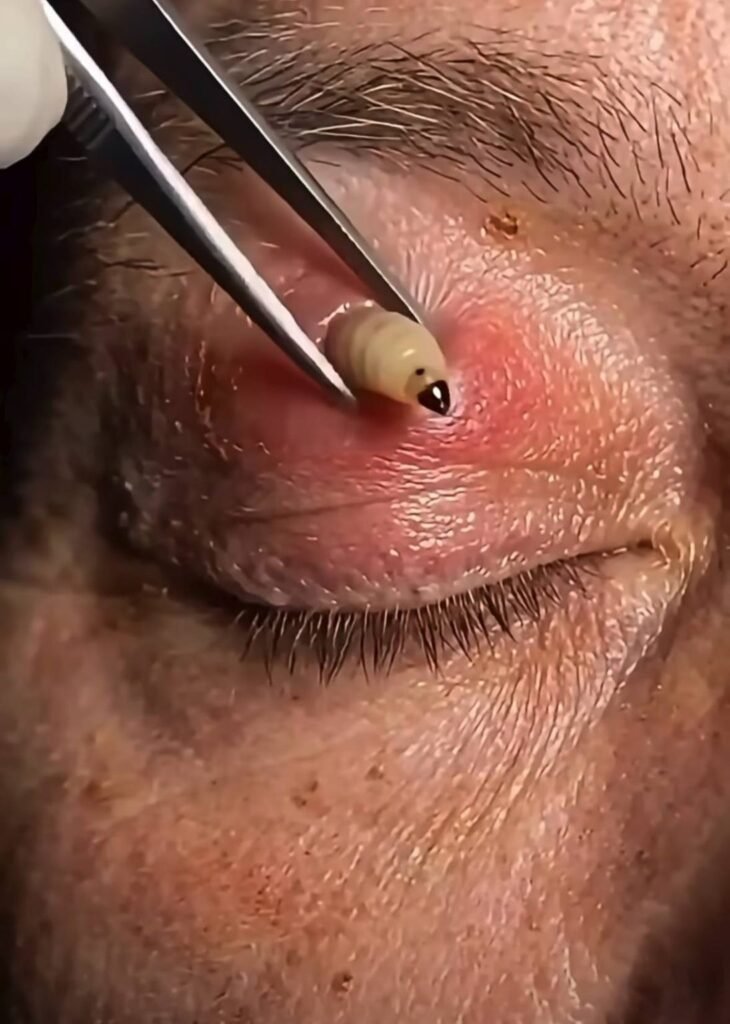
An extremely close-up view of a human eye area reveals a small, pale-colored cylindrical object protruding from a swollen, reddened bump on the upper eyelid. The skin surrounding the affected area appears irritated, slightly raised, and inflamed, with a noticeable difference in color and texture compared to the surrounding skin. The unusual object has a smooth, cream-colored surface, a rounded body, and a darker tip that stands out against the reddened skin beneath it. Its position near the eyelid creates a visually striking and unusual scene.
A pair of narrow metal tweezers enters the frame from the upper left, carefully positioned around the pale object. The tweezers have reflective silver edges that catch the light, making their shape and fine tips clearly visible. One side appears to support the object, while the other approaches it from above, suggesting a delicate attempt to grasp and remove it. The object is located directly on the irritated skin, near the natural crease of the upper eyelid, creating a highly detailed and visually intense close-up scene.
The camera captures the scene from an extremely short distance, revealing even the smallest characteristics of the skin. Fine lines, tiny pores, subtle wrinkles, and individual eyelashes are visible in extraordinary detail. The upper eyelid appears swollen and shiny under the intense lighting, while the surrounding skin displays natural variations in tone, including warm brown, reddish hues, and slightly darker areas. The contrast between the red, swollen region and the pale object immediately draws attention to the center of the image.
At the top of the frame, short, dark eyebrow hairs can be seen growing in different directions, creating a natural, irregular texture. Some hairs overlap visually, while others lie close to the surface of the skin. A small brown spot is also visible above the irritated area, adding another distinctive detail to the surrounding skin. The eyebrow region is sharply focused, with each individual hair clearly distinguishable.
Below the swollen area, a row of dark eyelashes follows the natural curve of the closed eyelid. The eyelashes vary slightly in length and direction: some point downward, while others extend outward. Their dark color contrasts with the lighter skin directly above them. The eyelid remains closed, and the visible portion of the eye is hidden by the natural skin fold and the camera’s position.
The lighting is intense and direct, concentrated primarily on the central area of the image. It creates small highlights on the skin’s surface, emphasizing its natural texture and the slightly moist appearance of the swollen region. The metal tweezers reflect the light along their narrow edges, while the pale object remains clearly distinguishable from the surrounding reddish skin. Shadows form beneath the tweezers and around the raised bump, adding a greater sense of depth to this close-up image.
The composition is tightly framed, leaving very little empty space around the subject. The swollen eyelid occupies most of the image, while the tweezers and the small pale object serve as the primary focal points. The camera angle is slightly diagonal, with the metal instrument entering from above and directing the viewer’s attention toward the center of the irritated area. The extremely short distance makes the scene feel immediate and detailed, as though the viewer were observing a delicate procedure from just a few centimeters away.
The image features a combination of natural skin tones, warm highlights, redness, dark eyelashes, and shiny metallic surfaces. Every visible element contributes to the appearance of a highly detailed medical close-up. The pale object contrasts sharply with the surrounding skin, while the redness and swelling make the affected area stand out visually. The image has a highly realistic and detailed appearance, capturing the texture of the skin, the tiny hairs around the eye, the delicate folds of the eyelid, and the precise positioning of the tweezers.
The central element remains the small, pale object that appears to protrude from the swollen area of the eyelid. Its rounded shape, smooth surface, and dark tip are clearly visible in this close-up, although its exact nature cannot be determined from the image alone. The tweezers are positioned immediately around it, suggesting that the person handling the instrument is attempting to grasp it carefully. The scene is presented without a wider background, keeping all attention focused on the eye area and the unusual detail at its center.
Overall, this is an extremely magnified and sharply focused image of a human eyelid, showing irritated skin, fine eyebrow hairs, dark eyelashes, a small pale object, and metal tweezers positioned around it. The intense lighting, tight framing, realistic skin texture, and contrast between the different surfaces make the image visually striking. The photograph focuses exclusively on the physical details of the area, allowing the viewer to observe the unusual object and the surrounding skin without distractions from other elements or the background.