

Few songs in the history of popular music manage to bridge the ancient and the modern as seamlessly as “Rivers of Babylon.” When Boney M released the track in 1978, the group transformed a passage from the Hebrew scriptures into one of the most recognizable disco anthems ever recorded, reaching audiences that stretched far beyond the dance floors of Europe.
The song draws its lyrics almost entirely from Psalm 137, a text composed during the Babylonian exile of the sixth century BCE. The psalm describes the grief of the Israelites who were forcibly displaced from Jerusalem and forced to live as captives in Babylon.
Its opening lines — describing sitting by the rivers and weeping at the memory of Zion — carry a weight of collective mourning that has resonated across centuries and cultures.
Boney M was a Caribbean-influenced Eurodisco group assembled by German producer Frank Farian in Frankfurt during the mid-1970s. The ensemble featured vocalists Liz Mitchell, Marcia Barrett, Maizie Williams, and Bobby Farrell, whose combination of West Indian musical sensibilities and Farian’s polished production style created a sound that was simultaneously danceable and emotionally layered. Mitchell, a Jamaican-born singer, became closely associated with lead vocal duties on many of the group’s most celebrated tracks.
“Rivers of Babylon” was originally recorded by Jamaican vocal group The Melodians in 1970, drawing directly from both Psalm 137 and Psalm 19. The Melodians’ version, rooted in reggae and rocksteady traditions, became a beloved track in the Caribbean and gained wider attention after appearing on the soundtrack to the 1972 film The Harder They Come, which introduced Jamaican music to international audiences.
▶ Watch the full video below
If the video doesn’t load, watch it directly on YouTube.

When Boney M adapted the song eight years later, they retained the spiritual gravity of the original while reshaping it within the energy of late-1970s Eurodisco.
The 1978 recording reached number one on the UK Singles Chart, where it remained for five weeks. It spent a total of 40 weeks on the chart, a record at the time that underscored just how deeply the song embedded itself in the listening habits of an entire era. Across Europe, Australia, and beyond, the track became one of the defining commercial and cultural moments of the late disco period.
What made the arrangement work was its restraint. Farian’s production did not overwhelm the lyrical content with instrumentation. Instead, the string arrangements, the rhythmic pulse, and Mitchell’s vocal delivery created space for the words to register — something genuinely unusual in an era when production often prioritized spectacle over substance. Listeners who might not have known the biblical source material could still feel the song’s undertone of longing and displacement.
Liz Mitchell’s vocal performance sits at the center of the track’s enduring appeal. Her voice carries both warmth and gravity, navigating the song’s spiritual dimension without tipping into melodrama.
The harmonies provided by Barrett and Williams give the recording a choral quality that subtly reinforces the communal nature of the psalm’s subject matter — a people mourning together, not an individual in isolation.
▶ Watch the full video below
If the video doesn’t load, watch it directly on YouTube.
The song’s crossover success was notable not only for its chart performance but for the conversations it opened. Audiences encountered a biblical text set to disco rhythm and responded with something deeper than mere enjoyment.
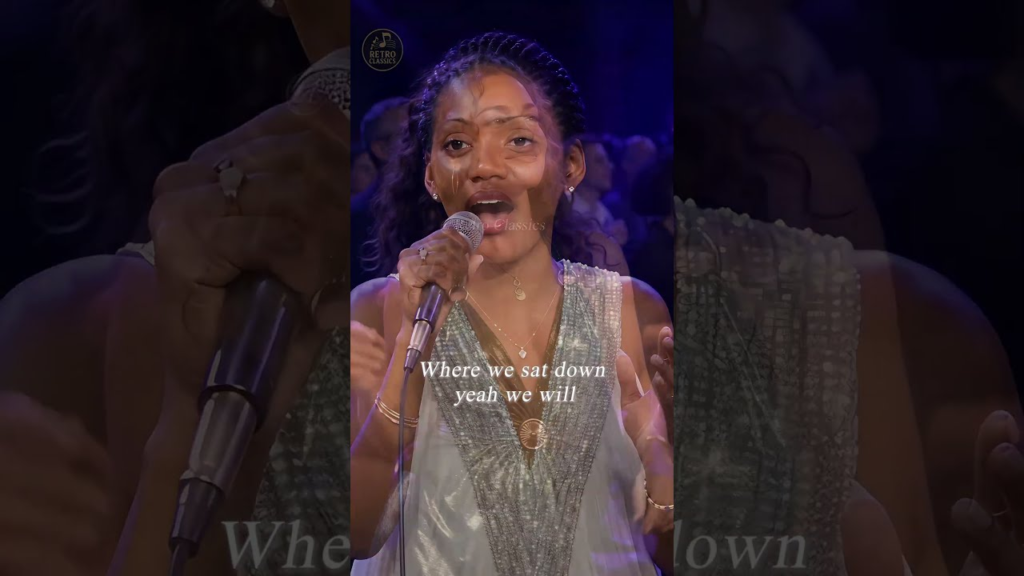
Comments and listener reactions across decades reflect the same pattern seen with the Retro Classics upload, where viewers invoke scripture, spiritual reflection, and cross-language appreciation in roughly equal measure — a remarkable response to what the music industry might have categorized simply as a pop single.
Boney M’s popularity peaked between 1976 and 1982, a period in which the group produced a string of internationally successful recordings including “Rasputin,” “Ma Baker,” and “Sunny.” “Rivers of Babylon” remains among their most performed and recognized works, and its inclusion in retrospective compilations, film soundtracks, and karaoke catalogues across subsequent decades speaks to its durability as a cultural object.
The song also carries particular significance within discussions of diaspora music. Its movement from a biblical psalm to a Jamaican reggae adaptation and then to a European disco h.i.t traces a path of musical transmission that mirrors the movement of peoples and ideas across time and geography. Each iteration preserves the emotional core of the original while translating it into the sonic language of a different moment and community.
▶ Watch the full video below
If the video doesn’t load, watch it directly on YouTube.

For younger audiences encountering the song through platforms like YouTube, “Rivers of Babylon” often serves as a point of entry into both music history and biblical literature.
The Retro Classics channel version, featuring an AI-generated visual performance, has drawn hundreds of thousands of views and multilingual commentary, suggesting that the song continues to reach listeners across generational and linguistic boundaries in ways that few tracks from the same era have managed.
The arrangement’s accessibility — built on a melody that is immediately memorable and lyrics that are simple enough to follow yet layered enough to repay closer attention — makes the track particularly well suited to the kind of communal listening experience that streaming platforms now facilitate.
Audiences sing along, share the video across networks, and return to it in moments when the song’s themes of longing and spiritual searching feel personally relevant.
“Rivers of Babylon” is, in this sense, more than a disco classic. It is a document of how music carries meaning across time, how a lament composed in captivity thousands of years ago can find its way into a recording studio in Frankfurt, onto the charts of dozens of countries, and into the listening queues of audiences who may know nothing of its origin but recognize its emotional truth immediately. The full performance of this timeless track is in the video below.