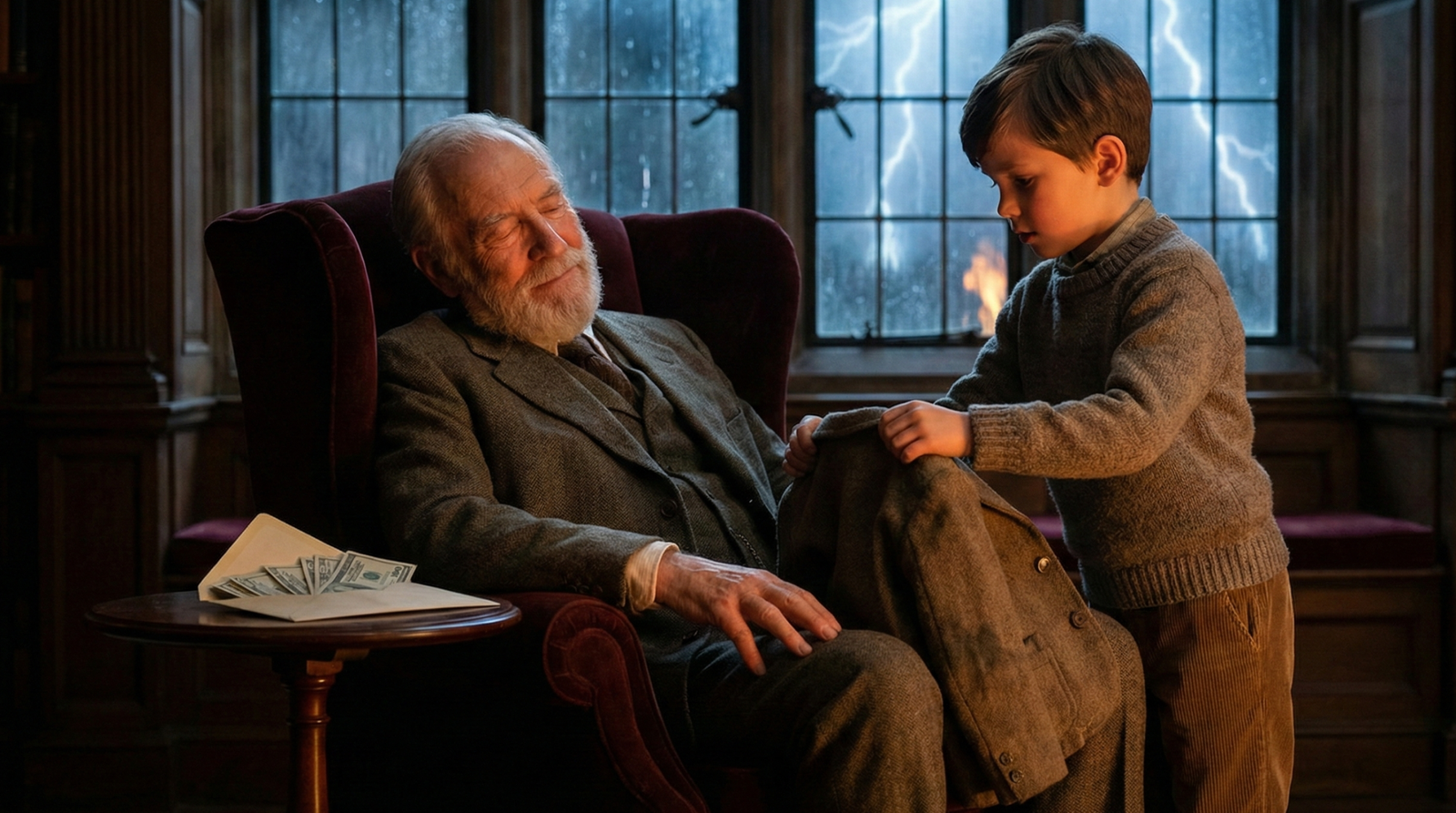
His eyes were closed, his breathing slow and even, his thin body settled deep into the burgundy velvet of his favorite wingback chair. To anyone glancing in, he looked like a fragile old man lost in an afternoon nap while rain tapped steadily against the tall windows.
But behind those closed lids, Charles was alert. Counting seconds. Listening.
At seventy-seven, Charles Whitaker was a titan of industry. His name crowned skyscrapers, cargo ships, and tech foundations across the country. He possessed wealth beyond measure—estates, power, influence. Yet there was one thing he did not possess: trust.
Time had hardened him. His grown children visited only to discuss inheritance. Business partners smiled while calculating advantage. Employees had disappointed him with small thefts and quiet betrayals.
Over the years, Charles had formed a cold belief: give anyone the chance to take something valuable unseen, and they will take it. No exceptions.
This stormy afternoon, he intended to prove it again.
The library had been arranged like a stage. The fireplace glowed softly. Thunder rattled the windows. On the small mahogany table beside his chair lay the bait: an open cream envelope stuffed with crisp hundred-dollar bills—five thousand dollars. Carelessly placed, as if forgotten by a senile old man.
To Charles, it was nothing. To most, it was salvation.
He heard the doorknob turn.
It was Maria Lopez, his newest housekeeper, employed for barely three weeks. Young, widowed, worn by hardship. Her husband had died in a warehouse accident, leaving her with debt and a seven-year-old son.
Schools had closed because of the storm, and her apartment roof leaked. With no babysitter, she had begged permission to bring her child.
“Stay here, Ethan,” Maria whispered anxiously. “Sit on the rug. Don’t move. Don’t touch anything. Mr. Whitaker is sleeping.”
“Yes, Mom,” came the obedient reply.
“If I lose this job, we won’t have anywhere to go tonight,” she added, voice trembling.
Charles listened as she left the room.
Now only two remained: the wealthy man pretending to sleep and the poor child alone with temptation.
Silence stretched. The clock ticked. Firewood cracked.
For several minutes Ethan didn’t move. Charles felt a flicker of grim satisfaction. The boy would wait. He would make sure the old man was truly asleep.
Then came the faint rustle of movement.
Here it is, Charles thought bitterly.
Small, careful footsteps approached. The boy was close now—so close Charles could sense him beside the chair. The envelope lay inches from Ethan’s hand.
Charles braced for the quick snatch.
Instead, he heard a soft sound.
Zzzzip.
A zipper.
Confusion flickered through Charles’s mind. What is he doing?
He felt fabric shift.
Then something warm settled gently over his legs.
It was a jacket—thin, slightly damp from rain but still holding a child’s body heat. Ethan was covering him.
Charles’s thoughts stalled.
“Your hands are cold, sir,” Ethan whispered softly. “My mom says old people get sick easy.”
The words pierced through years of cynicism.
“Don’t die,” the boy added quietly. “Please don’t die like my dad.”
That single word—dad—hit Charles like a blow. This child wasn’t thinking about money. He was thinking about loss.
Charles waited, stunned.
He heard the envelope slide slightly across the table. For one sharp moment, he thought the boy had changed his mind.
But the sound wasn’t theft—it was protection. Ethan had pushed the envelope farther from the edge so it wouldn’t fall.
Then the boy sat on the floor beside the chair, leaning his back against it as if guarding the sleeping old man.
The longest minutes of Charles Whitaker’s life followed. Each second felt like judgment.
The door burst open.
“Ethan!” Maria rushed in, panic flooding her face. She froze at the sight: her son beside the chair, the envelope moved, his jacket draped over her employer.
Color drained from her face.
“Mr. Whitaker, I’m so sorry!” she cried. “He’s just a child. Please, we’ll leave. Don’t call the police.”
Charles opened his eyes.
They were red.
“Let him go,” he said hoarsely.
“Sir—”
“Let the boy go.”
Maria released Ethan slowly.
Charles lifted the small jacket from his knees. It felt priceless.
“You put this on me?” he asked.
Ethan nodded shyly. “You looked cold.”
Charles glanced at the envelope.
“Did you see the money, Maria?” he asked.
“Yes, sir.”
“Why didn’t you take it? I was asleep.”
Maria straightened, dignity replacing fear. “Because it’s not mine. I’d rather my son sleep hungry than think his mother is a thief. Hunger fades. Shame doesn’t.”
A tear rolled down Charles’s cheek.
“I put that money there as a trap,” he admitted quietly. “I wanted proof that everyone is corrupt.”
He looked at Ethan.
“But your son didn’t see money. He saw me.”
Charles picked up the envelope and held it out.
“Take it.”
Maria stepped back. “Sir, I can’t.”
“It’s not charity,” he said firmly. “It’s a fine—for being blind too long. Fix your roof. Pay debts. Use it.”
Her hands trembled as she accepted it.
“And starting tomorrow,” Charles added, “Ethan comes here after school. This house is too quiet. I’ve had the library order children’s books.”
Maria wept softly. “Thank you.”
Charles handed Ethan his jacket. “Thank you for keeping me warm.”
From that day forward, the mansion changed. Not outwardly—the stone walls stayed gray—but inside, warmth returned. Charles was seen in the garden teaching Ethan about birds, or reading adventure stories instead of financial reports.
He lived two more years. In his journal he wrote, “The only years I was truly alive.”
When Charles Whitaker died, the funeral was grand. Executives and politicians praised his empire. But in the front row sat Maria and a nine-year-old boy clutching an old, too-small jacket.
When it was his turn, Ethan approached the coffin. He gently laid the worn jacket over Charles’s feet.
“In case you get cold up there, Grandpa,” he whispered.
Among towering floral arrangements and golden wreaths, that small jacket was the only treasure Charles truly carried with him.
Because in the end, we do not take what we lock in safes—we take what we leave in hearts.