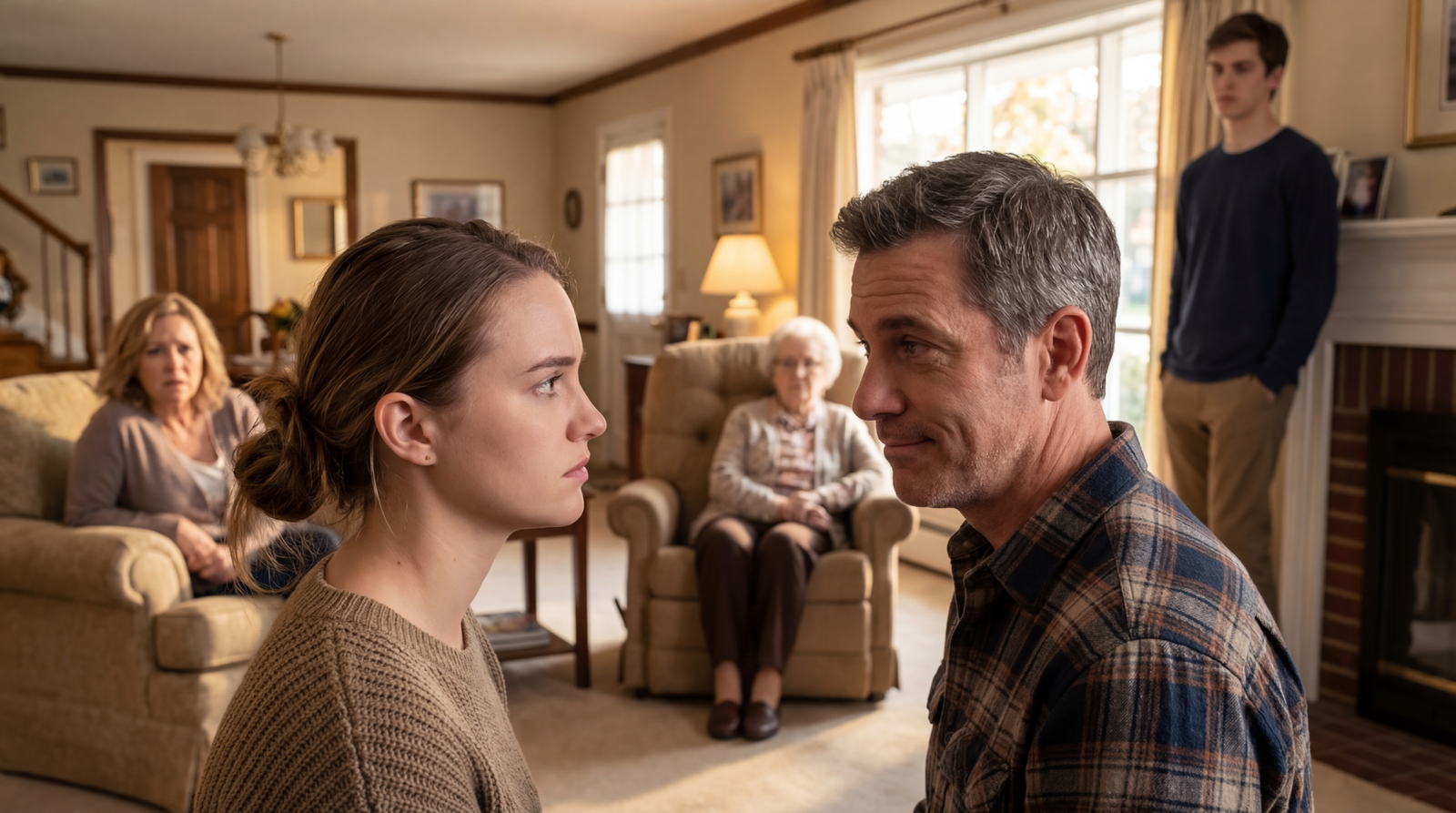
My father’s living room smelled like lemon pledge and burnt coffee, the kind that sat on a warmer too long. Rain ticked against the picture window in quick, irritated taps, and the whole house felt tight—like the air had been wrung out of it.
Victoria sat on the edge of the couch in her Seattle blazer, legs crossed, phone face-down as if a courtroom might break out at any second. Ethan leaned against the fireplace with his hands in his pockets, eyes on the floor like he’d rather be anywhere else. Grandma Margaret sat in the armchair by the lamp, her fingers worrying the fringe of a throw blanket, staring at the carpet pattern as if it was telling her a story only she could hear.
Dad stood near the mantel with his jaw clenched, shoulders squared like this was his meeting to run.
When I said, calmly, “I can take Grandma with me,” he didn’t even let the sentence land.
“You can’t even afford a car,” he sneered, his voice sharp enough to cut. “So shut your damn mouth.”
For half a second, the old heat climbed my throat—the familiar blend of humiliation and rage. Then, through the glass, something dark and sleek slid out of the low clouds.
A blade-thrum rolled over the neighborhood. The air shivered. Picture frames trembled on the wall.
The helicopter dipped, lowered, and settled—right on the broad back lawn behind the house, where Dad used to set up the folding table for Fourth of July burgers.
I smiled like I’d been holding it in my pocket all along.
“My ride’s here,” I said.
Dad went still.
Mom made a small sound—half gasp, half whimper—and her knees buckled. Victoria caught her elbow too late. She sank to the couch in a faint, blinking like the room had tilted.
Outside, the rotor wash lifted wet leaves in a spinning halo.
And that was the moment my family realized they’d been wrong about me for years.
It wasn’t even close.
—
My name is Samantha Hayes. I was twenty-seven that fall, and if you asked me who I was, I never would’ve answered with a job title.
I would’ve told you about Portland—how it always smelled like espresso and wet cedar, how the sky stayed the color of tin for weeks, and how the rain made the city sound like it was whispering. I lived in a one-bedroom apartment above a used bookstore downtown, the kind with creaky stairs and a bell on the door that chimed every time someone wandered in looking for something they couldn’t name.
My guitar leaned against my kitchen chair because there wasn’t space anywhere else. My counters were always littered with staff paper and coffee rings. My neighbors probably thought I was broke, because I drove an old Subaru with peeling paint and a back seat full of laundry baskets.
They weren’t wrong about the Subaru.
They were wrong about everything else.
My family had always used the word “dreamer” like it was a diagnosis.
Victoria was the one they bragged about. Debate trophies, law school, a firm in Seattle that had her working late nights and wearing sharp heels like armor.
Ethan was the prodigy. He wrote code the way other people breathed. By twenty-five, he was in San Jose, making enough money that Mom’s eyes got glossy when she said the name of his company.
Then there was me—Sam—who wrote songs and waited tables and came home with guitar calluses and tip money.
In my parents’ minds, that made me a phase.
To my grandparents, it made me family.
That difference mattered more than they ever understood.
—
I grew up on the rainy side of Portland in a modest two-story house with chipped blue paint and a porch that complained under your feet if you stepped in the wrong spot.
The backyard was a stubborn jungle of blackberry vines that snagged your jeans and stained your fingers. There was a cedar tree back there too—old enough that its branches dipped low and wide like protective arms.
On summer evenings, when the sun didn’t quite set until after nine, I used to sit under that cedar and listen.
Not to my parents.
To Grandpa Thomas.
He wasn’t famous. He didn’t have posters on walls or a documentary about him. But in the seventies he’d played trumpet in smoky Chicago bars, the kind with red booths and a stage light that made everything look like it belonged in a different era.
When he moved to Oregon, he traded the city noise for rain and pine, and the trumpet became something he played for himself, for Grandma Margaret, and sometimes—if he was in the mood—for me.
Grandma had been a nurse for most of her life, steady hands, steady voice, a scent of lavender soap that seemed to follow her even when she’d been cooking all day.
Grandpa’s hands were rough from years of work and years of holding brass. But when he put that trumpet to his lips, the whole house changed temperature.
The air warmed.
The world slowed.
I was eight when I scribbled my first melody on the back of a math worksheet. It was barely a handful of notes, crooked and clumsy.
Grandpa studied it like I’d handed him a masterpiece.
“Sam,” he told me, tapping the paper with one finger, “music isn’t just something you hear. It’s something you carry. Keep it close, and it’ll carry you back.”
My parents did not know what to do with that.
Dad ran a lumber supply company. He spoke in margins and deliveries and forecasts. Mom taught chemistry at the local high school—her world was periodic tables and lab reports and grades that could be measured.
To them, success looked like diplomas and promotions.
To me, it sounded like brass on a rainy night.
That was the first crack.
—
Family dinners at our house were like competitions I couldn’t win.
Victoria would talk about mock trial wins and scholarships. Dad would lean forward, his face brightening with pride, asking questions like he was investing in her.
Ethan would launch into whatever project he was building—an app, a robot, some line of code that made Mom nod as if she understood every word.
Then someone would look at me.
“What about you, Sam?” Mom would ask, and it always sounded like she was trying to soften a blow.
I would tell them about a song. Something I’d been working on. A melody inspired by rain streaking down my window, or by the way the streetlights flickered outside my room.
Silence would follow.
Dad would clear his throat. “That’s… nice.”
Then he’d ask, “How are your grades?”
Or Mom would press her lips together, holding back the question she really wanted to ask.
When are you going to get serious?
They loved me. I believe that.
They just didn’t believe in me.
Not in the way I needed.
So on weekends, I went where the belief lived.
Grandma and Grandpa’s house was smaller and warmer. Grandpa kept vinyl records in a cabinet like they were sacred—Miles Davis, Chet Baker, Ella Fitzgerald. He’d set the needle down and the room would fill with that crackling hiss, the sound of another world waking up.
He taught me to listen for the spaces between notes.
Not the obvious parts.
The quiet parts.
Looking back, I realize those weekends were my real education.
They gave me permission.
—
By the time I was eighteen, the pressure in my parents’ house was a constant hum—like a fluorescent light you couldn’t turn off.
College brochures stacked on the kitchen counter. Engineering. Business. Pre-law—Victoria mailed me that one like she was sending me a lifeline.
I smiled, thanked them, and slipped the pamphlets into my drawer like they were junk mail.
I had already decided.
The idea of lecture halls and formulas I didn’t care about felt like putting my heart in a box and sealing it shut.
Music wasn’t a hobby to me.
It was the only thing that made sense.
One Sunday morning, Mom made pancakes. The house smelled like coffee and maple syrup, and for once, everyone seemed in a decent mood.
Victoria was home from Seattle, talking about a case her firm had won. Ethan was tapping away on his laptop.
I took a breath and said it.
“I’m not going to college.”
The air dropped.
Dad’s mug paused halfway to his mouth.
“What?”
“I’m going to focus on my music,” I said, forcing my voice to stay steady. “I’ll work. I’ll pay my own way. But I’m not applying to any schools.”
Mom blinked, like she needed time to process the words.
“Samantha,” she said slowly, “be serious.”
“You can’t make a living playing songs in your bedroom,” Dad snapped. “You need a degree.”
“I don’t want a degree,” I said. “I want a career.”
Victoria leaned back, arms crossing. “Sam, I’m telling you this as your sister—people chase art and end up broke. Living with their parents at thirty.”
Ethan didn’t speak. He just kept typing, but I could feel him listening.
Dad’s voice rose, the same tone he used when something went wrong at work.
“If you do this,” he said, “you’re making the worst mistake of your life. And if you think you can live here while you ‘figure it out’—think again. This isn’t a free ride.”
That was the line.
Two weeks later, I left.
—
I didn’t leave with a triumphant speech or a dramatic slam of the door.
I left with a duffel bag, my guitar, and a few hundred dollars I’d scraped together from babysitting and market jobs.
I rented a tiny studio above a used bookstore downtown. The heater clanked. The floorboards complained. My view was mostly a brick wall.
But it was mine.
During the day, I waited tables at a café that smelled like espresso and burnt sugar. At night, I played until my fingers ached.
No applause.
No record deal.
Just me and the songs.
Those first two years were exhaustion wrapped in instant noodles. Rent ate almost everything I earned. The rest went to guitar strings, cheap recording gear, and groceries that weren’t just pasta or peanut butter when I could manage it.
Some nights after closing, I climbed the narrow staircase to my apartment, kicked off my shoes, and sat cross-legged on the floor with my guitar.
Streetlights flickered outside my window like a heartbeat.
I’d record demos on my battered laptop and listen back, wincing at mistakes, telling myself the next one would be better.
My mom called often.
“Are you eating?” she’d ask.
“Yes.”
“Are you still… doing the music thing?”
“Yes.”
“You could come home,” she’d say softly. “Take a couple classes. Just to be safe.”
“No.”
Dad’s calls were shorter.
“You find a real job yet?”
Even Ethan texted once.
You’re smart enough to do something else.
The only people who didn’t try to steer me back onto their track were my grandparents.
Grandpa called from their landline, his voice crackly with static.
“Roads like this,” he told me, “are never paved.”
Grandma sent care packages—coffee beans, oatmeal cookies, sometimes a twenty-dollar bill tucked into a paperback like a secret.
They didn’t fix my problems.
They just reminded me I wasn’t crazy.
That mattered.
—
Then, one cold January night, my phone buzzed as I was walking home from work.
Grandma’s name lit up the screen.
Her voice sounded wrong—thin, shaken.
“Sam,” she said. “It’s your grandpa. He… he collapsed. They’re taking him to St. Mary’s.”
I didn’t even lock my apartment door.
I ran for the bus stop, lungs burning, heart hammering.
The hospital was bright and harsh, all fluorescent lights and antiseptic. Grandma sat in the waiting room with her hands folded so tightly her knuckles looked white.
When I reached her, she grabbed my wrist like she was afraid I’d drift away.
The doctor’s words were quick. Professional. Cruel.
“He didn’t make it.”
I stared at his mouth as if the sentence might rearrange itself into something else.
It didn’t.
The funeral was small—a church with creaky pews and stained glass that threw colored light onto the floor.
Victoria flew in. Ethan came. My parents sat in the front row, faces stiff with grief they didn’t know how to show.
I played a simple hymn on my guitar. My hands shook so badly I almost dropped the pick.
Afterward, people hugged Grandma, offered casseroles, said the same phrases in different voices.
“He’s in a better place.”
“He’s at peace now.”
Grandma nodded like she was hearing them from underwater.
That night, I went back to my apartment and opened my notebook.
I didn’t plan.
I didn’t think.
I just wrote.
Memory poured out of me—Grandpa’s trumpet on rainy nights, his aftershave, the warmth in his laugh.
By dawn, I had a melody that felt like a goodbye.
I called it “Trumpet in the Rain.”
I recorded a rough version on my laptop and posted it online because I didn’t know what else to do with grief.
I expected maybe a few friends to listen.
I didn’t expect the world.
—
A week later, my inbox looked like it had been hit by a storm.
Musicians I’d never met wanted to collaborate. A singer from Seattle asked if she could record the song.
When her version went live on an indie album, something strange happened.
People listened.
A lot of people.
Strangers started tagging the track. It popped up in playlists I’d never heard of. I’d be wiping tables at the café and a customer’s phone would ring and my melody would spill into the air.
The first time I heard it in public, my hands froze mid-wipe.
Within a month, a small label reached out.
“We’re looking for writers,” the email said. “Your work has… something.”
The pay they offered was more than I made in two months of waiting tables.
I said yes.
Then I worked three nights straight to deliver a track.
When it released, it didn’t explode.
It didn’t need to.
It spread.
Quietly, steadily—streams climbing into six figures, then seven.
Then another request.
Then another.
Bands from Austin. Folk duos from Denver. Pop artists in Los Angeles.
My inbox turned into a map of time zones.
And somewhere in that snowball, I learned something about myself.
I could do this.
Not as a fantasy.
As a job.
As a life.
That realization was both thrilling and terrifying.
—
The first time a contract arrived in my email, I stared at it like it was written in a foreign language.
I learned how to negotiate from late-night internet searches and YouTube videos, pausing every five minutes to scribble notes.
I found a lawyer who didn’t laugh at me, who let me pay per email because that’s what I could afford at first.
I joined a performance rights organization. I registered every song.
I tracked royalties like my life depended on them.
Because it did.
For a while, I kept telling myself it was luck. A fluke. A one-time lightning strike.
Then it kept happening.
I started measuring my worth in statements instead of tips.
By year three, I crossed into six figures.
By year five, I was in eight figures.
Over eight figures.
I still lived above the bookstore. I still drove my old Subaru. I let people assume what they wanted.
Because my family didn’t get to claim this version of me until they were ready to see her.
And I wasn’t ready to hand it over.
So I made a choice.
I became someone else.
On paper, anyway.
I chose a pseudonym: Rain Miller.
Rain, for Portland.
Miller, for the way Grandpa used to say music was something you carried—like grain in your hands.
It started as fear.
I didn’t want my parents to find out and dismiss it as a fluke.
Later, it became armor.
The less they knew, the less they could break.
—
The only person I didn’t hide it from was Grandma.
After Grandpa died, she and I became each other’s anchor.
I visited her every week. I brought vinyl records and blueberry scones. I played Ella and Chet and Miles while she sat in her rocking chair, eyes shining, humming along.
When I told her about the first real royalty check, she squeezed my hand and whispered, “Thomas knew.”
But even those visits started changing.
At first it was small.
She’d ask me the same question twice in an hour.
Then three times.
One afternoon, she called me Margaret—her own name.
I laughed it off in the moment, but later, alone in my car, I sat with the engine running and my hands on the wheel, staring at the rain on the windshield.
The diagnosis came a month later.
Early-stage Alzheimer’s.
The neurologist explained it with the careful tone doctors use when they’re trying to be kind.
“Everyone progresses differently,” she said.
But the meaning landed like a weight.
This wasn’t going to get better.
That night, I went home and sat at my kitchen table under the dim light, staring at my guitar like it was the only stable thing in the world.
Then I made a promise.
Grandma wouldn’t fade out in a sterile room surrounded by strangers.
Not if I had any say.
And I had more say than anyone in my family realized.
—
I didn’t know exactly what care would look like yet.
I just knew I wanted Grandma safe, comfortable, and surrounded by the kind of warmth she’d given me.
Her house—small, steep, familiar—had stairs that suddenly felt like traps. Her kitchen had old knobs that were easy to forget. Once, she left the oven on for hours.
I pictured her alone, confusion rising like fog.
It made my stomach twist.
So I called Clare.
Clare wasn’t just an assistant. She was the person who could take my chaotic artist brain and turn it into a plan.
She was also the only person besides Grandma who knew I was Rain Miller.
“Find me a place,” I told her. “Outside the city. Space. Light. But it has to be safe—wide hallways, easy access, no death stairs.”
Clare didn’t ask why.
She just said, “Got it.”
Three weeks later, after touring too many overpriced shells and glossy McMansions that felt like hotel lobbies, we found it.
A weathered three-story estate in West Linn, built in the 1920s, with a red tile roof and creamy stucco walls.
It needed work.
But it had bones.
It had gardens that looked like they’d been loved once.
The moment I walked into the living room, I could see it.
A music room with a baby grand.
A lounge lined with Grandpa’s records.
A patio where Grandma could sip tea in sunlight.
I bought it outright.
No loans.
No co-signers.
Just a wire transfer that made the realtor’s voice wobble.
Then I started renovating like my life depended on it.
Because Grandma’s did.
—
I hired an architect who specialized in historic homes, someone who respected old charm but understood modern safety.
We added an elevator tucked neatly into the corner so it didn’t feel like a hospital feature. We widened doorways. We installed railings that looked elegant instead of medical.
Grandma’s bedroom became my obsession.
Big windows overlooking the garden.
A quilted reading chair.
A bookshelf stacked with her favorite novels—even if she might forget she’d read them.
We installed soft lighting that didn’t glare.
We made the bathroom safe without making it feel sad.
Every choice was a quiet rebellion against the future people tried to write for her.
But there was another idea that had been lodged in my mind for years.
When I was twenty-two, I’d splurged on a helicopter tour over the Columbia River Gorge.
It was supposed to be a once-in-a-lifetime thing.
The view stunned me.
Water like glass. Mountains rising like guardians. Clouds spilling over ridges like breath.
I went home and wrote a song that night because I didn’t know how else to hold the feeling.
If a view could wake something in me, maybe it could wake something in Grandma.
Even for a moment.
So I did something that, even now, feels slightly insane.
I bought a helicopter.
A sleek black Bell 407.
Room for me, Grandma, and a nurse.
I started lessons—enough to understand what I was asking of a machine—but I always planned to fly with a professional pilot.
I did it all quietly.
No announcement.
No social media post.
No family update.
Secrecy wasn’t just habit by then.
It was strategy.
—
The call that set everything in motion came on a Thursday night.
I was at my kitchen table, surrounded by paint swatches for the music room, when my phone rang.
Mom.
Her voice had that clipped sound it got when she was trying to sound calm but couldn’t.
“Sam,” she said, “we need a family meeting this weekend.”
My stomach tightened.
“About what?”
“It’s about your grandmother.”
The way she said it made my chest go cold.
“What’s going on?”
“We’ll talk in person,” she said, and then she hung up.
Saturday, I drove my old Subaru to my parents’ house in Beaverton.
It was fall—the kind of damp chill that smelled like wet leaves and cedar bark. The sky hung low. Everything looked washed out.
When I walked in, the scene was exactly what I expected.
Dad in his recliner like he owned the air.
Victoria in her blazer like she’d come straight from court.
Ethan with his phone, attention split.
Grandma in the corner, hands folded, eyes on the carpet.
They started with small talk—meaning they talked and I listened.
Then Mom cleared her throat.
“It’s getting worse,” she said. “Her memory. Last week she left the stove on all night.”
I nodded. “I know.”
Dad leaned forward. “We can’t risk her living alone anymore.”
“I agree.”
Mom’s shoulders relaxed like she thought I was finally going to fall in line.
“Good,” she said. “Because we found a nursing home in Hillsboro. Clean. Modern. Affordable. We’ll split the cost.”
Victoria nodded like it was the obvious solution.
“It’s the best option,” she said. “I can’t be driving down from Seattle all the time.”
Ethan shrugged. “Same. I’m in San Jose. It’s not practical.”
They spoke like Grandma wasn’t in the room.
Grandma’s fingers tightened on the blanket fringe.
I inhaled slowly.
“She doesn’t want a nursing home,” I said.
Dad’s laugh was short and humorless.
“And you know that how?”
“Because she told me,” I said. “She wants to stay with family.”
Victoria’s mouth curled. “Sam, this is serious. You can’t just play guitar at her bedside and call it care.”
Ethan’s voice was softer, but somehow worse.
“We know you love her,” he said. “But you’re not… equipped.”
Mom leaned toward me, eyes pleading like I was a stubborn child.
“Honey,” she said, “you don’t understand how much work it is. It’s a burden. Professionals—”
“It’s not a burden,” I cut in, surprising even myself. “It’s Grandma.”
Dad’s eyes sharpened.
“And how,” he asked, “do you plan to pay for her care? With tips from your café?”
The room went quiet.
It felt like every time they’d ever dismissed me gathered into one thick moment.
I looked at Grandma.
For a flicker of a second, she met my eyes and there was recognition. Clear and bright.
I stood.
“I’m taking care of her,” I said. “My way.”
Dad rolled his eyes. “Don’t make promises you can’t keep.”
I pulled out my phone.
I scrolled to Clare.
I hit call.
“Clare,” I said, keeping my voice steady. “Bring the helicopter.”
Then I hung up.
For a heartbeat, nobody spoke.
And then my father laughed.
Actually laughed.
“That’s the dumbest thing I’ve ever heard,” he said.
Victoria smirked. Ethan exhaled like he was embarrassed for me.
Mom pressed her lips together, trying to look kind.
That was fine.
They could laugh.
They just didn’t get to do it forever.
—
I walked out into the October air like I was stepping into a stage light.
The neighborhood behind my parents’ house had an open greenbelt—wide grass that ran between the back fences, where kids played soccer in summer and dog owners let their labs chase tennis balls.
That was where I told Clare to land.
Dad followed me to the back porch, still chuckling.
“Sam,” he called, “come back inside. Stop this.”
I didn’t turn around.
I crossed the wet grass and stopped in the center of the open space, hands deep in my jacket pockets, scanning the gray sky.
My heart didn’t hammer from the cold.
It hammered from the risk.
Because the truth was, I didn’t just want to prove I could take care of Grandma.
I wanted to prove they didn’t get to decide who I was anymore.
Behind me, I could see movement through the kitchen window—my parents, Victoria, Ethan, all clustered like they were watching a reality show.
Grandma’s silhouette sat still in her chair.
Clare had said twenty minutes.
At ten, I started to doubt myself.
At fifteen, the wind picked up and I wondered if the weather would ruin everything.
Then I heard it.
At first, it was low and distant, like thunder over hills.
It grew louder.
A steady, powerful thrum that vibrated in my ribs.
Heads turned along the street. Curtains fluttered. A dog barked.
The helicopter appeared over the treeline, black against the gray like an ink stroke.
It dipped smoothly and descended toward the greenbelt.
Rotor wash whipped leaves into a spiral. Rain stung my face.
It touched down with controlled grace, skids settling into the wet grass.
The sound wasn’t just loud.
It was undeniable.
My family spilled out the back door.
Dad first, face gone pale.
“What the hell is this?” he shouted, even though the rotor made shouting useless.
Mom clutched her sweater, eyes wide like she’d stepped into a dream she didn’t understand.
Victoria stopped mid-step, her phone slipping from her hand.
Ethan froze with his earbuds dangling.
I turned and walked back toward the house.
Not to argue.
Not to gloat.
To get Grandma.
Because this was never about them.
—
Grandma was dozing in her chair when I knelt beside her.
“Grandma,” I said softly. “It’s Sam.”
Her eyes fluttered open.
“Sammy?”
“We’re going for a ride,” I told her.
“In the car?” she asked, blinking.
I smiled. “Better.”
A nurse stepped into the doorway behind me.
My mother stiffened. “Who is that?”
“A licensed home-care nurse,” I said, keeping my tone even. “She’s been part of the plan.”
Dad’s mouth opened and closed like he couldn’t decide which accusation to throw first.
The nurse introduced herself calmly and helped us guide Grandma to her feet.
Grandma moved slowly but steadily, her hand on my arm.
When we stepped outside and she saw the helicopter through the drizzle, she stopped.
Her lips parted.
“Oh,” she whispered. “Thomas would have loved this.”
My throat tightened.
“I know,” I said.
Dad pushed forward. “This is insane. You can’t just—”
“I can,” I said, meeting his eyes. “And I am.”
Victoria’s voice cut through. “Sam, where are you taking her?”
“Somewhere safe,” I said.
Ethan looked from Grandma to the helicopter, confusion mixing with something like awe.
Mom’s voice trembled. “Sam, honey… what is happening?”
“You’re coming,” I told them. “At least Mom and Dad. Victoria, Ethan—follow us by car. I’ll send the address.”
Dad shook his head hard. “Absolutely not.”
Then Grandma squeezed my hand.
“I want to go,” she said, clear as a bell.
The sentence hung in the air.
Dad’s face tightened.
“This is manipulation,” he snapped.
And then he did something I didn’t expect.
He pulled out his phone.
And dialed 911.
—
The operator’s voice was tinny through Dad’s speaker as he stepped away from us.
“Yes,” he said loudly, as if volume made him more right. “My daughter is trying to take my mother-in-law. She’s—she’s bringing a helicopter into a residential area. We need someone here.”
My stomach dropped.
Not because I thought I’d done something wrong.
Because I knew what police lights would look like against wet grass.
Because I knew how quickly a family dispute could turn into a story strangers told.
Victoria’s eyes widened. “Dad, stop.”
Mom whispered, “Why would you do that?”
Dad ignored them.
He kept talking.
He kept building his own version of me.
I looked at the nurse. She stayed calm, hand on Grandma’s shoulder.
Clare stepped out of the helicopter, headset hanging around her neck.
She moved like someone who’d handled crisis before.
“Sam?” she called.
“Police are on their way,” I said.
Clare didn’t flinch.
“Do you have your paperwork?” she asked quietly.
I nodded.
Because yes.
I had learned the hard way that being right wasn’t enough.
You needed proof.
—
I pulled a slim folder from my tote bag—waterproof, because Portland taught you to plan for rain.
Inside were copies of what mattered.
Grandma’s durable power of attorney, signed months earlier when she was still lucid enough to understand exactly what she wanted.
Her healthcare directive.
A letter from her doctor documenting her diagnosis and her expressed wish to remain with family care.
A contract with the nurse’s agency.
Everything my lawyer had told me to have within reach.
Dad saw the folder and scoffed.
“You think that makes you qualified?”
“It makes me prepared,” I said.
Within minutes, a patrol car rolled up along the street, lights flashing but no siren.
Two officers stepped out, rain dotting their uniforms.
Neighbors peeked from windows. A kid with a scooter stopped at the sidewalk and stared.
The officer’s gaze flicked from the helicopter to Dad’s tense face to Grandma standing under my umbrella.
“What’s going on?” he asked.
Dad launched in. “My daughter is trying to take my mother-in-law. She’s—she’s unstable. She can’t afford a car and now she’s trying to—”
The officer held up a hand.
“Ma’am,” he said to me. “Is she going with you voluntarily?”
Grandma looked at him and smiled faintly.
“Yes,” she said. “Sammy’s taking me home.”
Dad’s jaw flexed.
“Sir,” the second officer said, “does your mother-in-law have a legal guardian?”
Dad hesitated.
“No,” he said.
I handed the folder to the officer.
He opened it, scanning.
Clare stood nearby, her posture calm but watchful.
The officer looked up at Dad.
“Sir,” he said, “it appears your mother-in-law has designated your daughter as her power of attorney. Unless there’s evidence of immediate danger, we can’t prevent her from leaving.”
Dad’s face flushed.
“This is ridiculous,” he snapped. “She can’t—she doesn’t—”
The officer’s gaze was firm.
“Sir,” he repeated, “that’s not for you to decide.”
For the first time in my life, someone in authority said out loud what I’d been trying to tell my family for years.
Dad didn’t control me.
Not anymore.
That thought hit like a clean breath.
And then the officer stepped back.
“Be safe,” he told me.
I nodded.
“I will.”
Then I helped Grandma into the helicopter.
And my father watched, powerless.
—
The helicopter door shut with a solid thunk.
Inside, the cabin smelled faintly of leather and clean metal.
Grandma sat with her hands folded in her lap, headset gently placed over her ears by the nurse.
Mom climbed in next, still pale, eyes darting between the controls and me like she was trying to confirm reality.
Dad hesitated at the door.
“I’m not doing this,” he said, voice tight.
Mom grabbed his sleeve. “You are,” she whispered. “Because if you don’t, you’ll regret it.”
He swallowed, then climbed in.
The pilot—professional, calm—gave quick instructions.
The rotor spun faster.
The world outside blurred.
Then we lifted.
The greenbelt shrank. Houses became tidy squares. Streets turned into gray ribbons.
Grandma let out a soft gasp.
“Oh,” she breathed, looking down at the neighborhood like it was a toy town.
The Willamette River glinted in the distance, a ribbon of silver through green.
“It’s beautiful,” Grandma said.
I glanced at my parents.
Mom’s hands were clenched on her seatbelt.
Dad kept flicking his gaze at me like I was a puzzle he’d refused to solve.
Over the headset, his voice came through, rough.
“Where are we going?”
“You’ll see,” I said.
Behind us, Victoria and Ethan were already in the driveway, climbing into Victoria’s spotless Tesla.
She looked up at the helicopter, face unreadable.
Ethan lifted a hand in a hesitant wave.
Then the clouds swallowed us.
—
We flew south over forests painted in fall colors, the kind of Oregon landscape that looked like someone had spilled gold and rust across the hills.
Grandma pointed at distant mountains, their peaks dusted with early snow.
For a stretch of minutes, she seemed lighter—eyes clearer, smile unburdened.
I wanted to freeze that version of her.
To keep it in a jar.
But you can’t bargain with time.
You can only give it better places to land.
Twenty minutes later, the pilot banked east.
And the estate came into view.
Creamy stucco shining against deep green gardens.
A red tile roof catching the weak sun.
Maple trees lining the long driveway, their leaves fluttering like a welcome.
In the backyard, a freshly poured helipad sat like a promise.
Dad leaned forward, squinting.
“What is that?”
Mom’s breath hitched.
We descended smoothly and settled onto the pad.
The rotor slowed.
The sudden quiet afterward felt almost unreal.
Like the world had held its breath.
Then the pilot shut down the engine.
Silence.
Not the awkward dinner-table silence I’d grown up with.
A different kind.
The kind that comes right before truth.
—
Victoria and Ethan arrived minutes later, tires crunching gravel.
Victoria stepped out first, staring at the house like it had been dropped from the sky.
Her voice sharpened in the wind.
“Whose place is this?”
Ethan’s eyes were wide. “Sam…”
I didn’t answer.
I helped Grandma down the steps carefully, the nurse beside us.
We walked through the back garden toward the patio.
Clare had insisted on planting roses—old-fashioned ones that matched the scent of Grandma’s old yard.
The smell hit Grandma and she stopped.
Her eyes closed.
“It smells like…” she whispered.
“Home,” I said.
Her fingers tightened on mine.
Inside, the foyer was warm and bright, wood polished, walls painted a soft cream that didn’t glare.
A chandelier threw gentle light across the floor.
And in the corner of the living room—on a dark walnut stand—sat Grandpa Thomas’s trumpet.
Grandma’s breath caught.
She reached for it with trembling hands, touching the brass like she was touching him.
“Thomas,” she whispered.
I swallowed hard.
“You’re safe here,” I told her. “You’re not going anywhere you don’t want to go.”
Behind us, my family stepped in like they were afraid to make noise.
Dad’s voice came low.
“Sam,” he said, “what is this?”
I turned to face them.
“It’s Grandma’s home,” I said. “And mine.”
Victoria’s eyes narrowed. “You bought this?”
“Yes.”
“With what money?” Dad demanded.
I let a beat pass.
The kind of beat Grandpa used to say mattered.
Then I said, “Sit down.”
And for once, my father did.
—
We gathered in the music room because that was where I felt strongest.
A baby grand sat near the windows, glossy black, waiting. Shelves held vinyl records—Grandpa’s collection, carefully restored.
On the wall hung framed sheet music—my grandfather’s old notes and, beside them, my own handwritten drafts.
Dad stood near the doorway like he was ready to bolt.
Mom stayed close to Grandma, still shaken.
Victoria perched on the edge of a chair, eyes hard.
Ethan hovered, hands in pockets, gaze darting around like he could sense something hidden in the walls.
Clare stood quietly in the corner, her presence steady.
I took a breath.
“For the past six years,” I said, “I’ve been writing music under the name Rain Miller.”
Victoria blinked once. “What?”
“‘Trumpet in the Rain,’” I continued, voice steady. “That song that got played everywhere. That was mine.”
Ethan’s head lifted sharply.
Dad let out a sound that wasn’t quite a laugh.
“You’re saying you wrote that?” he asked, disbelief thick.
“I did,” I said.
“And the songs you’ve heard in commercials, on TV, in movies,” I went on. “A lot of them were mine too. I’ve been earning royalties, investing, building something. Quietly.”
Mom’s face went slack.
Victoria’s voice came out smaller than I’d ever heard it.
“Rain Miller is you?”
“Yes.”
Dad’s hands balled into fists. “Why didn’t you tell us?”
I met his eyes.
“Because you never believed I could do it,” I said. “And I didn’t want you to ruin it for me.”
Silence.
Not comfortable.
Not polite.
Honest.
Then I pulled out another folder—thicker, heavier.
Deed paperwork.
Insurance.
A care plan.
A trust document set up for Grandma’s medical needs.
Royalty statements.
Numbers.
Real, undeniable numbers.
I tapped the top page.
“I’ve earned over twenty-five million dollars,” I said. “Royalties and investments. Twenty-five million.”
Dad stared at the paper like it was a threat.
Mom covered her mouth, tears swelling.
Victoria’s throat bobbed as she swallowed.
Ethan’s eyes went glassy.
The number hung in the air like a bell.
Twenty-five million.
Not tips.
Not a phase.
A life.
—
Dad shook his head slowly, as if shaking could knock the truth loose.
“No,” he said, voice raw. “This doesn’t make sense. You—you were waiting tables.”
“I was,” I said. “Until I didn’t need to.”
“Then why keep doing it?” Victoria snapped. “Why keep pretending?”
“Because I didn’t want this,” I said, gesturing at the room, the stunned faces, “to be about money. I wanted my work to be mine. Not a family trophy.”
Mom’s voice cracked. “Sam… honey.”
She reached out like she wanted to touch my face, like I was still twelve.
“Why didn’t you come home?” she whispered.
I looked at her.
“Because home didn’t feel safe,” I said softly. “Not for my dream. Not for me.”
Dad flinched like I’d slapped him.
Victoria opened her mouth, then closed it.
Ethan finally spoke.
“I’ve heard that song,” he said, voice quiet. “A hundred times. I never—”
His voice broke.
“I never knew it was you.”
Grandma, still holding Grandpa’s trumpet, lifted her head.
Her eyes moved from face to face.
“What are you all fussing about?” she asked, puzzled. “Sammy’s always been the one with music.”
That simple sentence cracked something open.
Mom started crying in earnest.
Dad turned away, rubbing his forehead hard like he could erase years.
For a moment, Victoria looked like she might cry too.
Then she swallowed it down.
Because she was Victoria.
But her voice softened.
“It’s beautiful,” she said, almost reluctantly. “That song… it’s really beautiful.”
I nodded.
“It was Grandpa,” I said. “I just wrote what he gave me.”
—
The days after the reveal didn’t snap into perfect harmony.
Real life doesn’t.
It stumbled.
It hesitated.
It rewrote itself slowly.
Grandma settled into the house like she’d been waiting for it without knowing.
Mornings became rituals.
Tea on the patio.
Jazz drifting from the speakers.
Sunlight pooling over her quilt.
Some days she remembered exactly where she was. She’d tell stories about Chicago, about Grandpa sneaking her into clubs when she was young.
Other days she’d ask me where Thomas was, and my chest would clench.
On those days, I’d play “Trumpet in the Rain” on the piano or the guitar.
And sometimes—sometimes—her eyes would light up like the song reached somewhere the illness couldn’t touch.
That was worth everything.
My parents visited more often than I expected.
At first, they came with guilt heavy on their shoulders—flowers, pastries, little offerings like they were trying to buy forgiveness.
Dad walked through the house like a man inspecting a structure he didn’t understand.
Mom lingered in the kitchen, touching cabinets, running her fingers over the counter like she needed proof it was real.
Victoria asked a hundred questions about the trust, the paperwork, the liability.
She couldn’t help herself.
Ethan stayed close to the music room.
One afternoon, he picked up my spare guitar and strummed a chord, hesitant.
“You play?” I asked.
His cheeks colored.
“A little,” he admitted. “I wrote some stuff in college. Never showed anyone.”
I stared at him.
“Why not?”
He shrugged, eyes down.
“Dad,” he said simply.
The answer sat between us like an old bruise.
—
A week after Grandma moved in, Dad cornered me in the hallway outside her bedroom.
His voice was low, like he didn’t want her to hear.
“I was wrong,” he said.
I waited.
He swallowed.
“I shouldn’t have said those things,” he continued. “I shouldn’t have—”
His eyes flicked toward the music room, toward Grandpa’s trumpet.
“I thought I was protecting you,” he said, and there was something almost broken in that sentence.
I leaned against the wall, arms folded.
“Were you?” I asked.
He flinched.
“I didn’t know how to understand it,” he admitted. “Music. Dreams. I—”
He exhaled hard.
“When my dad was alive, he worked me like a mule,” he said. “If I slowed down, he told me I’d end up nothing. So when you… when you chose something uncertain…”
He shook his head.
“It scared me,” he said.
I looked at him.
Not the big, unshakable man from my childhood.
Just a person.
Flawed.
Afraid.
“I needed you to believe,” I said quietly.
He nodded, eyes wet.
“I know,” he whispered.
Then he did something he’d never done in my entire life.
He apologized without adding a condition.
“I’m sorry, Sam,” he said.
It didn’t erase years.
But it opened a door.
—
The helicopter rides became a tradition, partly because I’d planned it that way and partly because Grandma smiled more when she was above the trees.
Every Sunday, if the weather cooperated, we’d fly.
Not always far.
Sometimes just over the river, over the forests, over the neighborhoods shrinking into patterns.
Grandma would stare out the window, her expression soft.
Sometimes she talked.
Sometimes she just hummed.
Once, as we banked over a patch of farmland, she reached across and patted my hand.
“Thomas would be so proud,” she said.
My throat tightened.
“I hope so,” I whispered.
Dad sat across from us, quiet, headset on, watching Grandma instead of the view.
Mom stared out the window like she was trying to understand how much she’d missed.
Victoria took pictures but didn’t post them.
Ethan listened with his eyes closed, like he was memorizing the sound.
The rotor thrum became a new kind of music.
One my family couldn’t ignore.
—
The midpoint of all this—what I didn’t understand at first—was that proving myself wasn’t the hardest part.
The hardest part was what came after.
Because once my family knew I wasn’t who they’d decided I was, they didn’t magically become the family I needed.
They became confused.
And confusion can turn into control fast.
It happened two weeks after Grandma moved in.
Victoria called me on a Tuesday morning.
“I talked to a colleague,” she said, skipping hello. “About guardianship.”
My stomach tightened.
“What about it?”
“She’s vulnerable,” Victoria said. “Legally. There are procedures. Oversight. If something happens—”
“If something happens,” I cut in, voice icy, “she’s in better hands here than in a facility.”
“That’s not what I meant,” Victoria snapped. “I’m trying to protect you. Protect her.”
“By making it a courtroom?”
She paused.
Then her voice dropped. “Dad is talking about filing,” she admitted.
My grip tightened on the phone.
“Filing what?”
“A petition,” she said. “For conservatorship. He thinks—he thinks you’re too young. Too unstable.”
I laughed once, sharp.
“Because I don’t drive the right car?”
“Sam, I’m serious.”
“I’m serious too,” I said. “Tell him to try.”
After I hung up, I sat at my kitchen table in the estate’s bright kitchen, staring at my hands.
Twenty-five million.
A helicopter.
A house.
None of it could stop my father from trying to grab control if he decided he should.
Money doesn’t fix family.
It just raises the stakes.
That was the moment I realized I was still in a fight.
—
I called my lawyer.
Not the per-email guy from my early days.
A real firm.
A woman named Marisol who had a calm voice and a spine made of steel.
When I explained, she didn’t sound surprised.
“Families get weird when money appears,” she said. “And when aging parents are involved. We’ll lock this down.”
“What does ‘lock down’ look like?” I asked.
“It looks like documentation,” she said. “Medical evaluations. Care plans. Financial transparency. And boundaries.”
Boundaries.
A word my family never respected.
Marisol helped me build a paper fortress.
We updated Grandma’s directives. We documented her wishes in writing and video when she was lucid.
We arranged regular medical check-ins.
We created a trust with clear rules.
We established that I wasn’t just the ‘dreamer’ making emotional choices.
I was the responsible adult planning care.
And the paper would prove it.
Evidence mattered.
Because people who didn’t believe in you always look for a reason to keep not believing.
—
Still, paperwork didn’t stop the emotional fallout.
Dad came to the estate one evening alone, his truck crunching gravel in the driveway.
He walked into the lounge and stood staring at Grandpa’s record shelves like they might accuse him.
I found him there.
He didn’t turn when I entered.
“I didn’t know,” he said, voice low.
“You didn’t want to know,” I replied.
He finally faced me.
“I thought she’d be safer in a facility,” he said, and I could tell he believed it. “I thought you were… playing house.”
“I’m not playing anything,” I said. “I’m keeping a promise.”
“To who?” he asked.
“To Grandpa,” I said.
Dad’s face tightened.
“I was at the funeral,” he murmured.
“And still,” I said, “you never listened.”
His shoulders slumped.
“I listened,” he insisted, then faltered. “I just didn’t… understand.”
I looked at him.
A man who’d built his world on certainty.
And now was surrounded by improvisation.
“You don’t have to understand music to respect it,” I said. “You just have to respect me.”
He nodded slowly.
“Okay,” he said, voice rough.
Just one word.
It sounded like surrender.
It sounded like the beginning of something.
—
The darkest night didn’t come from my family’s legal threats.
It came from Grandma.
One evening, after dinner, she wandered into the hallway and stopped outside a closet.
She turned to me, eyes wide with panic.
“Where am I?” she asked.
My chest tightened.
“You’re home,” I said gently.
She shook her head. “No. This isn’t my house.”
“It’s your house now,” I said, trying to smile.
Her face crumpled.
“I can’t find Thomas,” she whispered.
The words hit like a punch.
I crouched in front of her, taking her hands.
“He’s not here,” I said softly. “But you’re safe.”
She started to cry—quiet, confused tears.
For a second, I felt something inside me crack.
Because all my money, all my planning, all my careful renovations couldn’t stop the disease from stealing her.
I carried her back to her room, sat with her until her breathing eased.
When she finally fell asleep, I walked into the music room and sat at the baby grand.
The house was silent.
Outside, rain tapped the windows.
I put my hands on the keys and played “Trumpet in the Rain,” slow and aching.
I played it until my vision blurred.
Then I rested my forehead against the polished wood and let myself feel the thing I’d been refusing.
I was terrified.
Not of my family.
Of time.
That fear was the real enemy.
—
The next morning, I woke up to the smell of coffee and bacon.
Dad was in the kitchen.
For a second, I thought I was dreaming.
He was standing at the stove, awkwardly flipping eggs like he didn’t trust them.
Mom sat at the counter, sipping coffee, eyes red like she’d been crying too.
They’d spent the night in the guest room.
I hadn’t even noticed them arrive late, because I’d been with Grandma.
Dad looked up when I entered.
“She had a rough night,” he said quietly.
I nodded, throat tight.
Mom stood and came to me, wrapping her arms around my shoulders.
“I’m sorry,” she whispered.
Not the old vague sorry.
A real one.
“I didn’t know it was this,” she said.
I closed my eyes.
“It’s going to get harder,” I admitted.
Dad set the spatula down.
“Then we’ll help,” he said.
I stared at him.
“You?”
He nodded once.
Not confident.
Not loud.
Just steady.
“I don’t know how,” he said. “But I’m here.”
The sentence landed like a chord resolving.
Not perfect.
But something.
—
Victoria didn’t shift as easily.
She was trained to find the crack in every argument.
When she came again, she brought a notebook.
She sat with me at the kitchen table and asked questions about care schedules, insurance, emergency plans.
At first, it felt like interrogation.
Then, halfway through, her voice softened.
“I’m not trying to control you,” she said, sounding surprised by her own words. “I’m trying to… understand.”
I studied her.
For years, Victoria had been my mirror image in my parents’ eyes—proof of what ‘good’ looked like.
Now she looked tired.
Under the blazer and sharp tone, she looked like someone who’d been living in a straight line too long.
“Why does it bother you so much?” I asked.
She stared at her notebook.
“Because you did it,” she whispered. “You did the thing. You picked the uncertain path and… it worked.”
Jealousy flickered across her face like a confession.
“I did everything right,” she said, voice tight. “And sometimes I look at my life and it feels like it belongs to someone else.”
I didn’t know what to say to that.
So I said the truth.
“You can rewrite it,” I told her.
Victoria laughed softly, sad.
“You always talk like that,” she said.
“And you always act like you can’t,” I replied.
She looked up at me.
For a moment, we were just sisters.
Not rivals.
Not opposites.
Just two women trying to breathe.
—
Ethan surprised me most.
One afternoon, he showed up with a beat-up guitar case.
He held it like it might explode.
“I brought something,” he said.
He followed me into the music room and set the case down.
When he opened it, inside was a cheap acoustic guitar with worn frets.
“I bought it in college,” he admitted. “I was… lonely.”
He looked embarrassed saying it.
“I wrote songs,” he said quietly. “Just… for me.”
My chest tightened.
“Play one,” I said.
Ethan shook his head. “No. It’s not good.”
I smiled.
“You think mine were good at first?”
He hesitated.
Then he sat on the bench, fingers finding chords with surprising ease.
He played something simple. Raw. Honest.
It wasn’t polished.
But it had a spark.
When he finished, he stared at the floor like he was bracing for criticism.
I reached out and squeezed his shoulder.
“That’s you,” I said. “I can hear you in it.”
Ethan’s eyes went wet.
“I never told anyone,” he whispered.
“Why?”
He swallowed.
“Because Dad would’ve called it a waste,” he said.
The sentence was quiet.
But it hit like thunder.
Dad, passing in the hallway, heard it.
He stopped.
He didn’t come in.
But he stood there, unseen, listening.
Sometimes the truth arrives late.
But it still arrives.
—
That winter, the estate became what I’d dreamed it could be.
Not a trophy.
A home.
Grandma’s good days and bad days blurred together, but there were moments—bright, sudden—when she felt like herself.
One snowy afternoon, she sat in the lounge and asked for Grandpa’s Chicago stories.
Dad sat with her, awkward at first, then leaning in.
Mom made soup and hummed along to Ella Fitzgerald without realizing.
Victoria took a phone call from her firm and, when she hung up, stared out the window like she was reconsidering everything.
Ethan wrote code at the dining table and then drifted into the music room to strum quietly.
The house held us all, even the parts of us that didn’t fit together neatly.
And I kept working.
Being Rain Miller didn’t stop because my family discovered it.
If anything, it intensified.
Now I was writing for artists who could fill arenas.
Now I was negotiating deals with numbers that made my early life feel like another planet.
Twenty-five million became thirty.
Then more.
But the number I repeated in my head—like a mantra—was still twenty-five.
Twenty-five million.
Because that was the first time I said it out loud.
The first time I proved I wasn’t imaginary.
The first time my father looked at me and saw a person.
Numbers can be cold.
But sometimes they’re just evidence of survival.
—
In the spring, Dad asked to talk.
We sat on the patio while Grandma napped inside.
The garden smelled like new leaves and damp soil.
Dad stared at his coffee cup like it held secrets.
“I keep thinking about that day,” he said.
“The meeting?”
He nodded.
“When I said you couldn’t afford a car,” he murmured.
I waited.
“I wanted to hurt you,” he admitted. “Because I felt… challenged. Like you were embarrassing me.”
The honesty stunned me.
He swallowed hard.
“I was wrong,” he said. “And I don’t just mean about your money. I was wrong about what matters.”
I looked at him.
For the first time, I saw how much of his cruelty had been fear.
Fear of uncertainty.
Fear of being wrong.
Fear of being the kind of father who didn’t know how to love a child unlike him.
“I needed you to stop measuring me by your ruler,” I said.
He nodded.
“I’m trying,” he whispered.
It wasn’t a grand speech.
It didn’t fix everything.
But it was real.
And real was enough to start.
—
The final payoff—the thing that made me certain my choices had been worth it—happened on a quiet evening in June.
The sky was clear, rare for Portland, the kind of light that made everything look freshly painted.
Grandma sat in the music room, the trumpet on its stand beside her.
I played softly on the piano, letting “Trumpet in the Rain” drift through the room like a memory.
Halfway through, Grandma reached for my hand.
Her grip was gentle.
“Sammy,” she said.
“Yes?”
Her eyes were clear. Present.
For a heartbeat, it felt like the disease had stepped back.
“You didn’t just give me a house,” she whispered. “You gave me my life back.”
I swallowed hard.
“I just wanted you safe,” I said.
She shook her head.
“No,” she said softly. “You gave me music. You gave me Thomas.”
Tears blurred my vision.
Behind us, in the doorway, my family stood—Mom with her hand over her mouth, Dad with his head bowed, Victoria quiet, Ethan holding his guitar case.
No one spoke.
Because nothing could make that moment better.
It was already everything.
—
I used to think my story was about proving my family wrong.
And yes, part of me enjoyed watching my father’s face freeze when a helicopter landed where he expected me to shrink.
But that wasn’t the heart of it.
The heart of it was the promise I made to myself on a rainy night when grief swallowed me whole.
That the people who believed in me wouldn’t be abandoned in their hardest years.
That music—something my family treated like a childish phase—could build a home strong enough to hold all of us.
The estate wasn’t just walls and chandeliers and a helipad.
It was a second chance.
For Grandma.
For me.
And, in a strange way, for my parents too.
Some nights, when the house was quiet and the rain returned like an old friend, I’d sit in the lounge and look at Grandpa’s trumpet gleaming softly in lamplight.
I’d think about the eight-year-old me under the cedar tree, clutching a piece of paper with crooked notes.
I’d hear Grandpa’s voice.
Keep it close.
It’ll carry you back.
He was right.
Because in the end, it wasn’t the helicopter that changed everything.
It was the song.
And it still wasn’t over.
If you’ve ever been the one people underestimated, you probably know exactly what I mean.
What I didn’t tell you—what I couldn’t have known that night—is that the day after the helicopter landed, the fallout didn’t come from my family.
It came in a plain white envelope.
It was wedged into the mailbox at the estate, the kind with the little red flag that looked absurdly cheerful against the Oregon drizzle. The return address was printed in block letters from a neighborhood association in Beaverton, and my stomach tightened before I even tore it open.
Dad had been right about one thing: when you make noise in a quiet place, people look.
The letter wasn’t angry, exactly. It was polite in that stiff way paperwork is polite when it’s trying to threaten you without sounding like a threat. Concern for safety. Noise complaint. Request for documentation. A note about “future consequences.”
I stared at the page until the words blurred.
Have you ever done something purely out of love, only to realize the world could still punish you for it?
In the kitchen, the house was waking up. Coffee brewed. A kettle hummed. Grandma was humming too—soft, off-key, a melody that drifted in and out like she was trying to remember which room her morning belonged to.
I folded the letter and slid it into my folder—the waterproof one I’d started calling my armor—then walked down the hallway to Grandma’s room.
She was sitting on the edge of the bed, hands folded in her lap, staring at the garden through the wide window.
“Good morning, Sammy,” she said.
The way she said my name—steady, sure—hit me like sunlight.
“Good morning,” I whispered, then hesitated. “How do you feel?”
She tilted her head, considering the question like it was a math problem.
“I feel… like I should be looking for my purse,” she said. “And then I remember I don’t go to work anymore.”
A small smile tugged at her mouth.
I smiled back, even though my throat tightened.
“You don’t,” I said gently. “Your job is to enjoy breakfast.”
She laughed—quiet, surprised laughter, as if she’d forgotten she could.
In the doorway, Mom watched us with a cup of coffee clutched in both hands. She’d been staying more often lately, hovering like she wanted to make up for years with a few weekends.
“Everything okay?” she asked, eyes flicking to the folded paper in my hand.
I hesitated.
“Just… the real world,” I said.
Dad appeared behind her, hair still rumpled, his expression wary.
“What’s that?” he asked.
I held up the envelope. “Complaint letter. About the helicopter.”
His jaw tightened, the old reflex rising.
“I told you,” he started.
I met his eyes.
He stopped.
Then, quieter, he said, “What do we do?”
The question startled me more than the letter.
Not because he didn’t know what to do.
Because he’d finally asked instead of ordering.
“We handle it,” I said. “Legally. Calmly.”
Dad nodded once, as if tasting the new shape of our relationship.
“Do you need me to call someone?” he offered.
I took a breath.
There it was—the old dynamic trying to creep back in through the side door.
I could’ve said yes. It would’ve been easy. It would’ve made him feel useful.
But it would’ve turned my boundary into a suggestion.
“No,” I said gently. “I need you to trust me.”
His face tightened.
Then he exhaled.
“Okay,” he said.
And for once, it didn’t feel like surrender.
It felt like respect.
That was the boundary.
—
Marisol answered on the second ring.
“Tell me what happened,” she said, her voice calm like she was already walking through the problem with a clipboard in her head.
I read the letter to her. I kept my voice steady, even when my palms went damp.
When I finished, she said, “You didn’t do anything criminal. But you did something visible. Those are different problems.”
“Will this get messy?” I asked.
“It could,” she said. “Messy doesn’t mean dangerous. It means paperwork and people with opinions.”
I glanced toward the music room where Grandpa’s trumpet sat on its stand, brass catching a sliver of morning light.
“People have opinions about everything,” I muttered.
Marisol made a low sound of agreement.
“Here’s what we do,” she said. “We respond. We document. We show that your grandmother’s care is stable, that the helicopter operation is professional, and that you’re not creating a pattern of disturbance. We don’t argue emotion. We argue facts.”
Facts.
Evidence.
The same things my family had finally learned to take seriously when my dreams became numbers on paper.
When I hung up, Victoria was sitting at the kitchen island with her notebook open, already scanning the letter like it was a case file.
“I can draft a response,” she said, without looking up.
I arched an eyebrow. “Is that you helping or you controlling?”
Her pen paused.
She looked up slowly.
“Helping,” she said. “If you want it.”
The difference between those two words mattered.
“Okay,” I said. “You can help.”
A tiny smile flashed across her face—so quick it almost didn’t exist.
Ethan wandered in, rubbing sleep from his eyes.
“What’s going on?” he asked.
Dad cleared his throat. “Paperwork. Because of the helicopter.”
Ethan blinked, then let out a short laugh.
“Of course,” he said. “Even miracles come with terms and conditions.”
He poured himself coffee, then glanced at me.
“Did it freak you out?” he asked. “The cops. The letter. All of it?”
I stared at the dark liquid swirling in my mug.
“What do you think?” I said.
Have you ever been brave in public and terrified in private at the exact same time?
Ethan’s gaze softened.
“I’m sorry I didn’t stand up for you,” he said quietly.
I looked at him.
“You are now,” I said.
He nodded once.
And that was enough.
Then my phone buzzed.
—
It was Clare.
Two words popped on my screen.
SOMEONE POSTED.
My stomach dropped.
I called her immediately.
“What do you mean someone posted?”
“Someone in the neighborhood filmed the helicopter landing,” she said. “It’s on one of those local community pages. Not huge yet, but it’s getting shared.”
I looked out the kitchen window at the estate’s quiet garden—the roses, the maples, the calm.
The thing I’d built to protect Grandma was suddenly a spotlight.
“What’s the caption?” I asked.
Clare inhaled. “Something like ‘Crazy rich kid steals grandma with a helicopter.’”
My hand tightened on the phone.
Of course that’s what they saw.
Not a promise.
Not care.
Just spectacle.
My mother’s face went pale when she heard.
Victoria sat up straighter, eyes sharp.
Dad muttered, “Unbelievable.”
Ethan’s jaw tightened.
I could feel the old family instinct rising—the urge to circle wagons, to fight a narrative with a bigger, louder narrative.
But I’d spent six years living in secret for a reason.
I didn’t want fame.
I wanted peace.
“What would you do,” I asked, more to myself than anyone, “when strangers try to turn your love into entertainment?”
Nobody answered.
Because nobody had an easy answer.
Marisol did.
When I called her back, she said, “We do nothing publicly.”
“What?” Victoria snapped from across the kitchen, loud enough that Marisol probably heard.
Marisol’s voice stayed calm through the speaker.
“We don’t feed it,” she said. “We handle the letter. We protect the care plan. If it grows, we address it with a statement that centers your grandmother’s dignity. Nothing else.”
Dignity.
That word hit.
Because that was what my family’s meeting had lacked.
They’d talked over Grandma like she was furniture.
Now the internet wanted to talk over her too.
I looked down the hallway.
Grandma had wandered into the lounge and was standing in front of the record shelves, running her fingers over spines like she was choosing a memory.
She didn’t know she was viral.
She didn’t know strangers were inventing captions.
All she knew was music.
And the way it still made her feel safe.
So I made another decision.
Not loud.
Not flashy.
Just firm.
I walked into the lounge and put a hand on Grandma’s shoulder.
“Hey,” I said softly. “Want to listen to something?”
She turned toward me, eyes bright.
“Ella,” she said. “The lady with the moon voice.”
I laughed, surprised.
“Ella it is,” I said.
Behind me, my family watched.
And for once, nobody argued.
That was the win.
—
The post faded faster than I expected.
A new scandal replaced it. A new outrage. A new trending topic.
The world moved on.
But the experience left a mark on me.
It reminded me that even when you win, you’re still living in a world that loves to misunderstand.
A month later, on a rare bright Saturday in July, I hosted something I’d been putting off for years.
Not a party.
Not a flex.
A small house concert.
Just family, a handful of friends, and the nurse on standby.
Clare helped set up chairs in the music room. Dad grilled in the backyard like it was a peace offering. Mom arranged flowers on the piano like she was trying to make beauty out of apology.
Victoria stood by the window with her phone in her hand, resisting the urge to check email every ten seconds.
Ethan tuned his old guitar on the bench, fingers steady.
Grandma sat in her quilted chair, watching the room fill like it was a gentle surprise.
“Is this a wedding?” she asked me, whispering.
I smiled. “Just music.”
“Good,” she said, relieved. “Weddings are long.”
I laughed, and my chest loosened.
Have you ever realized the person you love is slipping away… and then they say something so perfectly them that you feel them return for a second?
The surprise guest—my risky idea—arrived just before sunset.
The singer from Seattle.
The one who’d recorded “Trumpet in the Rain” years ago.
She walked into my music room like she’d stepped into the origin story she’d only ever guessed at.
“Rain Miller,” she said, smiling like she couldn’t believe it.
“Samantha,” I corrected softly.
Her eyes warmed. “Samantha,” she repeated, like she was honoring it.
Dad stiffened in the doorway.
He knew the voice.
He’d heard it on the radio.
He just hadn’t known it had ever been connected to me.
When the singer—Kayla—sat at the piano and asked, “Ready?” my hands trembled.
Not from stage fright.
From the weight of the moment.
I looked at Grandma.
She was staring at Kayla like she recognized something beyond memory.
I began to play.
The first notes of “Trumpet in the Rain” filled the room, soft and aching, and Kayla’s voice rose over them like the sky finally opening.
Halfway through, Grandma lifted her hand.
Not waving.
Reaching.
Toward the trumpet on its stand.
I kept playing, eyes stinging.
When the song ended, nobody clapped right away.
The silence wasn’t awkward.
It was reverent.
Then Grandma spoke.
“Thomas,” she whispered.
Her voice was clear.
And in that single word, my whole childhood came rushing back.
That was the moment I couldn’t buy.
—
After the guests left and the house quieted, Dad stayed behind in the music room.
He stood in front of Grandpa’s trumpet, hands at his sides, looking like he didn’t know what to do with grief that had waited decades to be acknowledged.
“You know,” he said finally, voice rough, “I never asked your grandpa to play for me.”
I didn’t say anything.
Because I knew he was talking about more than music.
Dad swallowed.
“I acted like his trumpet was a toy,” he said. “Like your guitar was a toy. Because if I admitted it mattered… then I’d have to admit I didn’t understand something important.”
He turned to me.
His eyes were wet.
“And I hate being wrong,” he admitted.
I let out a slow breath.
“Me too,” I said. “But I hate losing people more.”
He nodded, shoulders sinking.
“Thank you,” he said, and the words sounded like they came from somewhere deeper than pride.
“For what?” I asked.
“For not letting me ruin it,” he said. “For building this anyway.”
I stared at him.
Then I said the thing that had been lodged in my chest since the living room in Beaverton.
“If you ever try to take control again,” I told him, gentle but firm, “I will stop you.”
Dad flinched.
Then, slowly, he nodded.
“You should,” he said.
The sentence landed like a final chord.
And then, from the hallway, Grandma called out.
“Sammy?”
My heart jumped.
I went to her.
She was standing in her doorway, hair mussed, eyes sleepy.
“Do we have to leave?” she asked.
“No,” I said softly. “We’re home.”
She blinked, then smiled.
“Good,” she whispered. “I like it here.”
I took her hand and guided her back to bed.
When I tucked the quilt around her shoulders, she squeezed my fingers.
“You did good,” she murmured.
I swallowed hard.
“I tried,” I whispered.
Outside, the garden lights glowed softly.
In the music room, Grandpa’s trumpet gleamed like a small, stubborn star.
And the helicopter sat quiet on the pad, finally just a machine—not a statement.
Because the statement had always been simpler.
Love is a decision.
—
If you’ve reached here, I’m curious—what moment hit you the hardest: the helicopter touching down on that wet lawn, Dad dialing 911, Grandma whispering “Thomas” at the trumpet, Ethan finally playing his own song, or my father saying “You should” when I named my boundary?
And what was the very first boundary you ever had to draw with your own family—softly, firmly, or all at once?
Because sometimes the bravest thing we do isn’t leaving.
It’s deciding what we’ll no longer accept—and loving anyway.