There are moments in a career—no matter how long, no matter how carefully built—when everything you think you understand about control, authority, and certainty collapses in the span of a few heartbeats. For Captain Adrian Keller, that moment arrived under a white-hot desert sun, in front of three hundred soldiers standing in perfect formation, all of them watching, all of them waiting, as he made a decision he would spend the rest of his life trying to understand.
He had always believed in structure. Not the soft, flexible kind that bends when pressure builds, but the rigid, unyielding kind that holds shape no matter what forces push against it. Discipline, in his mind, was not just a tool—it was the foundation of everything. It was what separated chaos from order, weakness from strength, failure from success. And at Blackridge Tactical Training Base, a sprawling military complex carved into the dry expanse of western Arizona, Adrian Keller was the one who enforced that foundation.
Blackridge was not a place for ordinary soldiers. It was where units came when they were already good and needed to become something more—sharper, faster, harder to break. The base stretched for miles, a patchwork of firing ranges, simulation zones, urban combat mockups, and testing facilities that were rarely mentioned in official briefings. Helicopters cut across the sky at all hours, their rotors slicing the air with mechanical precision, while convoys of armored vehicles moved like slow, deliberate beasts across the sand. Everything about Blackridge was designed to strip away weakness and expose what remained.
And yet, for nearly a month, there had been one person on that base who didn’t seem to fit into that system at all.
Her name, at least according to the file, was Lieutenant Mira Larkin.
She arrived without ceremony, without introduction, and more importantly, without explanation. The administrative officer who processed her transfer had spent an entire afternoon trying to verify her orders, calling numbers that led nowhere, cross-checking codes that didn’t appear in any accessible database. In the end, the system had simply accepted her, as if some higher authority had already made the decision and left no room for questions.
To most people, Mira Larkin looked forgettable. Not in a negative sense—she wasn’t sloppy or careless—but in a way that made your eyes slide past her without effort. She was of average height, with a lean, functional build that spoke of endurance rather than brute strength. Her dark hair was always pulled back tightly, never a strand out of place, and her uniform carried the faint wear of someone who had used it extensively without ever drawing attention to herself. Even her posture seemed deliberately neutral, as if she had trained herself to occupy as little space as possible.
But if you watched closely—and Adrian Keller always watched closely—you began to notice the inconsistencies.
She never rushed, but she was never late. She never competed, but she never failed. During obstacle courses, she moved with a kind of efficiency that wasn’t about speed but about conservation, as though she understood exactly how much energy each movement required and refused to waste even a fraction more. On the firing range, her shots landed with such precision that instructors stopped recording her scores after the third session, quietly agreeing among themselves that there was no point in documenting perfection.
What unsettled people wasn’t just her competence. It was her silence.
Soldiers at Blackridge were loud by nature. They shouted, joked, complained, argued—noise was part of the culture, part of the way they bonded under pressure. But Mira Larkin existed outside of that rhythm. She spoke only when necessary, her voice calm, measured, almost detached, and when she wasn’t speaking, she observed. Always observing.
Rumors spread quickly in environments like that.
Some said she was intelligence. Others insisted she was an embedded evaluator sent to assess the program. A few claimed she had connections high up the chain of command, the kind that made questions disappear before they were even asked.
Adrian Keller rejected all of those explanations.
Because none of them justified what he saw as a problem.
From his perspective, Mira Larkin represented a break in the system. She didn’t integrate, didn’t compete, didn’t engage—and in a place built on cohesion and visible performance, that made her a liability. Worse, it made her unpredictable.
And unpredictability, in Keller’s world, was a threat.
So he watched her. Day after day, week after week, building a quiet case in his mind, waiting for the moment when he could force clarity out of ambiguity.
That moment came during a full battalion inspection.
The sun was merciless that afternoon, hanging high in the sky as if it had no intention of moving. Heat radiated off the ground in shimmering waves, turning the air thick and heavy. Three hundred soldiers stood in formation on the main training field, their uniforms crisp, their posture rigid, their eyes fixed forward. It was the kind of scene Adrian Keller understood perfectly—order, structure, control.
He moved down the line slowly, inspecting each soldier with practiced precision, his presence alone enough to tighten shoulders and sharpen focus. When he reached Mira Larkin’s position, he stopped.
There was nothing visibly wrong with her. Her uniform was correct, her stance flawless, her expression neutral.
And yet, something about her still didn’t belong.
“Lieutenant Larkin,” he said, his voice carrying across the formation.
“Yes, sir.”
Her response was immediate, steady, almost too steady.
Keller circled her once, deliberately, letting the silence stretch just enough to draw attention. He could feel the awareness ripple through the ranks—soldiers sensing that something was about to happen.
“You’ve been on this base for four weeks,” he continued, his tone measured but loud enough for everyone to hear. “And yet no one seems to know where you came from.”
No response.
“You don’t engage in team exercises the way others do. You don’t compete. You don’t interact.” He stopped in front of her again, eyes narrowing slightly. “And you move like someone who believes the rules don’t apply.”
Still nothing.
That silence, more than anything else, pushed him forward.
“Let’s correct that,” he said.
A pause.
Then, clearly, unmistakably: “Remove your jacket.”
The words landed heavily, like something irreversible.
A few soldiers shifted almost imperceptibly. Others kept their gaze locked forward, though tension crept into their posture. Orders like that weren’t common—not in that context, not in front of that many people.
Keller folded his arms. “That’s a direct order, Lieutenant.”
For a brief moment, Mira Larkin didn’t move.
Then she reached for the buttons.
There was no hesitation in her hands, no visible emotion. Just a slow, deliberate motion—one button, then another, then another—until the fabric loosened. The desert wind picked up slightly, brushing across the field, carrying dust in thin spirals around their boots.
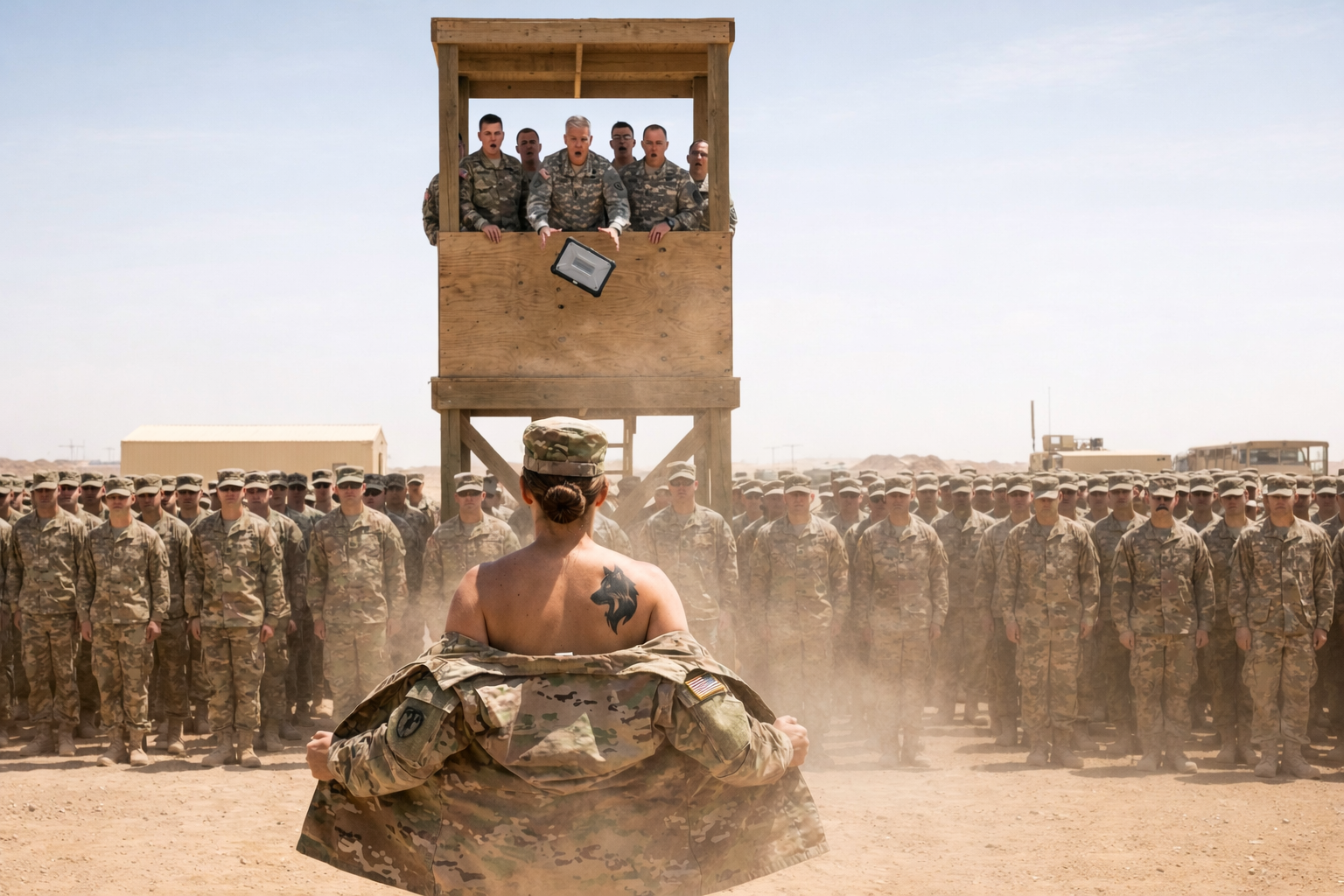
She slipped the jacket off.
And then she turned.
At first, nothing seemed out of the ordinary.
Then people saw it.
Between her shoulder blades, stark against her skin, was a symbol that didn’t belong to anything openly acknowledged. A wolf’s head, sharp and angular, enclosed within a circle of fine, precise lines that resembled coordinates more than decoration.
For a fraction of a second, no one reacted.
Then everything changed.
Up on the observation platform, where senior officers watched the exercise from the shade, Brigadier General Victor Hale had been half-focused on a tablet, reviewing performance data from earlier drills. But when Mira turned, something in his peripheral vision caught his attention.
He looked up.
And froze.
The tablet slipped from his hand, hitting the floor with a dull crack that seemed impossibly loud in the sudden silence. His chair scraped backward as he stood abruptly, eyes locked on the figure below.
“No…” he murmured, barely audible.
The officers around him turned, confused, following his gaze.
Hale’s face had gone pale.
“Stop this,” he said sharply, though his voice didn’t carry yet.
Down on the field, Keller hadn’t noticed.
He was still staring at the tattoo, something about it tugging at a memory he couldn’t quite place.
Then the loudspeaker crackled.
“Captain Keller.”
The general’s voice cut through the air, sharp, controlled, but carrying an undercurrent of something far more dangerous than anger.
Every soldier snapped to attention.
Keller looked up. “Sir?”
A pause.
Long enough to make the silence feel heavy.
“Have that officer put her jacket back on,” Hale said.
Another pause.
And then, more quietly, but with unmistakable weight: “Immediately.”
Keller blinked, confusion flickering across his face. “Sir, I—”
“Now, Captain.”
Something in the tone made further argument impossible.
Below, Mira Larkin had already begun to move, lifting the jacket and slipping it back on with the same calm precision she had shown moments earlier.
Up on the platform, General Hale exhaled slowly, as if trying to steady himself.
“Because if I’m not mistaken,” he continued, voice tightening, “you just ordered someone from a program that does not officially exist… to expose a classified identifier in front of three hundred personnel.”
The words hit Keller like a physical force.
Program that does not exist.
In that instant, the memory clicked into place.
Briefings. Fragments. Warnings spoken in rooms where phones were left outside and doors were sealed.
The Iron Viper Initiative.
A unit so deeply classified that even acknowledging its existence was considered a breach.
And the people in it… didn’t get reassigned. They didn’t rotate through training bases.
They appeared when something bigger was already in motion.
Keller felt the blood drain from his face.
Across the field, Mira Larkin finished adjusting her uniform.
And for the first time since arriving at Blackridge—
She smiled.
It wasn’t a wide smile. Not triumphant, not mocking.
Just a small, quiet expression, like someone who had been waiting for a moment to arrive—and had finally decided the waiting was over.
Later, in a secured briefing room far from the training field, the truth unfolded in layers, each one heavier than the last. Mira—whose real name, Keller would learn, wasn’t even in the file he had been given—had not been sent to Blackridge to train.
She had been sent to evaluate.
Not just the soldiers.
But the leadership.
The systems.
The assumptions.
And in one impulsive attempt to assert control, Adrian Keller had revealed exactly what she had been there to measure.
Failure under pressure.
Misuse of authority.
The inability to recognize what you don’t understand.
The consequences were swift. Quiet, but absolute.
Keller’s command was reassigned within days. Officially, it was a routine rotation. Unofficially, everyone who mattered understood what it meant.
And Mira Larkin?
She was gone before the week ended.
No farewell. No explanation.
Just an empty bunk, a cleared locker, and the faint sense that something significant had passed through Blackridge without ever truly belonging to it.
Lesson of the story:
Authority without awareness is dangerous. The more power someone holds, the more critical it becomes to recognize the limits of their understanding. Not everything that appears quiet is weak, and not everything that refuses to perform on command lacks value. Sometimes, the greatest strength lies in restraint, in observation, and in knowing when not to act. And the most costly mistakes often come from the need to prove control, rather than the wisdom to question it.