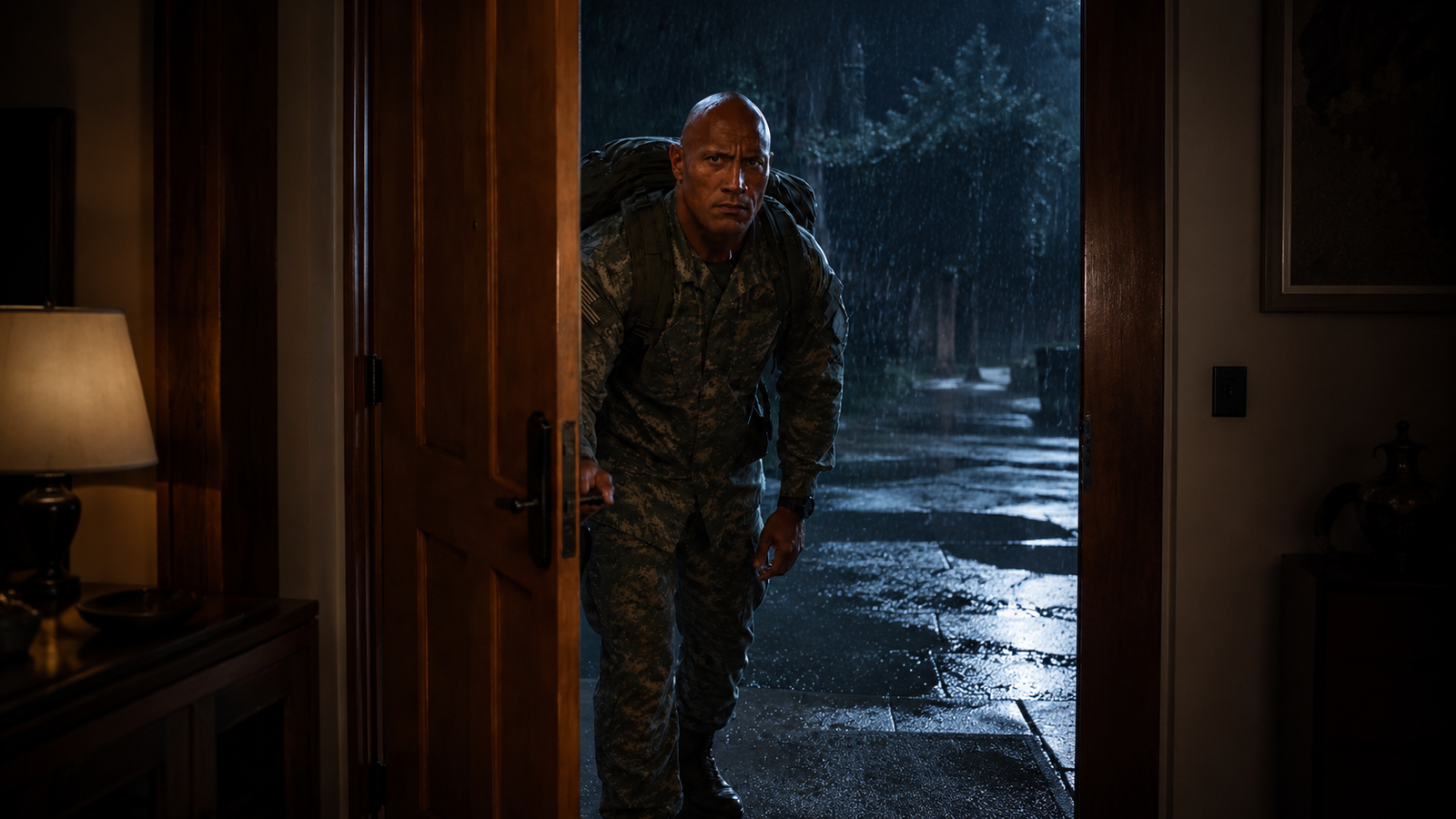
There is a particular cruelty in the word home.
Not the building. Not the address. The feeling — that specific gravitational pull that exists nowhere else on earth, the thing that keeps soldiers alive in places where nothing else can, the private promise they make to themselves in the dark: I am going back. I am going back to that.
He carried it the entire time. Through the mud, through the sleeplessness, through the months that blurred into each other until time stopped being days and became just before and after and the space between. He carried it in his chest like a second heartbeat. Constant. Reliable. The only thing that never left him.
I am going back.
She is there.
I am going back.
I. The Weight of the Bag
The duffel bag weighs forty-three pounds.
He knows this because he weighed it before he left, the way soldiers do — methodically, without sentiment, cataloguing what is being carried and what is being left behind. Forty-three pounds of gear and clothing and the accumulated objects of a life lived in the field.
But that was before.
Now the bag weighs something else entirely. It weighs the same forty-three pounds on his shoulder but in his body it weighs everything — every kilometer between there and here, every night he pointed his mind toward home like a compass points toward north, every letter he wrote in bad light, every photograph he looked at until the paper went soft at the edges from handling.
He has rehearsed this moment ten thousand times.
The door opening. The warmth of indoor air after months of weather that had no interest in human comfort. Her smell — the specific combination of shampoo and something underneath, something that is only her, that he has never found words for because it exists below the level of language. The sound of his name in her voice, which is different from his name in anyone else’s voice, which contains something no other sound contains.
He has rehearsed it so many times that it has become a place he could go — in the bad moments, in the moments when the darkness came in through the walls of wherever he was sleeping, he could close his eyes and go there. Stand at that door. Feel that warmth.
He reaches for the handle.
II. The Door
The door is heavier than he remembers.
This is the first wrong thing — small, almost nothing, the kind of detail that would mean nothing in any other moment. But he has been living in a world where small wrong things matter enormously, where the details that don’t fit are the ones that get you killed, and so his nervous system notices. Files it.
The door is heavier.
He pushes through it.
The warmth hits him first — that domestic warmth, the particular temperature of a home that has been lived in, breathed in, that holds the heat of bodies and cooking and ordinary life. He breathes it in. His shoulders drop half an inch. His grip on the duffel loosens slightly.
He is home.
And then he stops.
He stops the way animals stop when something is wrong — not a decision, not a thought, something older than both. The body receiving information faster than the mind can and acting on it before the translation is complete. Every hair on him. Every nerve. The whole system going suddenly, silently alert.
Something is wrong.
He doesn’t know yet. He knows and he doesn’t know. The mind is still catching up, still assembling the image from the pieces — the living room, the couch, two figures, close together, an embrace, her white sweater, a man who is not him — still trying to make it mean something other than what it means.
The breath in his chest goes very heavy.
Like something is sitting on it. Like the weight of the duffel has migrated inward, through skin and bone, and settled on his lungs.
He stands in the doorway of his own home and does not move.
III. The Turn
They feel him before they see him.
That particular awareness that comes when someone enters a space — the change in air pressure, the cold from the open door, some peripheral signal that something has changed. They turn.
And in the turning, everything is contained.
Her face does something that faces do only when the mind is moving faster than it can conceal — it shows the truth in the half-second before the social self catches up and tries to cover it. Not guilt, exactly. Something more specific than guilt. The expression of someone who has been caught not in a lie but in the act of having chosen something, and who now has to face the full weight of that choice and the person that choice was made against.
She stands.
The movement is too fast. Too much like something reflexive, defensive, the body trying to create physical distance from what it was just doing as if distance is the same as not having done it. She stands and she looks at him — this man in the doorway with his camouflage and his duffel bag and his face that is still trying to understand what his eyes are already certain of — and she opens her mouth.
«I can explain.»
Three words.
The worst three words in the human language, not because of what they mean but because of what they acknowledge in the saying. I can explain means: there is something here that requires explanation. It means: what you are seeing is what you think you are seeing. It means: this is real. This happened. I am not a stranger to this — I chose this. Repeatedly. Over time. In the home we share. While you were away.
He doesn’t say anything.
He can’t say anything.
The air has left the room somehow. He is standing in a warm house and there is no air.
IV. What the Face Does
There is a theory in photography that the most powerful portrait is not the one that shows emotion — it is the one that shows the moment before emotion, the instant when the body has received the information but the feeling has not yet arrived. The frozen quarter-second of pure receiving.
His face is that.
Eyes wide — not performing wideness, not the wideness of a man who wants to communicate shock, but the involuntary wideness of pupils dilating in response to threat, the body preparing to see better in case seeing better can help. It cannot help. There is nothing to see better. The picture is complete. He sees it perfectly already.
Tears forming.
Not falling. Forming — the specific physics of grief arriving in the eyes before the person has consciously acknowledged that grief is coming. The body always knows first. The body is already in mourning while the mind is still processing, still cycling through the data, still looking for the interpretation that makes this mean something other than what it means.
He is not going to find it.
His breathing — the breath of a man who has controlled his breathing in situations where controlled breathing was the difference between life and something else, who has trained his body to remain steady in conditions of extreme duress — his breathing is unsteady. This is the thing that breaks him more than anything. That this — this, in his own living room, with his own duffel bag still on his shoulder, with the warmth of his own home still surrounding him — this is the thing his body cannot hold together for.
Not the war. Not the months. Not the fear and the cold and the dark.
This.
V. The Geometry of Betrayal
There is a specific geometry to this moment that deserves attention.
The soldier stands in the doorway. The doorway is the threshold between outside and inside, between the world he has been in and the world he was returning to. He is on the line. He has not yet fully entered the room. He has not yet fully arrived home — he arrived somewhere, crossed a threshold, but home is not here anymore. Home was a place that existed in his chest for months and it turns out the address was wrong.
The duffel bag is still on his shoulder.
This matters. He has not put it down. He has not made the gesture that means I am here, I am staying, I am unpacking, I am home. His body knows what his mind is still absorbing — that this is not a place to put the bag down. That there is nowhere to put the bag down. That the home he carried in his chest for all those kilometers does not have a physical address anymore.
The woman is standing. The other man is still on the couch, doing the thing that people do in situations like this — becoming very still, very small, hoping that if they take up less space the situation will somehow become less than it is.
And the soldier is on the threshold.
Not inside. Not outside. On the line.
He is going to have to choose a direction. He is going to have to step forward or step back, and both of them are wrong, and there is no third option, and his body hasn’t figured out yet which wrong thing to do.
So for now he just stands there.
In his doorway. In his camouflage. With his bag.
With his face doing the thing it’s doing.
VI. What He Was Thinking About on the Plane
On the plane home he was thinking about the kitchen.
Specifically: the smell of coffee in the morning, the particular sound the machine makes, the way the light comes in through the window over the sink at a specific angle in the early morning that turns everything gold for about twenty minutes before the angle changes and it’s just a kitchen again. He was thinking about sitting at that table with a cup of coffee and having nowhere to be and nothing required of him except to be present in that kitchen, in that light, with her somewhere nearby moving through the ordinary geometry of an ordinary morning.
He was thinking about ordinary.
He had not had ordinary in a very long time and he had not understood until it was gone how much ordinary was what he actually wanted. Not the dramatic things. Not the milestones. The Tuesday morning. The unremarkable Wednesday. The Thursday that is exactly like every other Thursday and contains nothing except the quiet fact of being alive in a warm place with someone you love.
He was thinking about ordinary the entire flight.
He was planning his ordinary.
He was going to put the bag down. He was going to take a shower for the first time in — it doesn’t matter. He was going to find her wherever she was in the house and he was going to hold onto her for long enough that both of them understood something that didn’t need words. And then they were going to make coffee. And sit in the kitchen. In the morning light.
That was all he wanted.
That was all. Such a small thing. Such a completely ordinary, completely irreplaceable thing.
VII. The Specific Nature of This Grief
He has been near grief before.
He has sat with people in the worst moments of their lives. He has delivered news that destroyed things. He has been present for loss in forms that most people spend their entire lives not seeing. He understands grief as a concept, as a weight, as a physical fact that arrives in the body and must be carried.
But this grief is a different species.
This grief has a specific characteristic that other grief does not — it is retroactive. It does not only exist in the present. It reaches backward through time and changes the meaning of everything that came before. Every letter he sent and she received and responded to — what was she thinking when she wrote back? Every phone call in bad signal where he said I love you and she said it back — where was she? What was ordinary for her while he was constructing ordinary as the thing he was surviving toward?
The grief reaches back and rewrites everything.
Every memory he has of her now has a question mark attached. The memories themselves are intact — they happened, they were real — but their meaning has shifted. He is holding a collection of moments that he understood one way and now must understand differently, and he doesn’t know yet what the new understanding is because he is standing in a doorway with a bag on his shoulder and he hasn’t had time to think yet.
He may not be able to think for a very long time.
VIII. The Cut to Black
The camera holds on his face.
It holds longer than is comfortable. It holds past the point where you expect it to cut, where something should happen, where someone should speak or move or the scene should progress to its next stage. It holds until his face is the only thing in the world — that specific face at that specific moment, the last second before a man’s understanding of his own life changes permanently.
And then:
Black.
Not a fade. A cut — the hard, final punctuation of something ending not gradually but all at once. Like a door closing. Like the sound of a bag that will not, now, be put down in this house.
The question the film refuses to answer: what does he do next?
Does he step forward into the room — into the conversation, the explanation, the wreckage of a thing that will take years to sort through if it can be sorted through at all? Does he step backward, back through the door, back into the cold, the duffel still on his shoulder, nowhere to go, home having ceased to exist in the thirty seconds since he opened the door?
Does he say something? Does he say nothing?
You are not told.
You are left instead with his face. With the tears that had not yet fallen. With the breath that was not steady. With the specific expression of a man who survived everything that was thrown at him for months and came home to find that home was the thing that broke him.
IX. What He Carried
He carried forty-three pounds on his shoulder.
He carried her in his chest — the idea of her, the memory of her, the promise of returning to her. He carried that through everything. It was the thing that worked when nothing else did. The compass. The north.
He carried ordinary.
He carried the kitchen. The coffee. The Tuesday morning light through the window over the sink. He carried it all across the distance — all those months, all that geography, all that weight — and arrived at a door and opened it and stepped through and found that what he had been carrying the whole time was not the destination.
It was a place that had existed once and did not exist anymore.
And he is standing in the doorway of where it used to be, with forty-three pounds on his shoulder and a face that has not yet decided what to do with what it now knows, and the camera is holding on that face because there is nothing else worth looking at in this moment.
Just him.
Just this.
Just the specific geometry of a man discovering that the distance between two people is not always measured in kilometers — sometimes it is measured in the small choices made in quiet rooms while someone else is far away, surviving toward a home that was being dismantled without his knowledge, one ordinary day at a time.
The duffel bag is still on his shoulder.
He has not put it down.
He does not know yet where he is going to put it.
He does not know yet if there is anywhere left to put it.
He stands in the doorway.
The door is still open behind him.
The cold comes in.