The hospital hallway smelled faintly of antiseptic and the soft sweetness of flowers sitting in a small vase near the nurse’s station. Seventy-one-year-old Grace Thompson carefully held her hospital gown closed with one hand and clutched a paper bag of prescriptions with the other. She had called her son, Michael, three times to pick her up—but each call went unanswered. Her heart ached, not from the minor surgery she had just undergone, but from the fear that something had happened to the only family she had left.
Tired of waiting, she pushed her walker toward the exit. Outside, the late autumn chill cut straight through her thin coat. The street was quiet—so quiet she could hear every distant horn and every leaf crunching beneath passing feet. With a sigh, she hailed a cab.
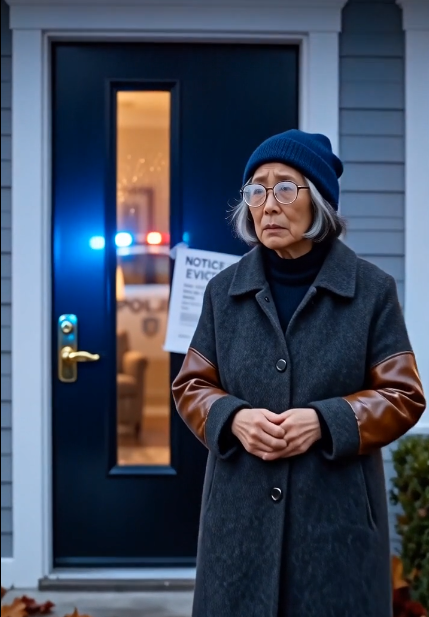
As the taxi rolled through her New Jersey neighborhood, Grace rehearsed what she would say to Michael. She imagined him apologizing, helping her inside, reassuring her. But when the cab pulled into the driveway, her breath caught. The familiar dark wooden door she had painted years ago was gone—replaced with a new one with shiny brass handles. Taped crookedly at eye level fluttered a printed note:
“Don’t bother coming in. The house is ours now. There’s no place here for freeloaders. – Michael”
The word “freeloader” pierced her like a blade. She felt disbelief, then anger—but she steadied herself. She was not as fragile as Michael believed. With quiet resolve, she went to her car.
Instead of calling him, she dialed a number she had memorized long ago. Mr. Reynolds, the family attorney, answered immediately. “It has happened,” she said calmly. “Bring the files. Bring a locksmith. And perhaps… the sheriff.”
Her son believed he had won. But Grace had been preparing for this exact moment for five years. Her late husband had left her a secret—one she was ready to use.
Inside the house, Michael lounged in his father’s leather recliner while his wife, Karen, discussed renovations. They didn’t hear Grace’s car approaching. They didn’t notice the headlights sweeping across the windows, nor the drilling sound as the locksmith worked on the new lock.
When the door opened, Michael stormed forward—only to stop dead in his tracks. Grace stood there, frail but unshaken, flanked by two uniformed police officers and Mr. Reynolds holding a thick briefcase. The locksmith quietly packed his tools in the background.
“What is this?” Michael shouted, panic rising. “You can’t be here! This is my house!”
Grace stepped inside, eyes soft but unwavering. “Michael, you’ve made a mistake. This house is mine. Everything in it is mine. Changing the locks doesn’t make it yours.”
Mr. Reynolds opened his briefcase and removed documents that made Michael’s face drain of color. “Your father anticipated this,” he said. “Five years ago, he transferred full ownership of the house, land, and savings to your mother to ensure you could never take advantage of her.”
Michael stammered, unable to form a defense. Karen backed away, staring at him. “You lied to me?” she whispered.
Grace held up the note Michael had left. “You called me a freeloader,” she said softly. “But your father taught me patience—and he prepared me for this moment. This home, this legacy… they are mine.”
Michael’s arrogance collapsed. He opened his mouth, but the officers and legal documents silenced him. He had underestimated his mother—and his father.
“Thirty minutes,” Grace said calmly. “Remove what belongs to you. After that, the officers will handle trespassing.”
In stunned silence, Michael and Karen packed their things. Their entitlement dissolved into humiliation.
When the door closed behind them, Grace breathed deeply. She looked around at the furniture, photographs, and the warm glow of the home she had built with her husband. For the first time in years, she felt safe—and powerful.
She walked through each room, touching the familiar objects, remembering birthdays, holidays, and quiet evenings with her husband, Arthur. He had known the son Michael would become, and he had trusted Grace to execute his final plan.
Grace sat in Arthur’s old leather chair and gently touched the framed letter he had left her. “You always knew, Arthur,” she whispered.
Her phone buzzed with messages from neighbors and friends—support, admiration, relief. Grace realized that her story carried a lesson.
She typed a message to her community group:
“Age and love are stronger than greed. Stand tall, protect what’s yours, and never let anyone make you feel small. If you’ve been underestimated, share this story. Let people see that courage grows with time.”
She looked around her reclaimed home, smiling as warm sunlight filled the room. This wasn’t just about winning a fight—it was about reclaiming her dignity.
“Share this,” she whispered. “Someone out there needs to stand tall today.”