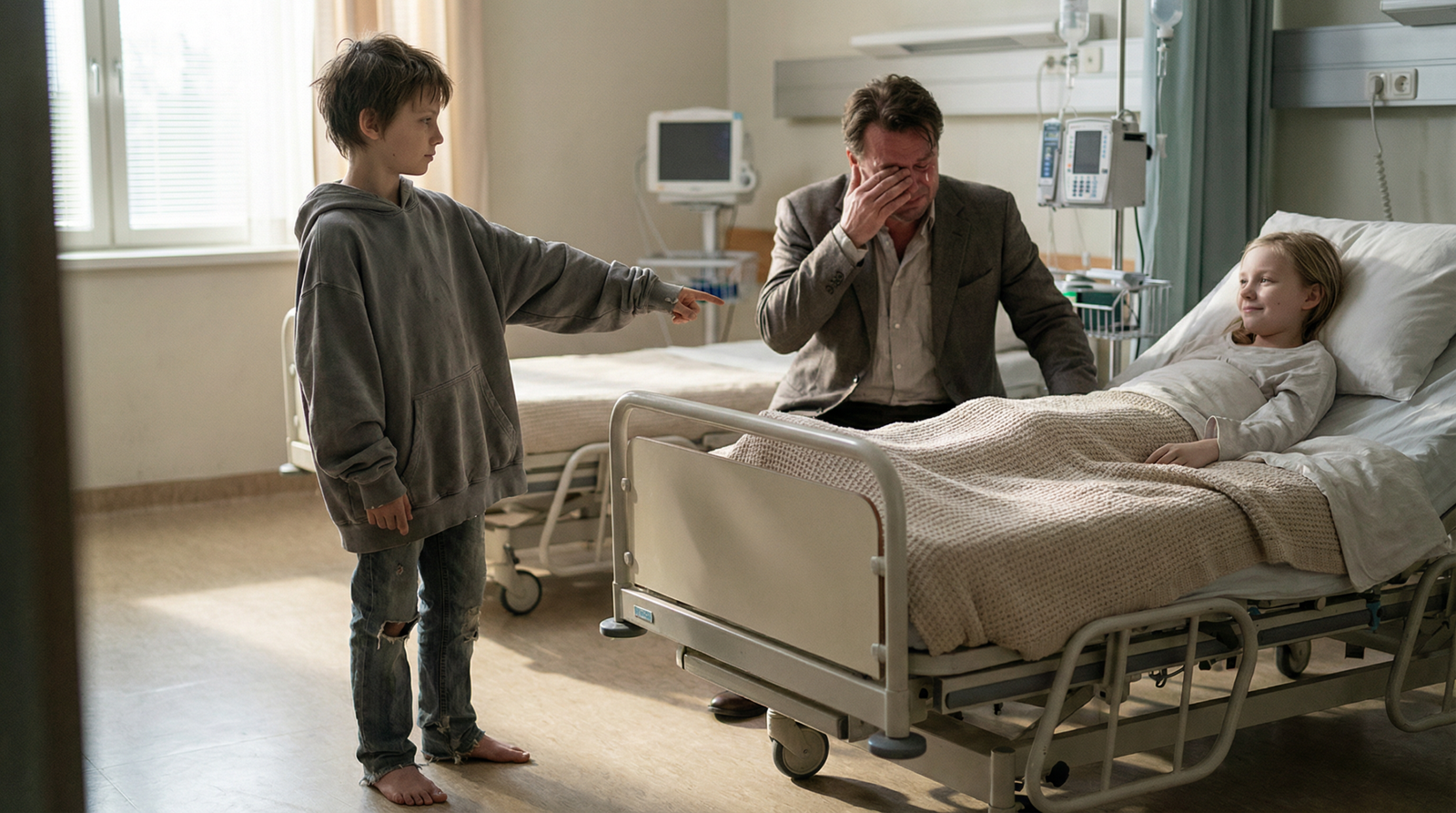
Gabriele Belli was sitting on a bench outside the San Luca Medical Center when the boy appeared out of nowhere and said the one sentence Gabriele had spent a fortune trying to stop hearing.
“I can help her walk.”
Gabriele turned slowly.
The kid was thin, his torn clothes hanging off him, his bare feet dusty with city dirt as if he had been walking all day. He couldn’t have been older than nine. His hair was a mess, his face smudged —
and yet his eyes were calm.
Certain.
It was that certainty that stopped Gabriele from snapping, from brushing him off the way he usually did with anyone who came too close to the rehab entrance.
His voice came out rough.
“What did you say?”
The boy didn’t blink.
“I can help her walk,” he repeated, steady even as the wind cut down the avenue.
Six months earlier, Gaia Belli had been running circles in their garden, laughing so hard she couldn’t breathe.
Then the infection came — an inflammation that hit her spinal cord like a storm.
One week she was fine.
The next, she couldn’t feel her legs.
Gabriele had done what he always did with problems: he attacked them with money.
Private specialists.
The best equipment.
Second opinions in two different regions.
A neurologist who spoke in cautious numbers and made no promises.
Every time, the conclusion came dressed in different words.
“She will not walk again.”
Gabriele had built towers where there had been empty land.
He had closed deals that made grown men sweat.
He had always fixed everything by applying pressure until something gave.
But this wouldn’t.
That afternoon he stared at the automatic doors of pediatric rehabilitation like they were a wall. He felt hollow — like a man who had finally met something he couldn’t negotiate with.
The boy shifted his weight but never looked away.
Gabriele almost laughed.
Almost.
It would have been an ugly laugh.
“And how exactly do you think you’ll do that?” he asked. “You’re not a doctor. You’re a kid.”
The boy nodded as if that were irrelevant.
“I know,” he said. “But I helped someone once.”
“Oh yeah? And now they run marathons?”
A tiny smile tugged at the boy’s mouth.
“Not a marathon. But she walks. Because I didn’t let her stop trying.”
Something tightened in Gabriele’s chest.
Not hope. Not yet.
More like anger at how badly he wanted to believe a stranger with broken shoes — actually, no shoes at all.
Too many professionals had spoken about Gaia like she was a file.
Like hope was dangerous.
Like joy was a distraction.
This boy didn’t.
This boy spoke like someone who had hit rock bottom and decided not to stay there.
“What’s your name?” Gabriele asked.
“Nico.”
“And what do you want from me, Nico?”
“Just a chance. Let me meet her.”
He should have said no.
Every rational part of him screamed that this was a mistake.
And yet refusing felt wrong — like slamming a door that had already been slammed too many times.
He stood.
“Okay,” he said quietly. “One chance.”
In Gaia’s room, the afternoon light made her look smaller than an eight-year-old should ever look.
She sat in her wheelchair near the window, a blanket over her legs, a sketchbook on her lap.
Her once-bright, mischievous face now carried the caution of someone who didn’t want to hope too much anymore.
Then she saw Nico.
Her expression changed.
Not happy.
Not excited.
Awake.
“Hi,” Nico said softly. “I heard you used to like running.”
“Yes.”
“And now you can’t.”
“No.”
“Maybe… not forever.”
Gabriele looked at his daughter’s eyes — really looked —
and saw something he hadn’t seen in months.
A tiny spark.
Not belief.
Curiosity.
And in that moment he understood something terrifying:
this boy might be the last thing they hadn’t tried.
Nico didn’t perform miracles.
He didn’t pretend to heal.
He talked.
He joked.
He turned therapy into games.
“Your legs need to remember what joy feels like,” he told her one day. “They stopped trying because you stopped believing.”
She rolled her eyes.
“Maybe it’s stupid,” he smiled. “But sometimes stupid works.”
He tapped rhythms and told her to “play drums” with her toes.
Made her kick invisible clouds.
Invented silly dances.
And slowly… she tried.
Then one afternoon, it happened.
“Right foot,” Nico said.
Gaia lifted it.
Only a few inches.
But it lifted.
The therapist gasped.
Gabriele’s vision blurred.
Nico didn’t celebrate.
He just nodded.
“Told you.”
Weeks later, Gaia stood.
Then walked.
Then, one day, she ran.
Doctors called it “unexpected recovery.”
Talked about neuroplasticity.
Statistics.
Gabriele didn’t argue.
He knew the truth.
A boy with nothing had refused to let his daughter give up.
One cold evening, Gabriele found Nico under a streetlamp, splitting a sandwich and giving the bigger half to a smaller kid.
“Come live with us,” Gabriele said. “Go to school. Let me help you.”
Nico shook his head.
“Not yet. There are kids out here who don’t have anyone who believes in them. Someone has to stay.”
Then he disappeared into the night.
Months later, Gaia ran across the park toward her father, laughing so hard she almost fell.
And every time Gabriele saw a barefoot child on the sidewalk, he slowed down.
Hoping.
He never saw Nico again.
But some nights, when the house was quiet, he whispered the truth out loud:
“Some people chase miracles with money.
I met one… wearing broken shoes.”