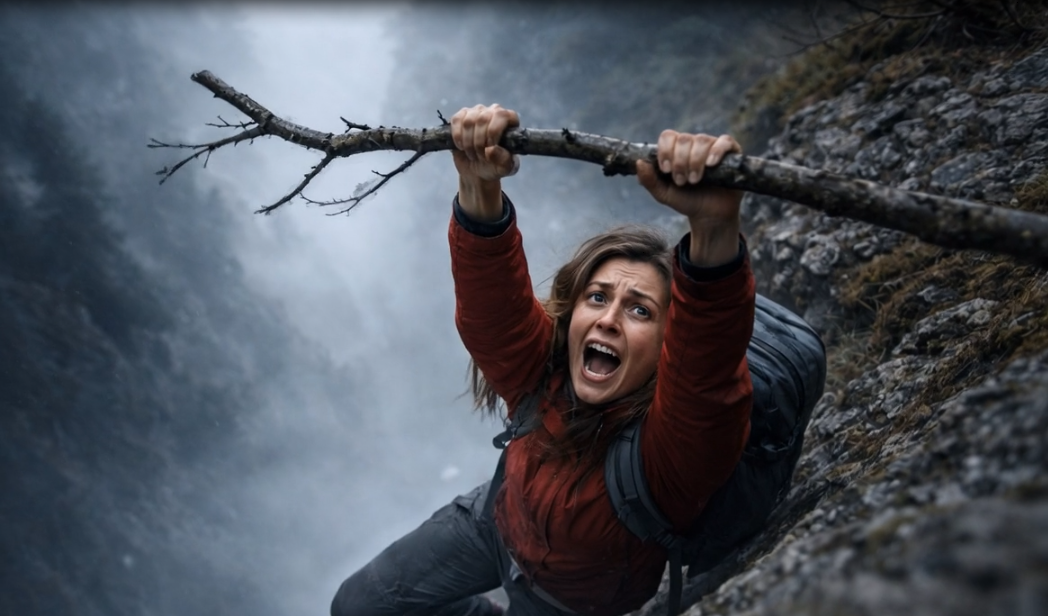
The mountain had a way of making every human problem feel both smaller and more dangerous.
Up there, where the air thinned into a cold ache and the fog moved like something alive, there were no polite misunderstandings, no convenient pauses, no gentle second chances. There was only stone, gravity, weather, and whatever courage a person could still hold onto when their fingers began to fail.
Elena knew that before she slipped.
She had known it when she started the climb before dawn, tightening the straps of her pack with hands that had become automatic from years of fieldwork. She had known it when she checked the map twice under the beam of her headlamp. She had known it when she glanced up at the dark shape of the ridge and told herself, as she always did, that fear was not a sign to stop. Fear was only proof that she understood the cost of getting careless.
But knowledge is a poor handhold.
One moment she was edging along the narrow trail, the cliff wall pressing cold against her shoulder and the valley yawning open beneath her. The next, the ground beneath a flat-looking stone broke loose into a spray of gravel and dirt. Her boot slid. Her knee struck rock. Her other foot missed the trail completely.
Then there was only falling.
Not a long fall. Not the kind that ends with silence. A crueler kind: short enough to leave hope intact.
She slammed against the ledge below with enough force to knock the breath from her lungs. Loose branches snapped under her weight. One arm dropped into empty space. Her body pitched forward. She caught herself on instinct, fingers clawing at wet soil, chest half on the edge, legs hanging over nothing.
For a few stunned seconds she could neither move nor scream. She could only hear the hammering inside her ribs and the trickling hiss of stones bouncing into the abyss below.
When the pain reached her in full, it came from everywhere at once.
Her left shoulder burned. Her knee throbbed. Mud streaked her face. Her mouth tasted like blood and grit. She tried to pull herself up, but the ledge crumbled under her elbow. Her body slid another inch.
That was when she understood exactly where she was.
Not on the trail. Not safely injured. Not waiting for a companion to offer a hand.
She was suspended between survival and disappearance.
The valley beneath her was a gray wound in the mountain, deep and indistinct through the fog. She could not see the bottom. Wind rushed upward in sharp, cold bursts that cut through her soaked jacket. Somewhere far above, invisible in the mist, a raven gave a single harsh cry and then was gone.
“Elena!”
The voice came faintly at first, almost stolen by the mountain.
Then again, closer. Urgent.
“Elena!”
Her eyes stung. She turned her head just enough to shout back, but all that came out was a ragged sound that barely resembled her own voice.
A shape burst through the fog above the ledge.
Jonah.
He dropped hard to his knees at the edge, one hand bracing against the rock, the other reaching for her before he had even fully seen how bad it was. His cap was soaked through. Dirt streaked the side of his face. His expression was not panic exactly—it was worse. It was the look of a man trying very hard not to imagine the next five seconds.
“Elena. Look at me.”
She tried to laugh, but it came out thin and broken. “I’m trying.”
His hand found her wrist. Then both hands closed over hers, rough and desperate, anchoring her to the mountain with sheer will.
For one suspended moment neither of them moved.
He looked down at her as if he were trying to memorize her face and calculate physics at the same time. She looked up at him with that terrible, involuntary honesty fear creates. No pride. No performance. Only the raw confession in her eyes: Don’t let go.
“I’ve got you,” he said.
It was the kind of sentence people say automatically in emergencies, the kind spoken before it can be guaranteed. But Jonah did not say it like reassurance. He said it like a vow he had already signed with his life.
The problem was that vows did not change the mountain.
His boots had poor purchase. The ground around the ledge was soaked and unstable. He could not lie flat enough to lower his center of gravity without risking sliding forward with her. Her pack had wedged against a jut of rock, but not by much. One good slip, one burst of panic, one shift in the mud, and both of them might vanish over the edge together.
“Listen to me,” he said, breathing hard. “Don’t pull yet.”
“I’m not exactly planning gymnastics.”
Her attempt at humor would have annoyed him under any other circumstances. Instead, his mouth twitched once, painfully.
“Good. That’s good. Keep talking.”
“Why?”
“Because if you stop talking, I’ll think you passed out.”
She swallowed and nodded as much as she could. Her fingers were already going numb inside his grip. “Okay.”
He scanned the ledge, the trail, the rocks around them. He looked for a root, a stable anchor, anything. There was a coil of rope in his pack, but it might as well have been on the moon for all the good it did at that moment. Letting go of one of her hands to reach it was too dangerous.
Below them, a few pebbles broke free and disappeared.
Elena shut her eyes.
“No,” Jonah said immediately. “Eyes open.”
She opened them again.
“That bossy tone is new,” she whispered.
“No, it isn’t.”
That was true. It wasn’t.
They had known each other for seven years, though for a long time “known” had been too generous a word. They had worked on the same conservation survey team, crossed paths in villages and field camps, shared weather reports, satellite maps, supplies, silences. She was the biologist who trusted data more than conversation; he was the rescue-trained logistics lead who could fix a stove, read a storm front, and annoy three governments in one afternoon if permits were late.
Everyone else had noticed the friction between them before they had. Not romantic friction at first. Something sharper. They disagreed professionally with exhausting regularity.
Jonah thought Elena took unnecessary risks in the name of precision.
Elena thought Jonah confused caution with control.
He believed mountains should be negotiated with.
She believed they should be studied.
He said she climbed like someone who trusted her own judgment too much.
She told him he talked like someone who needed to be obeyed.
Neither of them was entirely wrong.
Things changed the year of the river expedition.
Three weeks in a flooded valley, one damaged radio, one collapsed suspension bridge, two sick mules, and a fever that nearly killed Elena before anyone could get her to a clinic. Jonah had carried her through chest-deep water the last quarter mile when she could no longer stand. He never mentioned it afterward. She never thanked him properly.
Some bonds form through laughter and easy confessions.
Theirs formed through survival, unfinished arguments, and all the moments when one person silently noticed exactly how far the other would go before breaking.
“Elena,” Jonah said now, voice tightening. “I need you to tell me what hurts.”
“My shoulder. Knee. Pride.”
“Can you move your legs?”
She tried. Pain flashed hot through her hip, but her boots shifted. “Yes.”
“Good.”
“Not good enough.”
“No,” he said. “Not good enough. But good.”
The fog thickened around them, curling along the rock face and swallowing the view. The mountain seemed to narrow into this one ledge, this one grip, this one exchange of breath and fear. Jonah adjusted his position, digging one elbow into the mud. Elena gasped as her body slid another fraction downward.
His hands locked harder around hers.
“Stay with me.”
“I’m here.”
He exhaled shakily. “I know.”
That was when she saw it: the flicker of fear in him that he had been hiding. Not fear for himself. Fear of arriving two minutes too late. Fear of feeling her fingers leave his. Fear of having to go back down the mountain alone with a story he would never survive telling.
It frightened her more than the cliff.
Because Elena had long suspected something about Jonah that he was far too disciplined to ever admit. And hanging there with the wind tearing at her hair and dirt under her nails, she realized that if she died, she would take the answer with her.
So naturally, because terror makes fools of the honest, she said, “You’re mad.”
He blinked. “What?”
“You’re mad at me.”
He stared down at her in disbelief. “You are hanging off a mountain and this is what you want to discuss?”
“Yes.”
“No, absolutely not.”
“You get very formal when you lie.”
“I am trying to keep you alive!”
“Then answer me!”
Something sparked in his expression then—not anger, exactly, but exasperation so deep it circled around into sincerity.
“Yes,” he snapped. “I was mad at you.”
She went very still.
A gust of wind shoved rain-cold mist across both their faces.
“For when?” she asked quietly.
“For this,” he said. “For all of this. For every time you go off alone because it’s faster. For every ridge you decide isn’t dangerous enough to wait for backup. For pretending careful people are overreacting. For acting like your life belongs only to you.”
The words hit her harder than the fall had.
He swallowed, jaw tense.
“And,” he added, voice lower now, “because every time you do this, I’m the one imagining what happens if you don’t come back.”
The mountain disappeared.
Not literally. It was still there, wet and vast and merciless.
But for a second, all Elena could feel was the human truth suspended above her. The confession in his hands. The anger of a man who had no right to ask her for anything—except that he clearly had been asking, silently, for years.
She laughed once, softly, not because anything was funny but because the alternative was weeping. “That’s a terrible time to say something like that.”
“It’s a terrible time to make me say it.”
Her eyes burned. “I didn’t make you.”
“No,” he said. “You really, really did.”
Above them, thunder rolled somewhere deeper in the range.
Jonah looked up sharply. Storm.
Of course.
Mountains love timing almost as much as they love consequence.
He made a decision. “When I count to three, you’re going to kick your right foot against the wall and push upward. Not out—up. Use your left elbow if you can. I’ll pull.”
“My shoulder—”
“I know.”
“If I slip—”
“You won’t.”
“That is not science.”
“That is an order.”
She almost told him she didn’t take orders. But then his grip tightened, and she realized she already had.
“One,” he said.
She drew a shaking breath.
“Two.”
Mud trickled away under her chest.
“Three.”
Elena pushed.
Pain detonated through her shoulder so violently that black spots burst across her vision. Her boot scraped uselessly once, then found purchase on a crack in the rock. Jonah hauled backward with a sound torn from somewhere below speech. Soil gave way. Her pack snagged, tore loose, and dropped into the void.
For one terrible instant she thought she had failed.
Then her ribs slammed onto the ledge.
Jonah lunged forward, seized her jacket at the back, and dragged with everything he had left. Elena clawed at the mud, kicked, gasped, and then suddenly the abyss was no longer beneath her.
She was on the trail.
Not safely. Not gracefully. But wholly, violently, gloriously on solid ground.
For several seconds they did not move.
Elena lay facedown on the rock, coughing mud and rainwater, body trembling uncontrollably. Jonah remained half sprawled beside her, one hand still gripping the back of her jacket as if the mountain might demand a refund.
Then, slowly, he let go.
The silence that followed was enormous.
Not empty—never empty—but full of aftermath. Full of the shock people mistake for calm. Full of all the things that might have happened and did not.
Elena rolled onto her back and stared into the pale, shifting fog above. Rain began in a fine mist, barely visible except where it touched her face.
Jonah sat back on his heels, breathing like he had run miles. His hands shook openly now. He looked away from her, out into the blank valley, jaw clenched so tight she could see the muscle jump.
“You’re bleeding,” she said eventually.
“So are you.”
“That doesn’t answer my observation.”
“It answers enough of it.”
She would have smiled if her mouth didn’t hurt. Instead she turned her head toward him. “Jonah.”
He did not look at her.
“Jonah.”
Finally he did.
There are moments when people become unfamiliar to each other—not because they have changed, but because at last they have stopped hiding. His face held fear, relief, anger, and something softer than either of them had ever given a name.
“You nearly died,” he said.
“Yes.”
His laugh was short and broken. “That’s all you’ve got?”
“No.” She swallowed. “It’s just the truest part.”
Rain thickened. Somewhere higher up, stones clicked loose down a gully. They could not stay there long. They both knew it.
But still neither moved.
Elena pushed herself up onto one elbow and winced. “You said you were mad because my life doesn’t belong only to me.”
He closed his eyes briefly, as if regretting every honest word he had spoken in the last five minutes.
“Yes.”
She watched him. “Who else does it belong to?”
The rain tapped softly on rock.
Jonah’s answer, when it came, was almost swallowed by the weather.
“To me,” he said. Then, after a pause that seemed to take years to cross: “At least partly. If you’d let it.”
The mountain, for the first time all day, gave them nothing. No thunder. No sliding earth. No dramatic interruption. Just mist, rain, and the rough certainty of stone.
Elena looked at him for a long time.
At the man with mud on his sleeve and terror still unfinished in his eyes. The man who argued with her because he could not bear her recklessness. The man who had carried radios, built campfires, repaired cracked axle housings, memorized her coffee order, and just pulled her back from the mouth of the world with bleeding hands.
Then she reached out—not because she needed help this time, but because she wanted to cross the distance between them.
Her fingers touched the back of his wrist.
He looked down at them.
“I should tell you,” she said, voice unsteady, “that I hated you a little when we first met.”
He gave one breath of astonished laughter. “Only a little?”
“Fine. A lot.”
“That sounds more accurate.”
“You were unbearable.”
“You were reckless.”
“I’m still reckless.”
“You are.”
She squeezed his wrist faintly. “And you’re still unbearable.”
His eyes finally warmed, the first trace of life returning to his face. “Good. I’d hate to lose all my defining traits in one morning.”
Elena drew a breath that shuddered on the way in. “The problem is… I think I started loving those traits somewhere along the line.”
He went still.
Not startled. Not confused.
Still in the way a person becomes still when something long hoped for has finally arrived and they are afraid movement might scare it away.
Rain streamed from the brim of his cap.
“Elena,” he said carefully, “this is still a very bad time for you to say things like that.”
“I know.”
“That doesn’t make it less unfair.”
“I almost fell off a mountain. I think I’m allowed one dramatic confession.”
“One?”
“Maybe two.”
His hand turned under hers until their fingers met properly this time.
“I love you too,” he said.
Simple words. No flourish. No speech prepared over months of longing. Just the truth, at last, laid between them like a rope finally thrown across a gap.
Below the ledge, the valley remained hidden. Above them, the storm gathered itself in low growls. Around them, the mountain stayed exactly what it had always been—beautiful, indifferent, dangerous.
And yet everything had changed.
Because some moments divide a life cleanly in two.
Before the slip, Elena had been a woman measuring routes, distances, elevations, probabilities. After the slip, she would always remember the exact feel of Jonah’s hands closing over hers. The exact look in his face when he thought he might lose her. The exact instant she understood that survival was not only about staying alive, but about choosing what kind of life to climb back toward.
Eventually practicality returned, as it must.
Jonah helped her sit up. He checked her shoulder as gently as his rough hands allowed and wrapped it as best he could with a field bandage from his pack. He gave her water. She told him her knee would hold. He told her he would decide that, thanks very much. She insulted his bedside manner. He said surviving patients rarely got to leave anonymous reviews.
By the time they began the slow descent, the rain had steadied into a cold silver curtain. Jonah kept one arm around her when the trail narrowed. Elena did not argue. Once or twice she stumbled, and each time his hand closed around hers again with instinctive certainty.
Neither of them said much.
They did not need to.
The mountain had already drawn the confession out of them both.
Hours later, long after they reached the lower camp, long after her shoulder was reset by a grim village medic and her torn sleeve had been cut away, long after the kettle boiled over the stove and evening gathered dark around the canvas walls, Elena woke from an exhausted doze to find Jonah sitting just outside the tent flap.
He was cleaning mud from the watch on his wrist with absurd concentration.
She watched him for a while before speaking. “You know,” she said, voice sleepy, “for a man who rescued me heroically, you look terrible.”
He looked up and smiled—really smiled, this time, the strain finally broken. “For a woman who nearly gave me a heart attack, you’re surprisingly critical.”
“Part of my charm.”
“I’ve noticed.”
The lantern light between them was soft and gold. Outside, the rain had gentled to a whisper. Beyond the camp, the mountain rose unseen in the dark, keeping its cliffs and fog and brutal lessons to itself.
Elena shifted under the blanket. “Jonah?”
“Yeah?”
“If I ever say I’m going off alone again—”
“I’ll tie you to a tree.”
She smiled faintly. “I was going to say you should stop me.”
“I know what you were going to say.”
“And?”
“And yes,” he said. “Every time.”
Then he stood, ducked into the tent, and sat beside her. Not too close at first. Just near enough that the space between them felt chosen rather than accidental. After a moment, she leaned against him.
His shoulder was warm.
His heartbeat was steady.
Solid ground, at last.
And somewhere deep inside her, deeper than fear, deeper even than relief, Elena understood the real story of that day.
It was not the story of a fall.
It was the story of a hand that refused to let go.